

Avoid accidents at work
Safety on castors
The main causes of accidents at work are minimized by safe movement and braking as well as a firm stand of loads. Blickle, the wheel and castor specialist, makes a contribution to increasing occupational safety with its products.
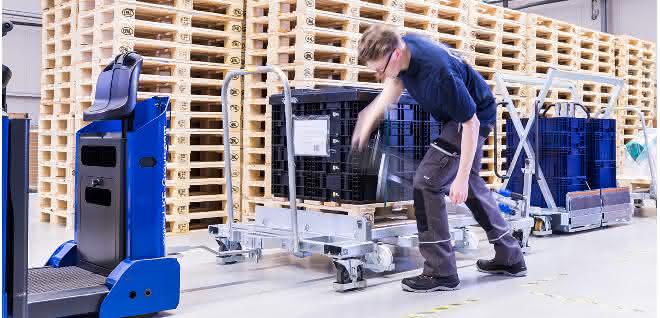
According to the German Social Accident Insurance (DGUV), 30% of the 781,050 reportable workplace accidents at companies in 2016 were caused by movement. The fourth most common cause of accidents, at around ten percent, is manual transportation. In addition to carrying a load by one person, this also includes transporting an object vertically and horizontally.
Moving, braking and stopping
When a trolley is in motion, it can quickly become a dangerous projectile depending on its speed. Blickle divides the potential hazards in intralogistics into three areas according to the movement status of the transport device: Moving, braking and stationary. In all these situations, the wheel and castor specialist aims to help increase occupational safety.
There are numerous sources of danger when operating a vehicle while driving. A castor equipped with foot protection offers protection from injuries caused by vehicle wheels or objects being thrown upwards. "Our transport systems are equipped with foot protection on all castors as standard," reports Peter Beele, Product Manager at Blickle's long-standing customer LKE, a manufacturer of transport equipment and systems based in Marl.
To prevent accidents at work, it is also important that the operator of a trolley retains control at all times while driving. Unlike conventional locking systems, drum-braked castors allow the speed of the trolley to be reduced even while it is in motion. Blickle also offers a wide range of swivel and fixed castors with dead man's function to further increase personal safety. The dead man's brake has a braking force of over 600 Newtons. In the initial position, the brakes are closed and only release when actively applied.
In the field of electric drive systems, the Blickle Ergomove series uses electromechanical dead man's brakes. Thanks to automatic brake release by means of sensor hand detection on the operating handles, the transport trolley can only be moved if the operator has both hands actively on the trolley. The trolley brakes immediately when a handle is released. The emergency stop and pinch protection functions also prevent pressure and crushing injuries and therefore meet the highest safety standards.
Safe even when at rest
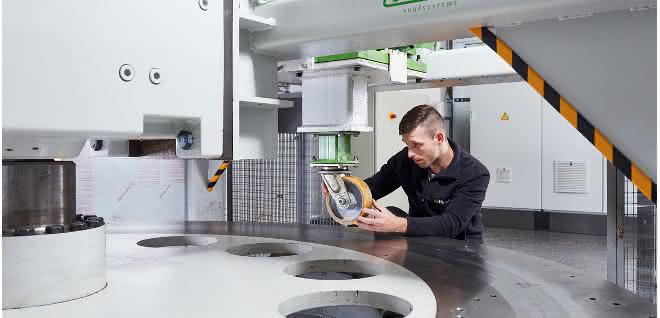
The focus is not only on occupational safety when moving and braking loads, but also when at rest. This is where the locking systems come into play. These are either integrated directly into the castors as wheel and swivel locks or can also be flexibly mounted on the trolley as stand-alone units, such as the locking feet. They are comparable to a classic jack and differ in that they take the load off the transport equipment without lifting it. When the locking feet are activated, a contact force of around 600 newtons is generated between the trolley and the ground. This ensures a secure stand even with heavy loads. The locking force always remains constant, regardless of the actual load.
Lifting castors enable the flexible lifting, moving, positioning and leveling of mobile operating equipment, transport devices and machines. Both locking feet and lifting castors are well suited for applications on smooth, slippery surfaces and ensure safety and stability.
The safety of the wheels and castors is already of great importance during the development process. Using the finite element method, the designers simulate the overall behavior of the end product in use, taking various effects into account. This allows them to optimize the product in the early stages with regard to the planned area of application. The calculated load capacities are then put to the test using special procedures in the company's own test laboratory.
Blickle has an electrically dissipative version in its range for almost all wheels and castors, especially for protection against electrostatic discharge. It protects the operator of a transport device from painful electrostatic discharge and sensitive electronic transport goods from damage. Blickle thus also supports manufacturers of electrical and mechanical equipment in complying with the European ATEX directive. as


You might also be interested in
BS Rollen Strengthens Its Presence in North Rhine-Westphalia
With the groundbreaking ceremony, BS Rollen is launching the construction of a new company facility in Hückeswagen. The new building will house administrative offices, an assembly line, and a high-bay warehouse, and is intended to facilitate further...
 read more...
Micro motors as the driving force behind intralogistics
Suitable transport structures in intralogistics are a prerequisite in all industries in order to withstand competitive pressure in the future. The basis for this is comprehensive automation, which would be inconceivable without an armada of powerful...
read more...E-scooter with customizable damping
The startup Scuddy has significantly improved the flexibility, performance, customizability and ergonomics of its second-generation foldable e-scooter of the same name - thanks in part to damping technology from ACE.
read more...Electric multidirectional counterbalanced...
360-degree steering on three wheels
Hubtex has given its FluX electric multidirectional counterbalanced truck an update: The new generation for the three-ton capacity class.
read more...New FLUX: 360-degree steering on 3 wheels
HUBTEX presents the new generation of the FLUX 30 electric multidirectional counterbalanced truck (load capacity 3 t). The innovative 2-in-1 stacker is both a front and sideloader. With its patented 360-degree HX steering, it transports both long...
read more...Norelem supports VDI Racing Camp
Mastering the challenges of e-mobility
Promoting young talent has been a priority at Norelem for many years: the company supports young talents with components and the necessary know-how and provides schools with illustrative material.
read more...igus:bike honored with German Design Award 2023
A wide, angular frame made of plastic, black wheels with Y-spokes: The futuristic look of the bicycle designed by Dutch bicycle developer mtrl with motion plastics from Igus can look forward to the prestigious German Design Award 2023.
read more...Floating garbage trap cleans up the Rhine
Every day, a ton of garbage flows down the Rhine. To catch some of it, the Cologne-based Krake association has now inaugurated a floating garbage trap. One of the sponsors of the so-called Rhine octopus is the plastics specialist Igus.
read more...Torwegge presents FlexO rollers
Visitors to the FMB - Supplier Fair for Mechanical Engineering can once again look forward to a new product at the Torwegge stand this year: the FlexO rollers.
read more...