
Still stacker at Schott
Reaching for the stars with the forklift
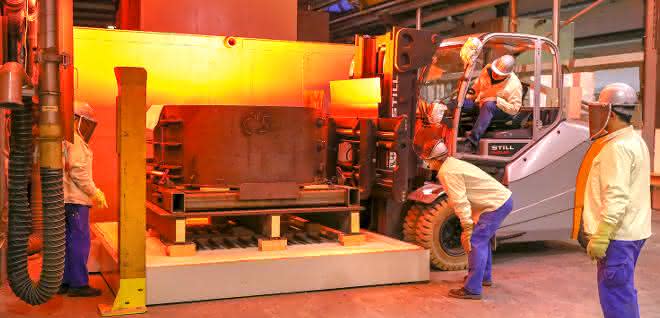
Schott is supplying mirror segments for the huge ELT telescope in Chile. The company purchased an eight-ton electric forklift from Still especially for handling the glass melting tank, and another RX 60-80 will be delivered shortly.
It will be the largest "eye of mankind": the new gigantic optical telescope - Extremely Large Telescope (ELT) - in the Chilean Atacama Desert. To look deep into space, 798 hexagonal mirror segments of the 39-meter main mirror must be arranged with an accuracy of two nanometers. This is possible with the Zerodur glass-ceramic from Schott in Mainz.
Sharp images from space
In 1903, Schott supplied the first telescope mirror carrier with larger dimensions. Since then, the company's astronomical mirrors have been contributing to the exploration of the universe. To be able to look deeper and deeper into space, telescopes need to capture as much light as possible. Schott's glass-ceramic mirror substrates ensure sharp images. With a construction period of ten years, the ELT is the most spectacular project of the European Southern Observatory ESO to date. It is due to go into operation in 2024.
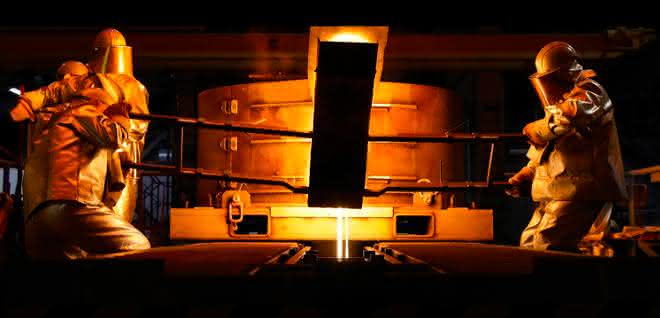
Schott has invested in new melting capacities and post-processing facilities at its competence center for glass-ceramics in Mainz. The new glass melting furnace is designed for mirror substrates with a diameter of up to 4.25 meters. It is also used to cast the round disks for the primary mirror and the two Zerodur mirror substrates for the secondary and tertiary mirrors of the ELT. The demand for Zerodur glass-ceramic is also very high for other applications. Schott has therefore already invested in a second melting tank.
In order to produce a glass ceramic with the required properties from the raw glass, it must be heated again. During ceramization, added substances form tiny crystals as the temperature rises, which contract when heated and counteract the thermal expansion of pure glass. By precisely coordinating the crystal and glass phases, an expansion of almost zero is even achieved for certain temperature ranges. This process can take up to several months.
Casting and ceramizing the ELT mirror segments therefore takes just under four months in each case. At peak times, one round disk is completed per day.
Vat handling with eight-ton electric forklift truck
The RX 60-80 electric forklift from Still with precise hydraulic control is used to handle the casting mold with the molten glass. The electric forklift is maneuverable and enables aisle widths of less than five meters. The laterally offset cab with the raised driver's seat ensures a clear view of the castings through and past the mast. Large viewing windows, low-lying tilt cylinders and the outer contour of the vehicle provide excellent all-round visibility. Such an overview increases work safety and operational readiness and reduces the risk of injury and damage.
Thanks to modern proportional valve technology, sensitive operation and infinitely variable hydraulic control of the lifting speed is ensured. The low center of gravity and the steering axle with the high self-aligning bearing ensure optimum stability. The excellent driving stability is impressive when negotiating tricky bends with the heavy mold. Speed, acceleration and braking behavior can be individually adjusted. GerdKnehr/as


You might also be interested in
E-scooter with customizable damping
The startup Scuddy has significantly improved the flexibility, performance, customizability and ergonomics of its second-generation foldable e-scooter of the same name - thanks in part to damping technology from ACE.
 read more...
Hurdles on the road to success
Welding is one of the most complicated processes in the manufacturing process, and it is becoming increasingly difficult to find suitable personnel. Can this problem be solved by automating processes? Can or should the robot colleague replace the...
read more...New plug-and-play solutions for the warehouse
Exotec announces a new Skypath conveyor system, the optimized Skypicker picking robot and Deepsky, another proprietary storage software. All three products can be seamlessly integrated into the manufacturer's Skypod system.
read more...Production automation
At Motek, Weiss will be presenting solutions for the linear and rotary movement of workpieces that can be easily integrated into the overall system of hardware and software.
read more...Solutions for surface hardening
Many industrially used components require a combination of a tough core and a hard surface layer so that they can better withstand the stresses of use. Hardening is achieved by rapidly heating the surface and then cooling it quickly.
read more...Wheel bearings and wheel bearing sets
Low-friction rolling behavior
Hecht Kugellager offers a wide range of bearing technology for use in the automotive industry, commercial vehicles and mobile machinery.
read more...Simulation in product development
The Munich-based start-up Spyra significantly shortens the development time of its production by using Solidworks simulation solutions.
read more...Doubling production capacity by 2026
Nabtesco is investing in a third production site, doubling its production capacity to two million precision gearboxes per year by 2026.
read more...Counterbalance trucks with lithium-ion technology
Clark has relaunched the GEX and GTX series.
read more...