
De-Man palletizing system
Put the sack of flour on the pallet
de Man has developed a flexible palletizing system for bags of flour and meal for Schapfen Mühle. The challenge was the large variance in the dimensions and fill levels of the bags, which are now perfectly stacked using a specially developed gripper.
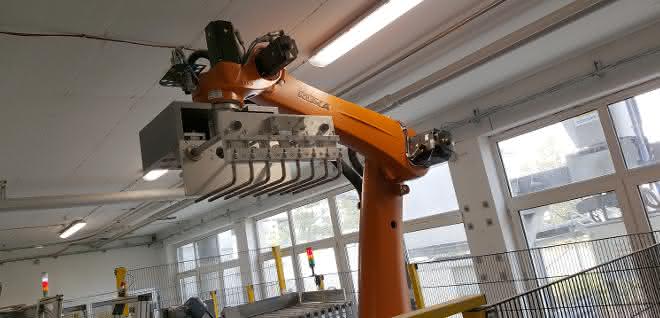
Schapfen Mühle is a traditional milling company from Baden Württemberg that specializes in spelt products, baking mixes and health foods. The flexible palletizing system was just the first of three stages in a comprehensive automation system for the customer. In the next step, de Man will supply another palletizing system and then a comprehensive pallet conveyor system including pallet wrapper and labeler, which will take over the automatic removal of the finished pallets from the two systems.
Bags of flour, meal and hulled products were to be palletized, which differ significantly not only in terms of their dimensions and weight, but also their filling level. The dimensions vary in length between 480 and 950 millimetres, in width between 225 and 480 millimetres and in height between 120 and 190 millimetres. The weight is ten kilograms (flour) or 25 kilograms (flour/ground/peeled products). The filling levels range from loose to tightly filled.
A wide range of pallet types also had to be considered: the mill uses Euro pallets as well as H1 hygiene pallets and container pallets. The specified output was a maximum of 560 bags per hour for the flour and meal products and a maximum of 480 bags per hour for the hulled products. In addition to the wide variety of products to be palletized, the limited space available and the low ceiling height also had to be taken into account.
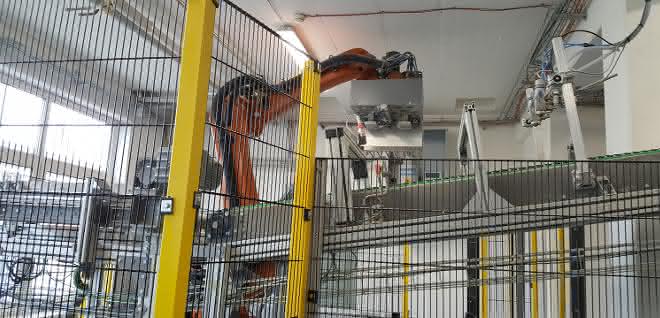
In the first stage of the project, De Man built a palletizing system with two pallet magazines, a floor layer magazine and a pallet lifting station for Schapfen Mühle. The entire system is almost 13 meters long, twelve meters wide and around 3.75 meters high. The two pallet magazines (one of which has a buffer space) each have a capacity of 15 pallets and are filled manually using an electric pallet truck.
They are adjustable in width to accommodate the different pallet types. A cross transfer carriage takes the empty pallets from the pallet magazine and transports them via a pallet conveyor system to the base layer magazine, which holds a Euro pallet with cardboard base layers. A handling system is used to remove one bottom layer at a time from the stack and place it on the empty pallet. This is then transported from the cross-travel carriage to the buffer station of the robot cell and, if required, to the palletizing station.
The elongated design of the entire system is due to the next step in the project: The second palletizing system will be positioned exactly between the two pallet magazines and the first system, so that the magazines supply both systems with pallets via the conveyor line. Prior to this, two new filling systems for flour and hulled products will also be built on the customer side, each of which will then serve one of the two palletizing cells.
Suspended from the ceiling
To feed the bags, an existing ascending conveyor on the customer side and a levelling belt were integrated into the system. The entire infeed had to be suspended from the ceiling for space reasons. The bags are taken from the ascending conveyor by a swivel conveyor, rotated by 90 degrees and conveyed onto the levelling belt with the bottom first. A conveyor belt then picks up the bags and transports them in a curve to the removal station in the palletizing cell, from where they are conveyed on a roller conveyor to the end stop.
The robot - a Kuka KR120-R3200 with four axes was used - now stacks the bags on the empty pallet at the palletizing station. In addition to the gripper fingers, the specially developed gripper has an upper and lateral pressure plate to transport the bags of different sizes and weights safely. The maximum width of the gripper can be set manually using a handwheel.
Lowering the finished pallets
The finished pallets are transported to the pallet discharge station, which is designed as a lift. Here they are lowered from a height of 500 millimetres to 80 millimetres and then removed with a hand pallet truck. The travel area of the cross conveyor, the bottom layer magazine and the palletizing station are surrounded by a safety fence, and access to these parts of the system is via safety doors. The safety interlock with guard locking only allows the safety doors to be opened once the hazardous movements have been safely stopped.
In the course of implementing the third stage of the project, both palletizing cells will be connected to the higher-level ERP system Navision, from which they will receive all order-related data (pallets, palletizing schemes, wrapping programs, label data). There is then a regular exchange of production, performance, order and master data for all articles between the systems and "Navision". as


You might also be interested in
Further simplify assembly processes
In addition to the proven racks with a length of one meter, Wittenstein alpha now offers optional two-meter racks for linear systems. They are particularly suitable for use in short axes, for example, in order to simplify assembly even further.
 read more...
Hiwin manufactures its own shaft gearboxes
Have you ever waited several months for an urgently needed corrugated gearbox? Hiwin has too. That's why the Offenburg-based drive specialist has decided to produce its own space and weight-saving reduction talent.
read more...Human-robot interaction at the trade fair
Sumitomo Drive Technologies is presenting its drive solutions for automation and robotics at Automatica 2023 together with the Lafert Group. The company will be showcasing two different applications of the Tuaka drive system for robot applications...
read more...Partial automation with robots
At Automatica, Promess will be showcasing its modular individual workstations and how these can be partially automated with robot support. The servo press manufacturer will also be providing information about the latest features of its Revolution X...
read more...A new benchmark for collaborative robots
At this year's Automatica, Denso Robotics will be showcasing its innovations in the field of robotics. The collaborative Cobotta Pro product family will be the focus of the presentations. Visitors to the trade fair can see all variants in various...
read more...Clamping system for a new milling machine
Investments in machinery often lead to further purchases - as is the case at Joma-Maschinenbau, whose modern production facility has recently been supplemented by a 5-axis milling machine.
read more...Schunk wants to simplify processes in automated production
The declared aim of automation specialist Schunk is to make its customers' processes comprehensible, simple and efficient. Data transparency plays an important role in this. It enables reliable processes and provides the basis for resource-saving...
read more...Festo and Hahn Automation develop battery tester for greater safety
The success and reputation of electric vehicle manufacturers depend on the safe and flawless functioning of batteries. Hahn Automation has therefore developed a battery tester that performs a fully automated 100% test of mobile energy storage...
read more...SPN Schwaben Präzision presents gearbox solutions for automation and industrial robotics
Short cycle times, robust technology, wear-free surfaces and compact designs have always been relevant for automation and robotics solutions. This year's Automatica trend topics include "Sustainable production" and "Digitalization and AI". SPN aims...
read more...