

Sustainable special load carriers
Network for smart containers
The iSLT.NET project is developing a network for reusable, intelligent special load carriers to increase sustainability in logistics while ensuring the timely and undamaged transportation of goods.
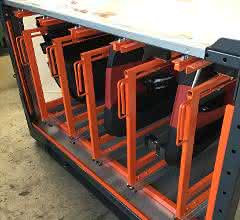
Special load carriers (SLT) are used for the safe transportation of large, bulky and sensitive components that do not fit into conventional crates or containers. They are mainly used in the automotive industry and in mechanical engineering. The special load carriers are designed to ensure the protection and optimized transport of components to the assembly plant. SLTs are therefore custom-made products that are developed and built individually for a component group. This severely restricts rebuilding and therefore recyclability and therefore contradicts the concept of sustainability.
There is aneed for action when it comes to sustainability
The low level of standardization means that SLTs have a short service life: the containers are scrapped after just three to four years of use, or after seven to eight years at the latest. This situation is exacerbated by the ever-shorter life cycles of products. New product series require the production of new SLTs, which in turn shortens the useful life even further. This means that high investment costs are incurred again and again at shorter intervals.
In addition, load carriers are often lost during use, as companies lack the necessary means to track the SLT's transportation routes end-to-end. To replace lost SLT, expensive and unsustainable disposable packaging is then used. A negative cycle of wasted resources, production delays and high investment and follow-up costs is emerging.
A project funded by the German Federal Ministry for Economic Affairs and Energy (BMWi) has the potential to break this cycle: In the PAiCE technology program, the iSLT.NET project is developing a network for reusable, intelligent special load carriers. With the help of a standardized modular system, not only is the reusability of the special load carriers guaranteed, but the cross-company use of SLT is also made possible.
In this way, cost savings of up to 50% can be achieved over two SLT life cycles. The standardized, cross-user approach also makes it possible to significantly increase the availability of new load carriers in the event of container damage or loss: Whereas today it still takes between eight and 14 weeks for an SLT to arrive at the customer, in future it will be possible to complete this process in just a few working days (depending on the inner workings of the load carrier).
The holistic approach of the project will greatly increase the cost-effectiveness, flexibility and efficiency of SLT and is a first in the industry: Although the modular approach has already been pursued in small projects, it has never before been considered on a cross-user basis. iSLT.NET also equips the SLTs with radio-based technology, which means they can be located at any time. The sensors then provide additional information about the condition of the containers. Follow-up costs due to loss and replacement can thus be significantly reduced. Intelligent and modular SLTs can therefore not only reduce the environmental impact, but also save money. as


You might also be interested in
Intelligent sensor technology for the packaging industry
At Interpack 2026, Sick will be showcasing its portfolio of sensor, automation and AI-supported solutions for secure and digitally networked packaging processes in the consumer goods, healthcare and pharmaceutical industries.
 read more...
Sales growth in a turbulent market environment
Thanks to innovations and a focus on strategic industrial markets, Sick was able to moderately increase its sales in the 2025 financial year. In a turbulent market environment, the company was able to maintain its position and gain market share with...
read more...Photonic microchips with 3D connector
How a 3D system makes photonic chips industrially viable
A research team from Heidelberg is developing a 3D-printed "connector" for photonic microchips. The solution promises a low-loss, standardized coupling of glass fibre and chip - and could fundamentally simplify the production of photonic integrated...
read more...Advanced material retrieval system
Steute shows nexy wireless network with extended connectivity
Steute's Leantec division is presenting an enhanced version of the nexy wireless network with improved connectivity and additional cybersecurity functions. The background to the further development is the increasing use of automated guided vehicles...
read more...Detecting air bubbles in liquids
EBE is launching a capacitive bubble sensor on the market that reliably detects air bubbles and liquid breakages, regardless of the liquid and the condition of the hose.
read more...Miniature acceleration sensors
Structural tests on printed circuit boards
The Z22198 family consists of very small triaxial accelerometers from Kistler that measure vibrations in three orthogonal axes.
read more...Positive development in sensor and measurement technology
In the first quarter of 2025, the sensor and measurement technology industry recorded sales growth of three percent compared to the previous quarter - according to the results of the quarterly member survey conducted by the AMA Association for...
read more...Sick extends contract with CEO
The Supervisory Board of Sick has extended the contract of CEO Dr. Mats Gökstorp by 5 years. The company also announced that Feng Jiao has resigned from his position as Chief Sales Officer at his own request. Markus Scaglioso has been appointed to...
read more...Kistler and Keller Pressure deepen partnership in China
The Kistler Group is intensifying its cooperation with Keller Pressure. By signing the agreement, the two companies are reaffirming their commitment to strengthening synergies and developing the Chinese market in a targeted manner.
read more...