
Premiere at Linde
The Roadster is available with a fuel cell
Linde Material Handling has expanded its portfolio. Curtain up for the first roadster with fuel cell drive.
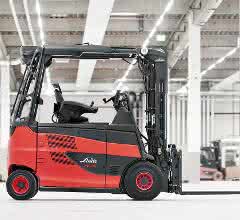
It is one of the crucial questions in goods handling: Which drive technology is best suited to the operating conditions of the forklift fleet? When answering this question, fleet managers need to consider a whole range of factors: are the forklifts used indoors or outdoors, do they work in single or multi-shift systems, what type of goods need to be moved, what is the local infrastructure like - and which drive type is best for the total cost of ownership?
"Our sales consultants can draw on a very wide range of possible energy solutions: from electric drives with lead-acid or lithium-ion batteries to fuel cell devices and internal combustion engine drives with diesel, propellant gas or natural gas as fuel. The best solution always depends on the conditions on site," says Markus Weinberger, International Product Manager Energy Solutions at Linde Material Handling.
80 percent of models are available with fuel cells
Linde Material Handling has been working on the development of production-ready industrial trucks with fuel cells for two decades. "Today, the Linde brand has the largest range of industrial trucks with fuel cell drives on the market," says Weinberger. "Around 80 percent of all models can be ordered with this promising energy variant. These include low-platform trucks, tow tractors or reach trucks as well as counterbalance trucks, including the Roadster model."
With the Roadster, Linde points to a well thought-out vehicle layout that is designed to ensure optimum visibility of the route and load. The elimination of the usual A-pillar, which could be dispensed with thanks to the power detour via overhead tilt cylinders and the overhead guard frame, makes a significant contribution to this. The Roadster versions of the Linde E20 to E35 electric forklift trucks are therefore particularly suitable for logistics and industrial plants with heavy passenger traffic. The operator can also perform precision work such as storing in containers more easily thanks to the significantly larger field of vision.
Energy generation through chemical reaction
"Because the Roadster shows its strengths above all indoors, the combination with fuel cell technology seemed ideal to us," says Weinberger, explaining the expansion of the portfolio. After all, the energy system does not produce any emissions during operation. Energy is generated through the chemical reaction of oxygen and hydrogen. The electricity generated in this way feeds a lithium-ion battery, which in turn supplies the traction and lifting motors; at the same time, the accumulator serves as a buffer for recovered braking energy and as a "power reserve" during power peaks. The only by-products of the process are heat and pure water. The latter is pumped out when refueling with hydrogen.
Keyword refueling: A complete refueling process only takes three minutes. This ensures maximum availability - especially in tough multi-shift operations. As the simple, quick and clean refueling process makes battery changes obsolete, this makes the fuel cell Roadster ideal for use in hygiene-critical sectors such as the pharmaceutical and food industries.
Of course, the economic efficiency factor also plays a decisive role. Markus Weinberger: "Our investigations and practical tests show that fuel cell systems can be economically viable from a deployment of around 20 vehicles. If the company already has its own hydrogen infrastructure, as hydrogen is needed in production anyway, the concept becomes even more economically attractive." as


You might also be interested in
Smart safety for vertical axes
Gravity-loaded axes in robotics applications must be safe. Mayr Antriebstechnik will be demonstrating at SPS how this can be reliably achieved in smart environments.
 read more...
Caliper brake from the construction kit
KTR presents the KTR-STOP PB pneumatic caliper brake. It can be used as a service or holding brake and is available in seven sizes and braking forces of up to 31 kilonewtons.
read more...Intelligent brakes and clutches
Process monitoring for greater efficiency
Mayr Antriebstechnik shows how intelligent, talking brakes and clutches can be cleverly used for process monitoring.
read more...Vertical axle brakes with checklist
Mayr Antriebstechnik is coming to Hanover with its electromagnetic, pneumatic and hydraulic vertical axle brakes.
read more...Interview with Jörg Rommelfanger, ABB
Automation has arrived in the SME sector
The number of robots in industry has increased significantly in recent years. Andreas Mühlbauer spoke to Jörg Rommelfanger, Head of ABB's Robotics Division in Germany, about the current direction of development, how companies can manage the entry...
read more...Brakes ensure greater safety
Where automation is involved, it must be ensured that even in the event of a control or power failure, unintentional movement sequences do not result in hazards or damage. The aim is to protect employees from injury and capital goods from...
read more..."Robotics Technology for Smart Automation"
Simply get started with automation
The current cobot ecosystem, Motoman robots for handling, welding, palletizing and many other applications as well as robots "made in Europe" - these are the focal points at Yaskawa's Automatica stand.
read more...Maneuvering heavy loads safely
Compact, powerful and maneuverable: The NexX multidirectional reach truck from Hubtex is ideal for use in confined storage spaces and narrow aisles. In addition to long goods, standard formats of up to 3 tons can also be transported.
read more..."Using DC technology consistently"
The DC-Industrie2 project recently came to an end and the follow-up project, ODCA, has been launched. In an interview with Andrea Gillhuber, Dr. Hartwig Stammberger and Dr. Jan Stefan Michels spoke about the potential of DC technology and its...
read more...