
Modular software for shipping logistics at publishing houses
Automated dispatch processing
Companies must continually optimize their processes. A global publishing company therefore relies on a modular and customizable shipping system that automates all the necessary steps in outgoing goods logistics: from picking the goods and dispatch processing via various carriers to checking the shipping process.
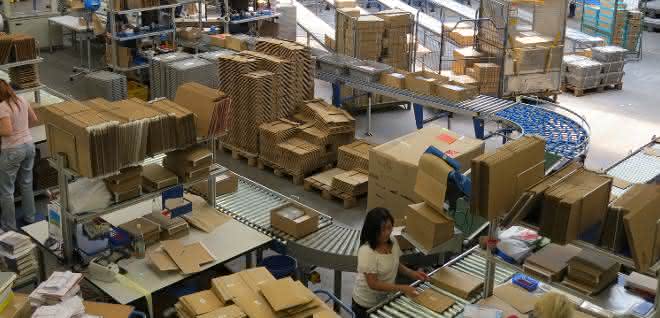
Brockhaus Kommissionsgeschäft, based in Kornwestheim near Stuttgart, is an international publisher and one of the premium suppliers in the German-speaking world. Around 120 employees of the independent family business founded in 1827 ensure that the approximately 640,000 deliveries per year - mainly books, CDs and DVDs - reliably reach owner-managed bookshops, chain stores, online retailers, general sales outlets and private customers.
In order to manage 45,000 pallet spaces, 120,000 deliverable products and around 640,000 deliveries a year, publishing house distributor Brockhaus needs suitable IT solutions. The management of internal processes, such as outgoing goods logistics, plays a major role in this. The expanding family business therefore uses modular shipping software that automates outgoing goods logistics processes.
Integrated into the existing conveyor technology
The Heidler barcode shipping system (HVS32) has been in use for many years. "I was familiar with the system from my previous job. The advantages of the software in terms of the integration options for various freight carrier modules and the ease of use were ultimately also of interest to Brockhaus," reports Joachim Bachmann, who as Managing Director of Brockhaus Kommissionsgeschäft is responsible for IT, organization and logistics. "Until 2006, a dispatch system with rudimentary functions was in use. This still required a lot of manual work when creating the daily shipping lists. In the course of a growth spurt, a new, efficient shipping system was finally required."
Although well-known, the solution from Heidler Strichcode had to undergo a conventional selection process. "We put our dispatch system out to tender, including weighing systems, scanners and printers," says Bachmann. "The new system had to be able to be integrated into the existing conveyor technology."
The HVS32 consists of a basic module as well as extension and carrier modules. The tool determines the recipient-related data by scanning the delivery note number and prints the labels with the carrier-relevant information after automatic weighing. The tool also increases presentability and transparency: data on fee and weight statistics, customer statistics, shipping lists, transit times and other predefined statistics can be called up in just a few clicks.
Application-specific modules integrated
Since the implementation of HVS32 with the carrier modules for DPD, DHL, Deutsche Post, Dachser, Wackler, Schenker and special forwarding agents specified by Brockhaus customers, the previously manual, time-consuming and error-prone creation of shipping lists is a thing of the past. The shipping data is transferred electronically to the respective forwarding agent. The HVS not only receives the customer address and the theoretical weight of the shipment via the publisher's ERP system for weight comparison in order to detect differences in the number of items, but also the customer's email address. The customer automatically receives the information that his shipment is on its way. In addition, the customer receives advance notification from the parcel service about when they can expect the ordered goods to arrive. The system maps the logistical processes that need to be mastered at Brockhaus, including the book trolley service. This means that overnight deliveries from this industry-specific delivery service can also be tracked transparently.
"We can now also optimize our pallet preparation with the HVS," says Bachmann. "As users, we can create pallet containers in HVS and define which customer order is to be placed in which container." As the pallet customers' requirements are complex, the shipping supplier must be able to respond to the instructions at any time during the packing process and the subsequent shipping and loading process. The user can therefore intervene manually at this point at any time and the shipping label and other documents are only created after the pallet has been weighed. Various data, for example the weight, comes from upstream systems, such as the merchandise management system, and is automatically printed on the label.
Tailor-made solutions for the shipping service provider
When implementing the solution, Heidler Barcode attaches great importance to meeting customer requirements precisely. Brockhaus, for example, has received a quick processing mask with a trolley connection in order to be able to retrieve labels with the corresponding weight classification. The label is generated on the basis of a scan. A weight comparison with the data from the upstream system serves as a safety check. If the weight falls below or exceeds the tolerance limits of the target weight, the label printing process is aborted and the parcel is sent for inspection. The individual shipping system solution also takes into account the growing importance of e-commerce and the shipping of small consignments. The packages are assigned directly to the individual carrier containers via stitches, so-called roller conveyors. pb


You might also be interested in
Robotics and autonomous order picking
Locus Robotics acquires Nexera Robotics and expands autonomous warehouse logistics
Locus Robotics takes over Nexera Robotics and may have taken a decisive step towards truly universal warehouse automation. A new gripping technology should now make possible what was previously considered difficult to automate.
 read more...
How bridging steps, stairs and catwalks are changing processes in production and logistics
At Logimat 2026, Munk Günzburger Steigtechnik will be showcasing modular bridging steps, stairs, platform and walkway systems for production, warehousing and logistics. With online configurators, distances can be efficiently shortened, processes...
read more...Highly automated warehouse for...
SSI Schaefer implements highly automated warehouse for CERP in France
SSI Schaefer and CERP are building a highly automated logistics center for pharmaceutical logistics in Wissous with shuttle storage, A-Frame, robotics and WAMAS software.
read more...Start of construction for new production hall
Mayr Antriebstechnik invests in its home base and internationally
Mayr Antriebstechnik strengthens location and international logistics: Construction of a new hall in Mauerstetten - parallel expansion of the plant in Poland as a logistics hub.
read more...Conveyor systems that adapt
Modern conveyor systems must reliably transport different product sizes, shapes and materials. The new modular product system from Kipp offers flexible, modular solutions for this: Adjustable side guides ensure precise alignment and gentle...
read more...Focus on sustainability and AI at the trade fair
With more than 120,000 square meters of exhibition space, LogiMAT 2025 will once again occupy all ten halls of the Stuttgart exhibition grounds. From March 11 to 13, global players, medium-sized companies and start-ups will provide an overview of...
read more...Workstation system for shipping and logistics
With Sintro Packing, Karl is launching a workstation system that is designed to meet the specific requirements of shipping and logistics. It is characterized by modular adaptability and ergonomic efficiency.
read more...Deutsche Messe announces Robotics Award
On the occasion of Hannover Messe 2025, Deutsche Messe is once again presenting the Robotics Award after a break of several years. Prizes will be awarded for robot-supported automation and logistics solutions. Companies and institutions from Germany...
read more...Micro motors as the driving force behind intralogistics
Suitable transport structures in intralogistics are a prerequisite in all industries in order to withstand competitive pressure in the future. The basis for this is comprehensive automation, which would be inconceivable without an armada of powerful...
read more...