

Interroll survey
Germany has some catching up to do when it comes to automated material flow
According to an Interroll survey, there is potential for increasing productivity in German SMEs: not even one in five production companies achieves a degree of automation of over 75 percent in their internal material flow.
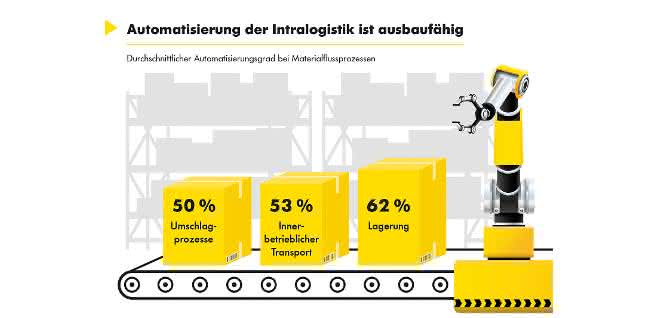
Automation and robotics are key technologies for greater competitiveness, quality and sustainability in industrial production. The internal material flow plays a central role in optimally exploiting the productivity potential of these technologies. This applies not only to the supply of materials to assembly lines or robots, but also to the seamless linking of storage and picking areas with incoming and outgoing goods. Most large companies have recognized this challenge. But what does automation actually look like for medium-sized companies?
Only a minority is already highly automated
The "Production logistics in SMEs" survey, which Interroll conducted in Germany in 2019, identified a clear need to catch up: the average degree of automation of internal material transport at the companies surveyed is only 53%. Not even one in five companies (19 percent) achieves a degree of automation in these processes of over 75 percent. Almost every tenth company (9 percent) has been very reluctant to invest and only has a degree of automation of less than 25 percent. In the case of handling processes, this even applies to one in five companies.
This situation in the companies suggests that there is a need to catch up in terms of equipment. If this reluctance to invest is not broken, these companies are likely to face competitive disadvantages in terms of productivity.
Interestingly, the survey also reveals this situation with regard to the susceptibility of warehouse processes to disruption reported by the respondents. For example, the number of companies with a degree of automation of less than 50 percent doubled to 48 percent compared to 24 percent of companies with a higher degree of automation. However, even those who automate are of course not completely safe from disruptions. Software malfunctions (40 percent) or incorrect operation of complex systems (32 percent) are among the most common causes of disruption.
Simplicity and robustness
The ease of use of conveyor modules also plays an important role for the survey participants when it comes to pallet handling. In fact, 61 percent of production planners consider this characteristic to be the most important factor in these processes. Across all respondents, it is the durability and robustness of pallet conveyor technology (58 percent) that make up the decisive advantage of a solution. And anyone who believes that those responsible in medium-sized companies are not open to future trends is mistaken: 67% consider predictive maintenance and professional service to be the most important criteria for ensuring smooth production processes, ahead of applications with a long service life (53%) and modularized products (50%).
In the survey commissioned by Interroll and conducted by the Faktenkontor agency (Hamburg), a total of 200 production companies in Germany were interviewed by telephone in 2019. The focus was on companies with 50 to 500 employees and a turnover of up to 500 million euros. The companies came from various sectors, including the mechanical engineering, food and consumer goods industries. Technical decision-makers in particular were addressed, such as technology managers, production managers and production planners.
With the results of this survey in mind, Interroll is working on a new solution - the Smart Pallet Mover (SPM) - to better organize and automate the "last mile" in production areas. This new interface is designed to improve the connection between the different phases of the material flow, i.e. the movement, organization, input and output of pallets. The SPM can be used not only in the vicinity of production machines, but also between different production cells within the same manufacturing process. as


You might also be interested in
Fraunhofer IOSB Opens Humanoid Robots Lab
The Fraunhofer IOSB is opening a Humanoid Robots Experience Lab in Karlsruhe, Lemgo, and Ilmenau. Companies and organizations can use these facilities to test potential applications for humanoid robots and develop pilot projects.
 read more...
Artificial Intelligence in Manufacturing
Trumpf and IPAI Are Expanding a European AI Network for Industry
The high-tech company Trumpf is an official partner of the IPAI AI network in Heilbronn. Together, the partners aim to exchange experiences, develop new AI applications for industrial use, and advance the development of artificial intelligence in...
read more...Case Study: Networked Manufacturing Platform for Toolmaking
Using a networked manufacturing platform, Escha GmbH & Co. KG, a manufacturer of industrial fastening technology, has comprehensively modernized its toolmaking operations.
read more...Barcelona Declaration on Robotics and...
Robotics Associations Adopt Global Automation Strategy
The global robotics industry is stepping up its collaboration. The associations AER Automation, A3, IFR, and VDMA Robotics + Automation have formed a long-term alliance by signing the “Barcelona Declaration on Robotics and Automation 2026.” The...
read more...Jane Heffner is the new president of the International Federation of Robotics
Jane Heffner is the new president of the International Federation of Robotics. Adrien Brouillard has been appointed vice president of the global federation.
read more...Greater Transparency in the Robotics Market
RoboFinder Launches as an Independent Comparison Platform
Launch at Gitex Europe: 'RoboFinder' aims to bring more transparency to the professional service robotics market. In this interview, founder and CEO Brian Engels discusses market potential, challenges, and the goals of the new platform.
read more...Artificial Intelligence for the Physical Space
Alibaba Expands Qwen Model Family with a Robotics Suite for Physical AI
Alibaba is expanding its Qwen model family with a robotics suite for Physical AI. The three models—for manipulation, navigation, and simulation—are designed to assist autonomous robots with complex tasks in real-world environments.
read more...International Federation of Robotics
U.S. Robotics Industry Sees Double-Digit Growth
In the U.S., sales of industrial robots rose by 11% compared to the previous year: 38,000 units were newly installed in 2025. This significant recovery is driven by robust growth in the food industry and other non-manufacturing sectors. However, the...
read more...Development Collaboration for Humanoid Robotic Hands Launched
Schunk is entering into a new development partnership with Robert Bosch Robotics. Their shared goal is to develop an industrial-grade robotic hand that can be integrated into various humanoid robot systems.
read more...