
FTS at ABB
Transportation of gas-insulated medium-voltage switchgear
ABB is automating the internal transport logistics of its production facility in Ratingen in 2023. In a first expansion stage, the company is optimizing the transport of gas-insulated medium-voltage switchgear using automated guided vehicles (AGVs) from Safelog.
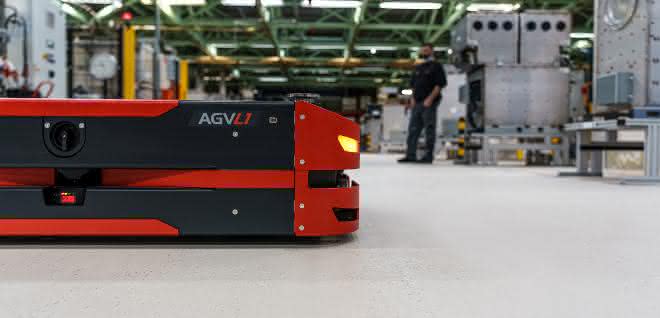
ABB is one of the world's leading technology companies. Around 110,000 employees work in more than 100 countries in the four business units Robotics and Factory Automation, Drive Technology, Electrification and Process Automation. The production site in Ratingen is one of the largest in Germany. Here, over 1,200 employees produce gas-insulated switchgear, vacuum interrupters and digital control and protection technology for the medium-voltage range, among other things.
Gas-insulated medium-voltage switchgear as a customized solution
The special feature of the Ratingen plant: In addition to the series production of gas-insulated medium-voltage switchgear, customized solutions are also manufactured. This means that the number of units and repeatability are relatively high. As gas-insulated medium-voltage switchgear is used for economical and safe energy distribution in medium-voltage grids, there is constant demand. The quality requirements are high, as a failure of such a system can bring an entire business or block of flats to a standstill.
As part of its future strategy for 2025, ABB is gradually realigning production in Ratingen. Among other things, the material flow between the workstations within final assembly was to be automated. Safety and ergonomics at the workplace were at the forefront of the decision to bring the established production processes up to the latest technological standards. Other important factors were the improvement, performance increase and cost reduction of internal logistics.
Complex requirements for the transportation of switchgear
ABB has a high operational efficiency in the production of complex medium-voltage switchgear thanks to a directed material flow. The production of customer-specific systems, from prefabrication to final assembly and quality inspection, takes just a few days thanks to series production. After the switchgear enclosures were manufactured in prefabrication, the workers used to transport them between the workstations with a hand pallet truck during final assembly and quality inspection. "A particular challenge of the project at ABB was the weight and size of the switchgear," reports Maximilian Scherbauer, project manager at Safelog. "Individual switchgear units can weigh up to 1,500 kg and reach a height of up to two meters." With these dimensions, even a short transport route quickly becomes a risk to safety and ergonomics in the workplace. Furthermore, the heavy transport always cost the fitters valuable working time.
AGV provider impresses with consulting expertise
In order to increase the safety and efficiency of transportation, ABB planned to automate the manual transport processes with the help of driverless transport systems. The capacity of the AGV was to be designed in such a way that it would also be able to cope with increasing demand in the future. ABB was looking for a strategic partner for the planning and implementation. After extensive research, Safelog was chosen. "The competent and professional appearance on site, coupled with a high level of readiness to deliver and a technically mature product, led to our decision in favor of the company from Markt Schwaben," says Maximilian Gersch, project manager at ABB. Another plus point was the IntelliAgent Safelog software. Thanks to the swarm intelligence of the mobile transport robots, this enables direct commissioning and integration of the AGVs into the existing production processes without a cost-intensive higher-level control station.
In joint on-site meetings in Ratingen and online workshops, the project teams from Safelog and ABB worked out a detailed procedure for the implementation. "We recommended the use of two L1 AGVs to ABB for the automation of transport tasks in final assembly," explains Scherbauer. The delivery was followed by several weeks of commissioning and a test phase for the system. Following this, the transport robots were fully integrated into the daily production processes.
Simply request switchgear via FTF
In the newly implemented automation process, a worker assigns a barcode with a serial number to a medium-voltage switchgear at the start of production. This identification allows each switchgear unit to be clearly identified at any time. After the switchgear has been placed on transport aids following pre-assembly, the mobile transport robots pick it up and take it to the work stations or buffer locations. The employees at these stations use the barcode and serial number to request the system for processing or select the destination for onward transportation. "In addition to the weight of the switchgear, the complexity of the route network was one of the biggest challenges in implementing the project at ABB," reports Scherbauer. "The route network of the mobile transport robots in final assembly comprises over 30 destinations, which are connected by more than 850 different routes." The individual target processes are the density test cabin, drive assembly, resistance measurement and repair station. If a system is not processed immediately, it can be temporarily stored in buffer areas until the next request. Once all work steps have been completed, the worker ejects the system and informs the downstream departments of final acceptance, packaging and dispatch of the new status.
Safelog IntelliAgent makes production transparent
The driverless transport system accepts transport orders according to defined priorities - work stations that influence the production output are also served first. Once work on the system has been completed, the employee selects a new destination. Direct transportation between workstations is not possible. The system can only be sent back to the buffer or to the delivery position. The system works according to the pull principle. All movements of the individual switchgear are recorded in the database. This means that it is always possible to see where a system is currently located. It is also possible to see which stations are currently blocked. These processes are managed by the Safelog IntelliAgent software. This and the directed material flow provide a better overview of the entire production process.
In addition to the technical implementation, Safelog also impressed with its extensive expert knowledge of strategic and operational issues. The project team from Markt Schwaben is available to ABB at all times and responds quickly and in a solution-oriented manner to new challenges. Gersch appreciates this good cooperation: "We find it very positive that we work very well with our permanent contacts at Safelog, not only on a technical level but also on a personal level."
New projects already being implemented
The automation of intralogistics with the help of Safelog's mobile transport robots has significantly improved work safety and ergonomics for employees. ABB has also been able to further optimize its directed material flow and can now evaluate it transparently. Instead of spending valuable working time on transportation tasks, the fitters can concentrate on value-adding activities. The plant's level of automation and digital maturity have increased significantly.
The collaboration with Safelog has strengthened ABB's resolve to utilize the potential of AGVs for intralogistics in other areas as well. Further expansion stages up to 2025 are currently being planned or are already being implemented. According to ABB, the system is to be continuously developed and expanded in the direction of plant transportation and material supply. Scherbauer is looking forward to these tasks with great enthusiasm: "The project with ABB still contains some exciting innovations until 2025. We look forward to continuing our successful collaboration in the coming years."


You might also be interested in
Housing and inserts for plenty of power
Lapp presented the expansion of its Epic Power series at SPS 2023: four new M23 circular connector inserts and three new M23 housings. The special feature: all housings can be combined with any of the four inserts.
 read more...
News and product updates from Smartgas
Portable gas analyzers for outdoor use
Smartgas is starting the second half of the year with a series of updates to existing products and a number of new products. Portable analyzers expand the range of applications, while new accessories such as protective housings and heating modules...
read more...Everything accurate in switch cabinet construction
To ensure smooth work processes, tools for processing enclosures and housings must function flawlessly and reliably. Häwa rounds off its punching range with the Multi-Press 500.
read more...Shafts and conversion parts
The Rodriguez range includes ball bushings including matching housings, shaft brackets, crossbars and supports.
read more...Cooling and temperature control units
Hygienic packaging sells safely
In few industries are the requirements for hygiene in the production process as strict as in the food sector - the health of consumers has top priority. This results in enormous challenges for all machines and components involved, especially in...
read more...Simple tool change in seconds
With the CMS, Schunk is launching a user-friendly, manual change system for quick component replacement. In addition to its simple and convenient operation, the CMS also stands out with its extensive range of optional modules and complementary end...
read more...Motion controller for small drives
Medium power range covered
Faulhaber has another housing-less and compact motion controller in its range, which is particularly suitable for integration in device construction and medical technology applications.
read more...Welding solutions in the name of resource efficiency
At the Welding & Cutting trade fair in Essen (September 11-15), Fronius will be focusing on the major drivers in welding technology. Quality requirements are increasing in all industries, but the required welding specialists are scarce. In...
read more...Safe solutions for cable installations
From thick power cables to thin sensor lines, cables and lines must be routed safely through systems and machines. A challenge that should not be underestimated, explains Jörg Sokat, Head of Product Management at Pflitsch.
read more...