

Automated guided vehicles
From electric tug to AGV
Autonomous driving is already part of everyday life when transporting materials from the warehouse to assembly. One innovation is manufacturer-independent special kits for converting standard electric tow tractors into driverless transport systems.
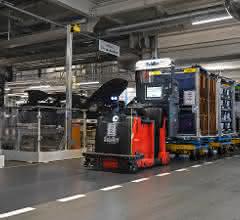
A road train that is available 99.986 percent of the time, drives autonomously and chooses the fastest route is still a dream of the future for long-haul transportation. For the autonomous transport vehicles from Schiller Automatisierungstechnik, this is reality. The company, headquartered in Osterhofen in Lower Bavaria, recently successfully completed a project with 22 autonomous route trains on behalf of a major Bavarian car manufacturer. The fleet transports over 500 tons of material per working day from the warehouse to assembly, covering a distance of over 300 kilometers every day. During the 10-shift test, over 1,550 kilometers were completed autonomously with maximum availability.
Converting electric tractors to autonomous systems
Founded in 1985 by Ewald Schiller, Schiller Automatisierungstechnik has developed into a company with more than 240 employees in Osterhofen, Metten, Grafenau and Shenyang, China. Electrical, mechanical and IT systems for automation, logistics, cleanrooms and electrical planning are among the company's core competencies. Schiller laid the foundations for the development of solutions for autonomous tugger trains in 2018. "It quickly became clear to us that safety technology would be a key issue for our driverless transport systems, because with tugger trains, as with operation with trailers in general, the trailers' lane departure is an important problem to solve," says Peter Stoiber, Head of Mobile Robotics at Schiller, explaining one of the challenges during the development work.
The engineer and his team also had to calculate the error probability of all components and ensure maximum availability in order to comply with the strict machine guidelines. The development work led to the perfection of an indoor GPS, with the help of which the tugger train always recognizes where it is. This means that no structural changes are necessary for orientation during transportation. Each Schiller tugger train can also be easily adapted to changing situations in the production process and can also be used at other locations. The biggest advantage of the solution is that commercially available electric tugs can be converted into autonomous systems using Schiller technology.
The task: Fail-safe electronics
Even if the tugger trains can still be operated by the driver after being fitted with the conversion kits, the autopilot shows its strengths in everyday use. For example, when the tugger train arrives near the next work station, a smartwatch on the wrist of the employee in charge reports the status via a vibration alarm. The employee can then load or unload the wagons and give the signal "All actions completed, send train on". In this way, the route is continued without delay. Unnecessary travel times for staff are eliminated. One of the last problems in the development process that Peter Stoiber, as Head of Mobile Robotics, had to face with his team was that the train sometimes has to travel on uneven tracks or cross building corridors on the many different routes through the automotive plant. These are potential hazards that could jeopardize the reliability of the electronics. It was therefore important to prevent the control cabinet from vibrating. To achieve this, the tugger train was to be fitted with vibration dampers at the critical points.
As with all electronic and mechanical components of the system, Schiller Automatisierungstechnik analyzed and tested the potential solutions in great detail. The design department identified ACE shock absorbers as the ideal solution partner. "ACE initially impressed us with its large selection of suitable components, and we were able to configure and calculate the vibration dampers on the ACE website," Stoiber recalls. "ACE's sales department then responded very quickly to our inquiry and convinced us with a sample. This gave us additional confidence in the quality and durability of the proposed solutions." Based on the key data of the maximum speed of 10 km/h and the control cabinet weight of 50 kg, four rubber-metal isolators of type AAM-52205 were determined. This family of maintenance-free and ready-to-install vibration dampers is designed to absorb loads between 0.5 and 22.7 kg. The small shock and vibration-isolating connecting elements therefore help to effectively protect lighter components. They isolate in all directions and can be mounted in any desired spatial axis and used for loads in the push, push and pull direction. Made of galvanized metal and with rubber components made of neoprene as standard, they are also available from ACE with highly damping silicone for special applications against heavy impacts.
Even though they are being used for the first time in their standard version on driverless transport systems in the logistics sector in the application described here, vehicle technology has long been familiar territory for these machine elements. ACE customers around the world use them to protect against shocks and vibrations in lighter electronic systems and components, including in off-road vehicles and trucks, which have always been steered by humans to date.


You might also be interested in
Plagiarius 2024 negative prize
On January 26, 2024, the Plagiarius campaign awarded its dreaded "Plagiarius" negative prize for the 48th time to manufacturers and retailers of particularly brazen counterfeits and fakes.
 read more...
Ivalua honors winners of the Generative AI...
AI-supported "add-ons" for buyers within 48 hours
Ivalua, provider of cloud-based spend management solutions, announced the winners and innovations of the first Generative AI Innovation Cup. The competition took place in December 2023. It was open to all Ivalua partners and employees - more than...
read more...Efaflex celebrates 50 years of high-speed...
The emphasis is on "fast"
Since day one, Efaflex has wanted to use new technologies as early as possible and drive progress in the industry. This year, the family business is celebrating its 50th anniversary under the motto "Fast Forward".
read more...Security of supply even during power outages
In the winter of 2022, Germany was worried about energy shortages. The drugstore retailer dm did not paint any horror scenarios, but nevertheless saw the possibility of controlled, temporary, regional power cuts (brownouts).
read more...Safety technology in mechanical engineering
Modules with new functions
Euchner's product highlights at EMO 2023 include the communication-capable solenoid interlocks.
read more...Transforming the paper industry towards climate neutrality
Together with partners from industry and research, Voith is developing a project for the optimization of energy and material flows in paper production. The aim of the research project is to develop a digital framework that enables effective process...
read more...Up to 95 percent less flue gas thanks to direct extraction
The requirements for occupational safety measures and safety technology are also constantly increasing in welding technology. The Technical Rules for Hazardous Substances (TRGS) stipulate that welding fumes and harmful substances must be extracted...
read more...Competitive advantages with large machines
Whether 3D-printed components for machines and systems, prototypes or aids for design: additive manufacturing is almost indispensable for modern companies in mechanical and plant engineering and automation if they want to play in the premier league.
read more...Transport technology from the modular system
Many transport tasks can be realized with the help of linear technology. Pre-configured solutions are available to simplify the interaction between the linear unit, motor, gearbox and controller. This minimizes the effort required for research and...
read more...