
TPU belts for the baking industry
Food belts defy the heat
Habasit has launched a new line of TPU food tapes: The premium TPU tapes are suitable for continuous operation at elevated temperatures of up to 110 degrees Celsius and have improved hydrolysis resistance.
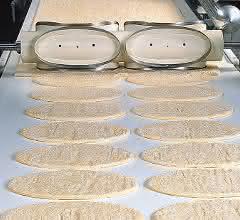
Manufacturers in the baking industry face numerous challenges in terms of efficiency and food safety due to the harsh operating conditions in their factories. High operating temperatures, sticky and oily products, humid environments, the risk of belt edge fraying and the effects of mechanical and chemical cleaning have a significant impact on belt life and properties as well as process hygiene and production waste.
Habasit has now launched a new and improved TPU food belt line: premium TPU food belts with enhanced properties that support longer belt life, higher production efficiency and improved food safety.
Laboratory and field tests
The new range of polyether-based TPU food belts has been extensively tested in the laboratory and in practice in demanding baking applications, from fresh pastry and bread dough transport to cracker production, pizza production and oven loading and unloading.
According to the manufacturer, the new belts offer four new properties that are particularly advantageous in the baking industry:
Increased temperature resistance: The belts work continuously and smoothly at temperatures of up to 110 degrees Celsius. In the bakery sector in particular, this means a longer belt life cycle with a lower risk of damage to belt joints. Higher temperature resistance also reduces the risk of delamination and therefore improves food safety. Habasit's experience with applications both before and after the oven, where high temperatures and humidity are present, has shown excellent results in terms of belt life.
Improved hydrolysis resistance: Improved hydrolysis resistance is achieved with a special TPU material. This leads to higher moisture resistance, optimized belt service life and improved food hygiene.
Reduced fraying of the belt edges: A combination of spun fibers and special knitted fabrics in the belt construction limits the risk of tearing long fibers out of the belt coating, significantly improving belt life and food safety. This combination is also suitable for knife edges and allows the belt to be used for narrow transfers.
Improved reverse side impregnation: A new impregnation formula for the reverse or running side of the belts ensures very low water and oil penetration, which improves processing hygiene and prevents microbacterial influences on the running side. In addition, the combination of improved impregnation with an innovative fabric protects against the ingress of dust and thus reduces the risk of belt shrinkage, an effect that can occur in bakeries.
In order to meet as many of the food belting requirements of the baking industry as possible, Habasit has also developed a range of profiles and other auxiliary materials with appropriate chemical resistance that can be attached to belt tops and backs using high-frequency welding and hot-air tools.
Habasit will be presenting its solutions at Iba in Munich from September 15 to 20. as


You might also be interested in
Plagiarius 2024 negative prize
On January 26, 2024, the Plagiarius campaign awarded its dreaded "Plagiarius" negative prize for the 48th time to manufacturers and retailers of particularly brazen counterfeits and fakes.
 read more...
Ivalua honors winners of the Generative AI...
AI-supported "add-ons" for buyers within 48 hours
Ivalua, provider of cloud-based spend management solutions, announced the winners and innovations of the first Generative AI Innovation Cup. The competition took place in December 2023. It was open to all Ivalua partners and employees - more than...
read more...Efaflex celebrates 50 years of high-speed...
The emphasis is on "fast"
Since day one, Efaflex has wanted to use new technologies as early as possible and drive progress in the industry. This year, the family business is celebrating its 50th anniversary under the motto "Fast Forward".
read more...Security of supply even during power outages
In the winter of 2022, Germany was worried about energy shortages. The drugstore retailer dm did not paint any horror scenarios, but nevertheless saw the possibility of controlled, temporary, regional power cuts (brownouts).
read more...Safety technology in mechanical engineering
Modules with new functions
Euchner's product highlights at EMO 2023 include the communication-capable solenoid interlocks.
read more...Transforming the paper industry towards climate neutrality
Together with partners from industry and research, Voith is developing a project for the optimization of energy and material flows in paper production. The aim of the research project is to develop a digital framework that enables effective process...
read more...Up to 95 percent less flue gas thanks to direct extraction
The requirements for occupational safety measures and safety technology are also constantly increasing in welding technology. The Technical Rules for Hazardous Substances (TRGS) stipulate that welding fumes and harmful substances must be extracted...
read more...Competitive advantages with large machines
Whether 3D-printed components for machines and systems, prototypes or aids for design: additive manufacturing is almost indispensable for modern companies in mechanical and plant engineering and automation if they want to play in the premier league.
read more...Transport technology from the modular system
Many transport tasks can be realized with the help of linear technology. Pre-configured solutions are available to simplify the interaction between the linear unit, motor, gearbox and controller. This minimizes the effort required for research and...
read more...