
Production logistics
Entry into automated intralogistics
The medical technology company Ziehm Imaging relocated its headquarters in 2020 and at the same time reorganized its intralogistics processes together with the Gebhardt Intralogistics Group.
Ziehm Imaging GmbH specializes in the development, production and worldwide marketing of mobile C-arms. The mobile X-ray devices provide an important basis for successful treatment in the operating room. With more than 700 employees, the company has locations worldwide in addition to its headquarters in Nuremberg. In order to keep pace with the company's dynamic growth, those responsible decided to relocate and expand the production and storage capacities. "Previously, our intralogistics processes were manual. Our parts, whether series or spare parts, were distributed across different warehouses and had to be made available to production and service manually. This was no longer up to date," says Holger Gratzer, Director of Process Planning & Quality Assurance at Ziehm Imaging, explaining the situation before the move.
He was therefore looking for a partner who could implement a solution that would automate the processes from goods receipt to the supply of production and service and map a system-supported, standardized logistics process.
Ziehm Imaging opted for Gebhardt. In addition to a coherent overall concept, the comprehensive solution portfolio, which enables the further development of the solution including the connection of production to the automated conveyor technology, the spatial proximity was also convincing. For Holger Gratzer, there was another reason: "We moved into an existing multi-storey building, which presented us with a number of technical challenges, particularly in terms of the load-bearing capacity of the ceilings. Gebhardt presented us with a solution that we can readjust individually depending on the warehouse's capacity and thus solve the problem of load-bearing capacity."
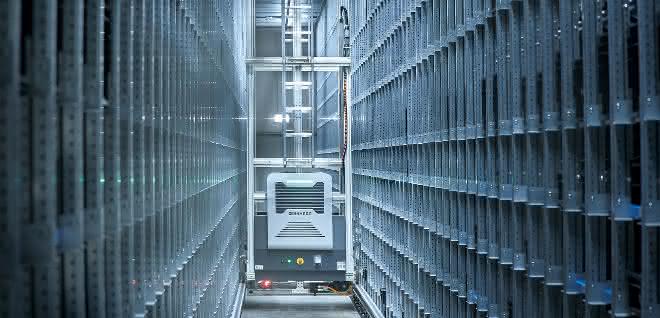
Gebhardt's scope of delivery included the conveyor technology, the automated small parts warehouse (AKL) including a StoreBiter multi-level shuttle (MLS) for each floor, a vertical pallet conveyor and a material flow computer with storage location management and load monitoring.
The central incoming goods department
Goods are delivered to Ziehm Imaging via four incoming goods loading ramps. After unloading, the goods are placed on roller conveyors at one of the two feeding stations. The employees in the central incoming goods department separate the delivered goods and pack them, depending on size and weight, into one of four different container types, which are taken from the empty container connection.
Various pallet types are available for larger series or spare parts. The subsequent incoming goods posting process links the goods to the container and forwards them via the quality assurance conveyor system for incoming goods inspection. If the automatic contour and weight check detects an error, the container is automatically transported to the NIO workstation (not-in-order workstation). The items are unpacked, repacked at the correct height, barcodes are compared and the container is then returned to the conveyor system, which transports the goods to the MLS warehouse. It is also possible to retrieve the goods directly to production via the miniload.
The way to the shuttle warehouse
The automated small parts warehouse realized by Gebhardt has one aisle on the ground floor and one on the upper floor. The warehouse is double or quadruple-deep and is operated with one Gebhardt StoreBiter MLS per floor. The shuttle warehouse on the upper floor is connected to the warehouse on the lower floor via a lifter. The miniload warehouse has a total storage capacity of 6,440 storage locations and stocks around 12,000 items ranging from series parts to all available spare parts. The storage locations are managed by the Gebhardt material flow computer, which monitors the warehouse and assigns the containers to their storage locations.
On both the ground floor and the upper floor, a picking workstation is located directly in the shuttle warehouse via a belt conveyor with an empty container delivery system. At Ziehm Imaging, the warehouse is connected to production via a fixed-cycle tugger train that transports semi-finished products and replenishment for production.
For the heavyweights - the vertical pallet conveyor
The vertical transport of full and empty pallets from the first floor to the upper floor and vice versa is realized with the integration of the vertical pallet conveyor from Gebhardt. Pallets weighing up to 350 kg are moved with the vertical conveyor. The load handling attachment (LAM) is a roller conveyor. The load-bearing equipment consists of two single roller chains with breakage monitoring. A contour check is also carried out here and goods are repacked if necessary. A total of three roller conveyors transport the panels from the ground floor to the upper floor via lifters, with a traffic light system indicating who is allowed to load pallets. To remove the goods, the lifter can be repositioned and the goods removed from top to bottom.
Trustworthy and made for the future
"From planning and project management to installation, we were very satisfied with the collaboration," summarizes Holger Gratzer. The challenges that arose both from moving into an existing building and from a tight schedule were solved promptly and unbureaucratically. "The solution that was implemented and the partnership-based and open cooperation at all times mean that we will continue to think of Gebhardt as a solution partner for future projects." Eva-Maria Müser, Gebhardt Intralogistics Group


You might also be interested in
"We are clearly different from the competition"
The IT company 21unity offers a range of hardware and software services, as well as traditional services. Andreas Mühlbauer spoke to Managing Director Anja I. Gondolf about the company's appearance at the Hannover Messe, its services and future...
 read more...
Think digital, act local
When it comes to industrial damping technology, on-site advice is often very valuable for engineers and designers.
read more...Plagiarius 2024 negative prize
On January 26, 2024, the Plagiarius campaign awarded its dreaded "Plagiarius" negative prize for the 48th time to manufacturers and retailers of particularly brazen counterfeits and fakes.
read more...Spindel Full Service records second-best...
Maintenance as an economic success factor
Spindel Full Service, the spindle repair specialist from Baden-Württemberg, can look back on its second-best financial year in its history - with 15% growth compared to the previous year. And the further forecast also looks good.
read more...Thyssenkrupp and Novelis cooperate
Platform for the circular economy
With a platform for the circular economy in the automotive industry, the two companies Thyssenkrupp Materials Services and Novelis want to set new standards for the recycling of used materials. The open platform will enable access to larger...
read more...How production can benefit from AI
Together with AI technology, IIoT networking makes it possible to better control machine parameters and optimize quality with predictive quality. Downtimes and set-up times can also be further minimized. Cloud platforms also make these technologies...
read more...Marco Ghirardello takes the lead
Fanuc has appointed Marco Ghirardello (48) as the new President and CEO of Fanuc Europe. Ghirardello succeeds Shinichi Tanzawa, who has led the company since 2016 and will take on a new role at Fanuc's headquarters in Japan.
read more...Efficient robot monitoring
Microchips are installed almost everywhere - whether in smartphones, washing machines or cars. With increasing digitalization, the demand for semiconductors has been growing rapidly in all areas of the economy for years.
read more...Everything on one platform
Functional and powerful tools are essential for professional work on the construction site, in the workshop or when carrying out repairs.
read more...