
Robot-assisted automation
Dematic founds "Robotics Center of Excellence"
Dematic has founded the "Robotics Center of Excellence" division, which specializes in the development and technology of robot-assisted automation.
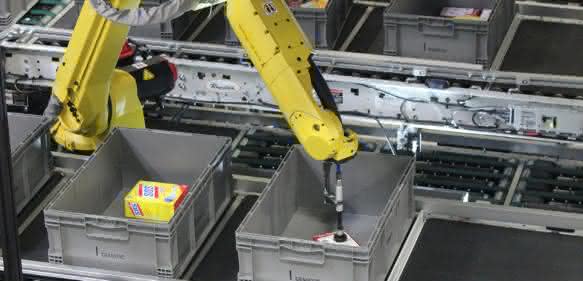
The new division is responsible for the application and implementation of robotic solutions designed to make order fulfillment more efficient, productive and responsive to today's on-demand and omni-channel shipping requirements.
The new division offers a wide range of automated solutions based on process improvements, robot technology, new visions and software. From goods receiving to shipping, these solutions can be used in all areas of the warehouse. Typical solutions include layer-by-layer and piece-by-piece depalletizing, tote replenishment, robotic piece picking, kitting, the introduction of crossbelt and pocket sortation systems as well as palletizing and truck loading. The solutions are designed for handling unit loads, crates, containers, layers and pallets.
Head of the new Robotics Center of Excellence division is Crystal Parrott. She brings more than 28 years of experience in robotics and automation and is responsible for leading all robotics initiatives, driving the robotics roadmap, and directing, coordinating and supporting robotics solutions. Prior to joining Dematic, Parrott was responsible for the development of advanced robotic solutions at Southwest Research Institute.
Jim Stollberg, EVP Global Product & Solution Management at Dematic, says: "Our customers are looking for solutions that address the order fulfillment challenges posed by changing consumer behavior. Robotic automation will be that solution. As was the case decades ago in the manufacturing industry, robotic applications counteract labor shortages and ensure accuracy and speed in operations." E-commerce fulfillment, stock replenishment for retail stores and wholesalers (B2C and B2B) are some of the typical market sectors that have the necessary requirements for automated and robotic order fulfillment.
"Technology advances in the future, in product handling and in software are the key factors that make robot technology, which is widely used in production, more practical and cost-effective for a wide range of applications," explains Parrott. "In addition, we can leverage our past experience in implementing robotic solutions for depalletizing and palletizing and combine it with new features. In this way, goods-to-robot picking, tote replenishment and sorter loading provide a powerful solution for a wide range of applications." kp


You might also be interested in
Modular storage concept
Gebhardt will be presenting the new Gebhardt Upstream at its LogiMat trade fair stand. The proven software solutions, warehouse technology solutions and conveyor technologies such as Galileo IoT, StoreWare and SpeedSorter can also be seen there.
 read more...
Flexible I/O and safety modules
To speed up commissioning and increase throughput in intralogistics systems, a system solution provider also uses decentralized I/O and safety modules.
read more...Fast shipping from the toy manufacturer
Dematic has automated the returns and shipping logistics at toy manufacturer Haba. The intralogistics specialist has installed a space-saving Dematic pocket sorting system at the distribution center in Bad Rodach, where it supports the efficient...
read more...Data analytics for sorting technology
Collect, analyze and optimize data
System provider Beumer is presenting an intelligent data analytics solution that can be used to examine large volumes of data that are generated during sorter operation, for example, and visualize the results.
read more...Digitalization in the material flow
Gebhardt: Smart sorter for logistics 4.0
Gebhardt is launching a fully automated, horizontal and smart sorting system onto the market. The SpeedSorter has a modular design with digital components and is suitable for various conveyed goods.
read more...Sorters take over order-related picking
Sorters play a crucial role in controlling and diverting the flow of goods. With the Omni Sorter and the Sphere Sorter, Trapo offers two solutions that help to keep supply chains running smoothly.
read more...Dispatch center in South Korea
Avancon installs sorter for Samsung smartphones
Together with the South Korean system integrator Asetec, a specialist in electronic control systems, pick-to-light systems and communication with higher-level BUS/IT systems, Avancon has installed a distribution and sorting system for the Samsung...
read more...High-performance sorter from Interroll
Crossbelt sorter processes 20,000 pieces per hour
With the Crossbelt Sorter MX 025H, Interroll is expanding its portfolio of automatic sorting solutions with a new high-performance system that can process up to 20,000 conveyed goods per hour.
read more...E-commerce: sorting system gets shoes on their way
Ferag is equipping the MyBox Logistics distribution center in Kielce, Poland, with a Denisort sorting line. It will sort 8,600 units - mainly shoes and fashion items - per hour.
read more...