

Increase productivity
Designing transport systems for high flexibility
Factories need flexibility to further increase productivity and introduce new products. Manufacturers must continuously adapt in order to increase productivity and production output. The article shows how plants should be designed accordingly.
To increase its output, a Japanese manufacturer of automotive parts sought to reduce the cycle time of critical processes while increasing part transport speed to minimize the time each part spends between processes. The production team at this company found that increasing speed beyond a certain level led to a decrease in productivity. When fast-moving parts are stopped with a conventional pneumatic stopper cylinder, a significant settling time is required before the workpiece can be removed from the conveyor and loaded into the process. They also found that increasing the speed of the processing machines to achieve a shorter cycle time resulted in more frequent line stoppages to rectify line faults that occurred.
Another manufacturer that produces small electric motors wanted to process orders for small batches of certain product variants more efficiently by shortening the changeover times on the production line. Through the optimization
The changeover procedure halved this time from 10 minutes to 5 minutes. However, the cumulative effect of these 5-minute changeovers still added up to around 16 hours of lost production per month. Therefore, the team had to carefully manage production and prioritize the highest volume products to optimize productivity.
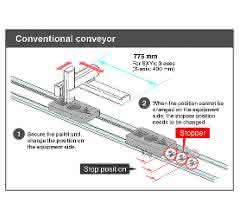
To further reduce time losses, the company sought to develop a special workpiece carrier. This customized fixture, which can hold three different components in small, medium and large sizes, allowed the line to produce up to nine different product variants without the need for changeovers. However, the two-axis robot they used to remove the selected part from the appropriate position in the fixture required the position of the conveyor stop to be changed depending on the product variant to be produced. Alternatively, the two-axis robot could be replaced by a three-axis robot that moves along the transport direction to remove the desired part. Both approaches would involve additional costs and would negate some of the desired savings due to increased production time.
Transport system - design and support
As the "main artery" of the production line, an intelligently designed transport system can help maximize production output, eliminate manual handling and ensure optimal space utilization of the factory. Configuring a conveyor system to optimize the operation of a plant is a task that often requires the adaptation of standard equipment or the development of custom solutions for specific challenges in the factory environment, such as extreme space limitations or height differences. Buffer units are often needed to compensate for different machine capabilities in the line and enable coherent, coordinated operation of the entire line. Transport system suppliers usually have a variety of different options and configurations available and can often offer specialized solutions tailored to the customer's individual needs.
As the system is usually designed by experts on the basis of a specification sheet, the result is well adapted to the company's requirements formulated at the start of the project. However, if these requirements change and evolve, it can be difficult to make appropriate adjustments to the transport system. For example, changing holding positions, which are realized with pneumatic cylinders and associated sensors and solenoid valves, may require software changes as well as adjustments to cabling and mechanical design.
The two companies presented above, which manufacture automotive parts and small engines, both encountered such limitations when trying to increase production output with conventional transportation systems. In each case, the project teams were not able to achieve 100% of the desired improvements.
Workpiece transport by means of linear modules
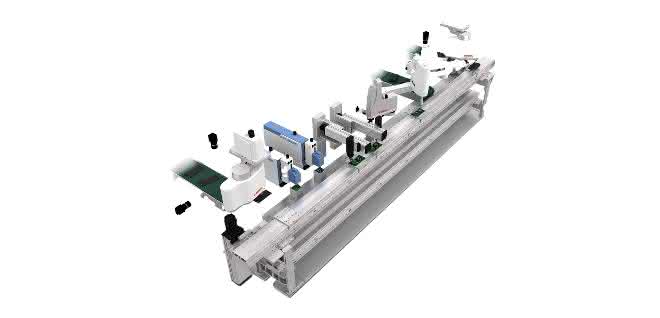
Compared to conventional transport systems, Yamaha's LCMR200 linear transport module offers significantly greater flexibility in adjusting and improving line performance. Parameters such as acceleration, deceleration, speed and stop positions are set electronically and can be easily adjusted by writing the new values to the controller. In addition, the linear drive enables bi-directional movement.
The associated YHX controller eliminates the need to code ladder programs and allows the user to specify direct values and simple point-to-point movements. A single controller can coordinate multiple LCMR200 modules linked together as part of a complete production cell.
As no additional sensors are required to add further stop positions, users can easily reconfigure their production line without compromising on reliability. The linear motor accelerates and stops quickly and smoothly, and the settling time after reaching the desired position is very short. It can be further optimized by adjusting the position tolerance: A larger tolerance enables an even shorter settling time. In addition, the user can increase the transport speed without having to install additional buffers, as all modules can stop, restart and reverse independently of each other if required in order to deliver each workpiece at the optimum time.
The slides of the LCMR200 can be programmed to stop at any desired point with a maximum repeat accuracy of ±5 µm. The transfer speed is electronically controlled up to 2,500 mm/s. A slide can carry loads of up to 15 kg, and the rigidity of the module allows processes to be carried out without the workpiece having to be removed from the slide. This ensures a short cycle time and also saves the technical effort and cost of developing a mechanism to transport the workpiece in and out of a separate fixture for each process.
The aforementioned automotive supplier quickly recognized how the LCMR200 could help achieve the desired 100% increase in productivity. As part of a pilot project, a production line was redesigned so that conventional transport systems were replaced by LCMR200 modules, resulting in a significant reduction in transfer times. This time saving in turn noticeably reduced the pressure to shorten the cycle time of the various processes in the line. As a result, production volumes exceeded the team's original target and the number of errors leading to downtime was reduced to such an extent that this assembly line was considered the pilot line for the entire plant.
Increased production thanks to flexibility
Similarly, the electric motor manufacturer used the LCMR200 to increase production by increasing the flexibility of the production line. The ability to change the module's stop positions by reprogramming saved a lot of manual work during setup. The team then introduced a QR code reader to identify each device type at the start of production so that all LCMR200 modules could automatically reconfigure their settings. This eliminated the need for human interaction with the machines or devices via the touch panel, resulting in complete end-to-end automation of product assembly. This has significantly increased output and eliminated the need for operators to intervene to change the product model. The company is now able to process small batch sizes just as efficiently as large orders.
Manufacturing companies are constantly faced with the challenge of increasing their productivity through measures such as increasing line speed and reducing changeover times. Conventional transport systems can be an obstacle to progress here, as they only offer limited flexibility, which requires a high level of technical effort for reconfigurations. The necessary improvements can often not be achieved with simple changes. On the other hand, making major changes usually requires considerable support from the manufacturer of the components concerned. Bidirectional, linear transport modules enable extensive reconfiguration of parameters such as speed and stop positions. In addition, system operators can usually make these changes themselves. Other benefits include the ability to perform processes such as mechanical assembly directly on the transport module, saving both process time and engineering overheads associated with removing and replacing the workpiece on a conventional transport system.


You might also be interested in
Plagiarius 2024 negative prize
On January 26, 2024, the Plagiarius campaign awarded its dreaded "Plagiarius" negative prize for the 48th time to manufacturers and retailers of particularly brazen counterfeits and fakes.
 read more...
Ivalua honors winners of the Generative AI...
AI-supported "add-ons" for buyers within 48 hours
Ivalua, provider of cloud-based spend management solutions, announced the winners and innovations of the first Generative AI Innovation Cup. The competition took place in December 2023. It was open to all Ivalua partners and employees - more than...
read more...Efaflex celebrates 50 years of high-speed...
The emphasis is on "fast"
Since day one, Efaflex has wanted to use new technologies as early as possible and drive progress in the industry. This year, the family business is celebrating its 50th anniversary under the motto "Fast Forward".
read more...Security of supply even during power outages
In the winter of 2022, Germany was worried about energy shortages. The drugstore retailer dm did not paint any horror scenarios, but nevertheless saw the possibility of controlled, temporary, regional power cuts (brownouts).
read more...Safety technology in mechanical engineering
Modules with new functions
Euchner's product highlights at EMO 2023 include the communication-capable solenoid interlocks.
read more...Transforming the paper industry towards climate neutrality
Together with partners from industry and research, Voith is developing a project for the optimization of energy and material flows in paper production. The aim of the research project is to develop a digital framework that enables effective process...
read more...Up to 95 percent less flue gas thanks to direct extraction
The requirements for occupational safety measures and safety technology are also constantly increasing in welding technology. The Technical Rules for Hazardous Substances (TRGS) stipulate that welding fumes and harmful substances must be extracted...
read more...Competitive advantages with large machines
Whether 3D-printed components for machines and systems, prototypes or aids for design: additive manufacturing is almost indispensable for modern companies in mechanical and plant engineering and automation if they want to play in the premier league.
read more...Transport technology from the modular system
Many transport tasks can be realized with the help of linear technology. Pre-configured solutions are available to simplify the interaction between the linear unit, motor, gearbox and controller. This minimizes the effort required for research and...
read more...