
Automated guided vehicles
Transportation under its own power
Delivery bottlenecks at car manufacturers are often due to inefficient intralogistics. The production of different models at one location sometimes fails due to a lack of flexibility within production. A new driverless transport system can help to remedy this situation by autonomously solving upcoming transport tasks in conjunction with other vehicles, even under changing production conditions.
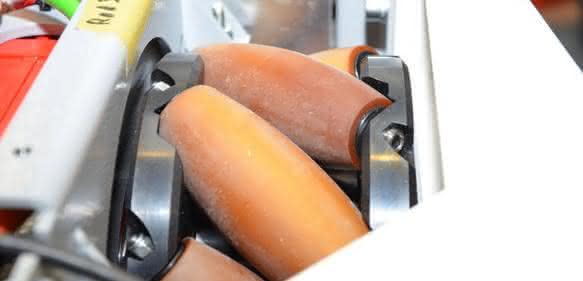
Buyers of new cars often have to exercise patience before taking their first joyride. This is because delivery times in the automotive industry are long. Depending on the manufacturer and model, it can take up to a year for the new car to arrive. There are many reasons for this. They range from supply bottlenecks at suppliers and manufacturers to capacity limits in production and inefficient material flows. "The solution is more flexible processes," says Uwe Schildheuer, Managing Director of Torwegge Intralogistics. With the Torsten automated guided vehicle (AGV), the developer of intralogistics solutions supplies a robot that could give the automotive industry new impetus.
While production processes in vehicle manufacturing in Germany are highly automated and state of the art, intralogistics is lagging behind. "Car manufacturers today often still think of the assembly line," says Schildheuer. This works well as long as the flow of goods is stable. This assumes that the same models are always produced at one location. If different vehicle types are built at one location, the flow of goods would be too complex for rigid assembly lines.
However, the current economic situation does not offer constant conditions. Experts speak of the "Vuca" world. It describes the increasing volatility, uncertainty, complexity and ambiguity. The consequence is an uncertain order situation. Two examples from the automotive industry: according to an Euler Hermes study, over 80 percent of German cars are currently exported. The UK and China are among the most important customers. It is not yet clear how Brexit will affect German-British trade. And it is also impossible to say whether German car manufacturers will continue to be as well positioned in China as they are at present, given the increasing competition from the domestic industry.
But if a flexible system were able to meet local demand promptly and in line with requirements, this would create an invaluable competitive advantage. According to Schildheuer, the Vuca world could only be met with a system that allows maximum flexibility. In order to be able to react quickly to customer requirements, production would have to take place at the point of need. This would also reduce delivery times, transportation costs and environmental impact. It is important to consider production and intralogistics in a network. "Those who continue to rely on assembly lines will not be able to break up the rigid material flows and production processes as well as thinking in terms of vehicle lines any time soon," predicts Schildheuer.
The Torsten AGV offers flexibility and networking instead. A car manufacturer uses four of them in production. The autonomously navigating transport vehicles transport production materials and replace forklift trucks.
The advantage of this is that Torsten is always in the right place at the right time due to his independent way of working. The vehicle works together with other units such as robots or workers and can therefore be easily integrated into existing processes. The possible applications go far beyond the transportation of material.
Several vehicle types in one production
Schildheuer describes a possible scenario: AGVs are used wherever material flows are subject to situational changes. Their use makes it possible to network different production cells with each other and to build different vehicle types in one production process. The system knows exactly which parts are to be installed where and when, and where to find them. It can not only transport individual parts but, thanks to its heavy-duty capability, it can also independently transport finished cars from the assembly cell to the warehouse, for example. This works because the vehicle's computer can process large amounts of data. Torsten selects the relevant information about the current status of the production process from this data in order to complete his tasks efficiently. The vehicle makes its decisions autonomously, but acts in a swarm-intelligent manner. To do this, it uses data networking with other units in the plant and is able to create a cooperative network to solve tasks. Integration into the overall autonomous system takes place via a fleet manager.
Many AGVs in a swarm in the future
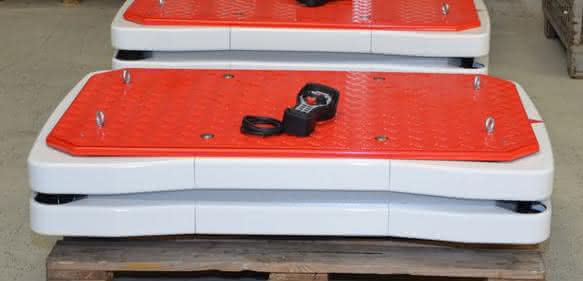
Torwegge tests various scenarios in a hall in Bielefeld, where the AGV is produced. Simulations are carried out before an order is implemented for a customer. This shows whether the system design is correct for the respective application, how many vehicles are required and how they need to be configured. Essentially, three elements are decisive: firstly, the size of the area on which the vehicle is working, secondly, the number and distance of the sinks and sources that it controls. And thirdly, the transport volume and the time specifications in the system.
The speed is limited for safety reasons. Torsten is allowed to cover a maximum of 1.5 m/s. "With regard to the other factors, anything is basically possible," says Schildheuer. Four AGVs were coordinated for the first customer.
In the future, Torwegge would like to realize a network of one hundred or more units including robots. The company is in the middle of the further development phase. In principle, however, the technology is so far advanced that it can be programmed to meet requirements. "We have created the conditions to make the automotive industry more flexible," says Schildheuer. If the manufacturers implement this, the new car may soon be just a few weeks away. am


You might also be interested in
Plagiarius 2024 negative prize
On January 26, 2024, the Plagiarius campaign awarded its dreaded "Plagiarius" negative prize for the 48th time to manufacturers and retailers of particularly brazen counterfeits and fakes.
 read more...
Ivalua honors winners of the Generative AI...
AI-supported "add-ons" for buyers within 48 hours
Ivalua, provider of cloud-based spend management solutions, announced the winners and innovations of the first Generative AI Innovation Cup. The competition took place in December 2023. It was open to all Ivalua partners and employees - more than...
read more...Efaflex celebrates 50 years of high-speed...
The emphasis is on "fast"
Since day one, Efaflex has wanted to use new technologies as early as possible and drive progress in the industry. This year, the family business is celebrating its 50th anniversary under the motto "Fast Forward".
read more...Security of supply even during power outages
In the winter of 2022, Germany was worried about energy shortages. The drugstore retailer dm did not paint any horror scenarios, but nevertheless saw the possibility of controlled, temporary, regional power cuts (brownouts).
read more...Safety technology in mechanical engineering
Modules with new functions
Euchner's product highlights at EMO 2023 include the communication-capable solenoid interlocks.
read more...Transforming the paper industry towards climate neutrality
Together with partners from industry and research, Voith is developing a project for the optimization of energy and material flows in paper production. The aim of the research project is to develop a digital framework that enables effective process...
read more...Up to 95 percent less flue gas thanks to direct extraction
The requirements for occupational safety measures and safety technology are also constantly increasing in welding technology. The Technical Rules for Hazardous Substances (TRGS) stipulate that welding fumes and harmful substances must be extracted...
read more...Competitive advantages with large machines
Whether 3D-printed components for machines and systems, prototypes or aids for design: additive manufacturing is almost indispensable for modern companies in mechanical and plant engineering and automation if they want to play in the premier league.
read more...Transport technology from the modular system
Many transport tasks can be realized with the help of linear technology. Pre-configured solutions are available to simplify the interaction between the linear unit, motor, gearbox and controller. This minimizes the effort required for research and...
read more...