
Condition monitoring
Predictive maintenance concepts improve system availability
With the system from Nord Drivesystems, drive and status data can be recorded regularly or permanently in order to optimize the operational safety and efficiency of machines and systems.
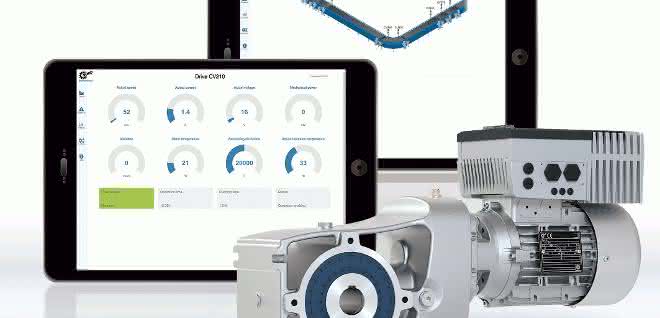
This information can also be used to develop concepts for predictive maintenance. The basis for this is the fast, efficient and comprehensive evaluation of analog and digital data - measured values, signals and operating parameters - by the intelligent PLC in the drive electronics.
The aim of predictive maintenance is to proactively maintain machines and systems and detect changes, reduce downtimes and increase overall system effectiveness. Condition-based maintenance replaces traditional time-based maintenance.
Unplanned downtimes or machine failures can be avoided by detecting and preventing unacceptable operating states at an early stage. Predictive maintenance enables predictable machine or system downtimes based on real drive and process data. For operators of systems and machines with drive systems from Nord Drivesystems, this results in a reduction in service and material costs and increased system availability. Other advantages include an increase in the service life of components and machines as well as predictable and cost-optimized maintenance.
Intelligent algorithms use drive data
Nord Drivesystems pursues a drive-based approach in which information from condition monitoring is transferred to predictive maintenance using intelligent algorithms and virtual sensors. This includes, for example, sensorless determination of the optimum oil change time based on the oil temperature. This makes use of the fact that oil ageing in gearboxes is particularly dependent on the oil temperature.
This information, in combination with known transmission parameters and specific, operational parameters, enables a more precise indication of the oil change time. A physical temperature sensor is not required for this. The drive data is pre-processed by intelligent algorithms in the integrated PLC of the frequency inverter, which serves as the evaluation unit. The data obtained can be made available via all common interfaces.
The right PLC software architecture for every solution
The drive's equipment can be optionally expanded and adapted to the respective automation task. The customer can choose which tasks (drive monitoring, drive control, process control) he wants to transfer directly to the drive. This scalability gives them the opportunity to gain initial experience in a smaller production area, for example, before converting their entire system.
Three expansion stages are available. In the small version, the drive PLC only monitors the drive. The drive parameters are pre-processed in the PLC and forwarded to the higher-level system controller, which is then responsible for drive and process control. In the medium configuration, the PLC also integrates the drive control and thus also executes drive-related functions. In the largest expansion stage, the inverter PLC completely replaces the higher-level system controller. In addition to communication with a control system, a local data management system without an internet connection can also take over the data if required.


You might also be interested in
"We are clearly different from the competition"
The IT company 21unity offers a range of hardware and software services, as well as traditional services. Andreas Mühlbauer spoke to Managing Director Anja I. Gondolf about the company's appearance at the Hannover Messe, its services and future...
 read more...
Think digital, act local
When it comes to industrial damping technology, on-site advice is often very valuable for engineers and designers.
read more...Plagiarius 2024 negative prize
On January 26, 2024, the Plagiarius campaign awarded its dreaded "Plagiarius" negative prize for the 48th time to manufacturers and retailers of particularly brazen counterfeits and fakes.
read more...Spindel Full Service records second-best...
Maintenance as an economic success factor
Spindel Full Service, the spindle repair specialist from Baden-Württemberg, can look back on its second-best financial year in its history - with 15% growth compared to the previous year. And the further forecast also looks good.
read more...Thyssenkrupp and Novelis cooperate
Platform for the circular economy
With a platform for the circular economy in the automotive industry, the two companies Thyssenkrupp Materials Services and Novelis want to set new standards for the recycling of used materials. The open platform will enable access to larger...
read more...How production can benefit from AI
Together with AI technology, IIoT networking makes it possible to better control machine parameters and optimize quality with predictive quality. Downtimes and set-up times can also be further minimized. Cloud platforms also make these technologies...
read more...Marco Ghirardello takes the lead
Fanuc has appointed Marco Ghirardello (48) as the new President and CEO of Fanuc Europe. Ghirardello succeeds Shinichi Tanzawa, who has led the company since 2016 and will take on a new role at Fanuc's headquarters in Japan.
read more...Efficient robot monitoring
Microchips are installed almost everywhere - whether in smartphones, washing machines or cars. With increasing digitalization, the demand for semiconductors has been growing rapidly in all areas of the economy for years.
read more...Everything on one platform
Functional and powerful tools are essential for professional work on the construction site, in the workshop or when carrying out repairs.
read more...