
Operational balancing
The history of operational balancing
Like many other processes in production, balancing is now integrated into the digital environment and largely automated. Of course, this was not always the case. It began a long time ago with a lot of manual work. This article shows the development of balancing from ancient times to the present day.
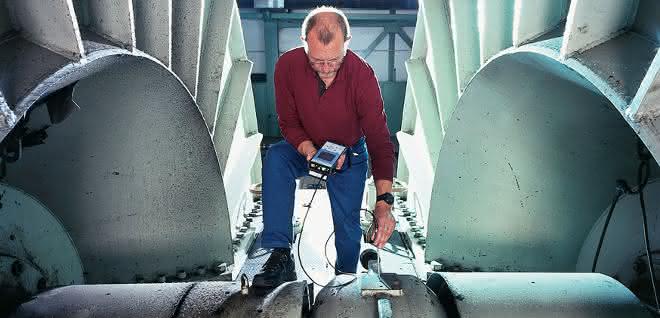
If you want to remove imbalances from a compressor in a chemical plant or a spindle in a machine tool, you are faced with a challenge. The rotor to be balanced usually cannot simply be removed. One possible solution is operational balancing, i.e. balancing a rotor in the machine. This method offers the advantage that the user does not have to dismantle the machine or remove the rotor. This makes balancing particularly quick and cost-effective.
However, this has not been possible for so long and many development steps were necessary to get to this point. The beginning of this technological history can even be traced back to ancient Rome.
Balancing without measuring technology and with little know-how
In ancient times, so-called static balancing was common: a disk-shaped rotor, for example a stone wheel, had more weight at one point, i.e. it was unbalanced. To eliminate this, the stone wheel was set up using a wooden rod, for example, so that it was supported at the center and could rotate freely. It was then set in rotation. The next step was to wait until the end of the rotation. Due to gravity, the heaviest point is now at the bottom. The "balancer" thus knew where the unbalance was.
Then either a small weight had to be attached to the opposite side, offset by 180 degrees, or some weight had to be removed at the heaviest point - until the rotor was largely unbalanced. In this way, oscillations and vibrations were at least roughly eliminated without complicated measuring technology and with the limited know-how of the time. Today's technology is of course much more precise and can easily detect and correct unbalance masses in the milligram range.
Sensors and electronics accelerate development
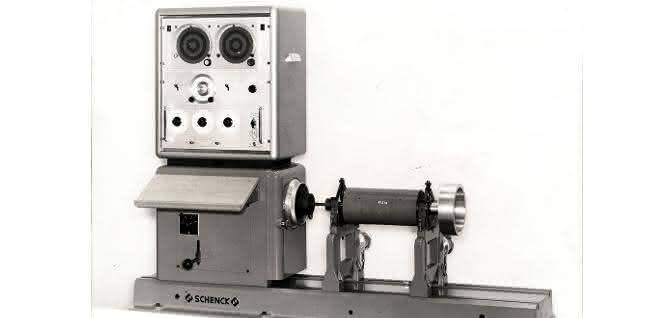
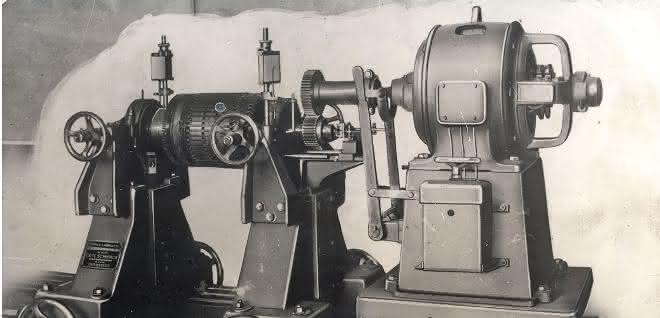
The process remained largely unchanged until the 19th century. It was not until 1870 that the first balancing machine was mentioned. In 1881, the entrepreneur Carl Schenck founded the Carl Schenck Eisengießerei & Waagenfabrik. Balancing machines were also produced there from 1907. This was also the starting signal for today's Schenck RoTec GmbH from Darmstadt. The company acquired the license for the balancing machine patented by engineer Franz Lawaczeck in 1908.
"From then on, all technical improvements were heavily dependent on sensors, measurement technology and later increasingly on electronics and microprocessors," says Marc Frisch, Technical Sales Manager at Schenck RoTec. The first sensors were developed as early as the 1920s to measure vibrations and thus detect unbalance. At that time, however, measuring the angular position of the unbalance on the rotating body was still problematic. It was only with the so-called watt-metric method from the 1940s that angles and unbalance parameters could be precisely determined. However, the measuring devices were still very large and heavy at this time and therefore not easy to transport. This changed in the 1960s and 1970s with the advent of transistor technology.
Balancing machines are becoming more intelligent
At the end of the 1970s, development then took the next important step. With programmable pocket calculators, users were able to solve balancing algorithms that they had previously had to calculate graphically by hand. This meant that the measured values were plotted on a sheet of paper - a polar diagram - and the unbalance was determined from the vibration and calibration values using an iterative, graphical process. Not only was this very time-consuming, but only a few specialists were able to do it. The increasing availability of pocket calculators then made balancing much easier. With the advent of microprocessor technology, programmable pocket calculators could be integrated into the machines so that the device itself calculated the unbalance and its position using a balancing algorithm. In addition, the displays and display options of the measuring devices continued to improve. While initially only certain key figures - such as vibration, magnitude or phase - could be displayed, graphical display options were increasingly added in the 1990s. On the new monitors, the unbalance could be displayed in polar coordinates - a significant help for the balancer. Gradually, the measuring devices became faster and more accurate, the displays became colorful and the values could be saved. And today? Users save the measured values and either transfer them to a stationary computer or use IIoT solutions such as Schenck One. This makes machine data available worldwide, ensures more efficient processes and machines can be used and maintained better and more cost-effectively.
Where will operational balancing go from here?
"I think that from today's perspective, as in many other areas, the basic technology for operational balancing is largely mature. The technology could still be developed further, but in practice no user would notice. The next big step is optimization, not just of the machine, but of all balancing processes. And we are already on the right track with the software and digitalization of our products," says Frisch. The next milestones could include, for example, further simplification of the operating systems for an operating balancer.
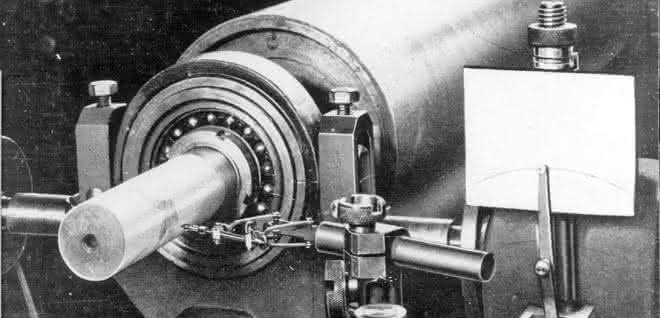
Measurement technology itself is very complex. It may be possible to simplify this in the future. Another interesting point is the optimization of condition monitoring. The aim here is to be able to make predictions about the condition of machines. For example, when the bearing is likely to fail because certain characteristics can be seen in the vibration curve. The new machines collect data that is centralized via a cloud connection and which the maintenance technician has an overview of. The data can therefore be called up in the control center or on a mobile device. Despite all the technology and improvements, balancing is still a matter of know-how. The technology can only ever be as good as the person operating it. And sometimes the conditions for operational balancing are less than ideal: the machine may exhibit resonances, unexpected operating conditions or non-linearities. In such cases, an experienced balancing professional from Schenck RoTec can be very helpful in providing support.


You might also be interested in
ESTIA aims to strengthen Europe's cloud
New tech alliance for EU sovereignty
Twelve companies, including Dassault Systèmes, are founding the European Sovereign Tech Industry Alliance (ESTIA). The initiative aims to strengthen Europe's technological independence and define requirements for sovereign cloud services. The start...
 read more...
Deutsche Telekom and Nvidia launch one of Europe's largest AI factories
With the Industrial AI Cloud in Munich, Deutsche Telekom and NVIDIA are creating one of the largest AI factories in Europe. Companies can train AI models, carry out simulations and access 10,000 GPUs.
read more...Leveraging data potential with AI and streaming
Huge data treasures are still lying dormant in many manufacturing companies. And yet it is high time that these treasures were unlocked. There is often a lack of resources and capacity to make data usable in real time. Streaming production data can...
read more...More awareness of noise
Dematic offers solutions that are tailored to different cloud environments and reduce environmental impact through reduced material consumption and improved energy efficiency.
read more...Generative AI in the automation environment
The mechanical engineering and automation industry is undergoing profound change. This transformation is being driven by more volatile global trade, geopolitical crises and increasing market pressure, which demands greater agility, technological...
read more...Rigid data structures have had their day
The traditional data center is no longer the center of data. A hybrid cloud storage approach enables manufacturing companies to both meet the current requirements of data-intensive processes and future-proof their infrastructure.
read more...Software as a service in three stages
CIM Database Cloud is a new out-of-the-box solution from Contact for end-to-end digital product development.
read more...How production can benefit from AI
Together with AI technology, IIoT networking makes it possible to better control machine parameters and optimize quality with predictive quality. Downtimes and set-up times can also be further minimized. Cloud platforms also make these technologies...
read more...More expertise for digital engineering
Altair, a computational science and artificial intelligence (AI) company, has acquired OmniV, a technology from Michigan, USA-based software company XLDyn.
read more...