
Fire protection
Moog Pieper develops video-based smoke detection
In Germany, every third fire leads to property damage of more than 500,000 euros. Added to this are losses due to possible production downtime. Why are industrial production facilities not equipped with early fire detection systems across the board - especially as it is also about protecting employees?

Whether caused by a technical defect, negligence on the part of an employee or arson, the causes of fires are varied - and expensive. The Bundesverband Brandschutz-Fachbetriebe e.V. (Federal Association of Fire Protection Companies) estimates that in Germany alone, several billion euros of economic assets are destroyed by fire every year.
In order to ensure comprehensive fire protection, a number of factors need to be taken into account: from structural protection measures and the avoidance of ignition sources to staff training - and of course the use of fire alarm systems. However, many companies rely on traditional smoke detection systems. These are not useless, but modern fire alarm systems are more suitable for effectively protecting human life and preventing production losses. Conventional smoke detectors quickly reach their limits in draughty interiors with high ceilings - and this applies to many production halls. They only report the outbreak of a fire when the smoke has already risen to the ceiling and the fire is already very large. Conventional point or light beam smoke detectors also often trigger false alarms in difficult environments with chemicals, dust or vapors. There are new, better fire protection solutions, especially for industrial environments, which complement existing systems and make them safer.
One of these technologies is video-based smoke detection, as developed by Moog Pieper from Schwerte in North Rhine-Westphalia. Cameras are used to detect fires while they are still smoldering. A standard network camera is connected directly to the fire alarm control panel. Analysis software is installed on the camera, which continuously scans the surroundings for sources of fire. The learning algorithm checks rooms for smoke and changes, but also knows to ignore people, clouds of dust and other irregularities in the image.
Thermal cameras for hardship cases
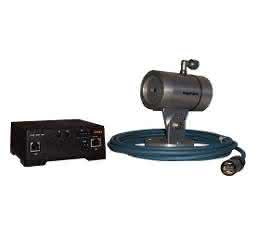
Fires are not undesirable per se in every production environment: in the glass and cement industry or in waste incineration plants, for example, a fire is unavoidable. Nevertheless, even in these environments, fires are serious dangers. In such extreme environments, thermal cameras that send alarms at low temperature differences are a good choice. The cameras are very robust and are also heat-resistant when installed in water-cooled housings. In principle, thermal cameras are also suitable for other production facilities. However, they are comparatively expensive as they rely on software that has to be adapted to the respective location and conditions. And there is another point to consider: Thermal cameras are only suitable for areas with a clear field of vision. Thermal cameras reach their limits when there are obstacles such as machine parts or pillars.
Fire protection in Industry 4.0
Every company has protection goals, but not always the budget to equip itself with a comprehensive solution. Nevertheless, there is a wide range of affordable options between the "luxury version" and traditional fire alarm technology. The current development towards a networked factory will also provide exciting impetus for fire protection. Through the dual use of cameras, fire protection can be integrated into the normal process control system. Camera safety systems equipped with several applications not only warn in the event of a fire, but also, for example, if there is a motionless person in the production plant as a result of an accident.
One aspect that should not be ignored, especially with regard to Industry 4.0, is access security. Process monitoring systems should never be set up in the same network as company data. The usual security precautions such as firewalls and access control are also important here. Special attention should also be paid to the choice of camera: Standard applications are sometimes installed on Asian cameras, which independently establish contact with servers in their home country and are therefore a potential gateway for industrial espionage. ee


You might also be interested in
Basler acquires 76% of Indian image processor
Basler, supplier of image processing components for computer vision solutions, has acquired 76% of the Indian sales partner Alpha TechSys Automation.
 read more...
Process monitoring and fault detection
Cameras ensure quality during laser melting
Powder bed-based laser melting (PBF-LB/M) opens up new possibilities in additive manufacturing. Modern camera systems provide crucial process data to further increase quality and efficiency.
read more...Vision Sensor is three times faster than its predecessor
The 'CS-62' vision sensor from di-soric is around three times faster than its predecessor, the 'CS-60'. In combination with the 'nVision-i 25.1' software, it enables image processing solutions that were previously reserved for smart cameras.
read more...Thermal imaging cameras for quality control
Automated thermal imaging cameras are often suitable for quality control applications where temperature plays a role. However, while there are various solutions on the market for slow processes, it is challenging to select a camera that reliably...
read more...Easy entry into industrial VGA thermography
Reliable temperature measurement is a prerequisite for the success of many industrial processes. Berlin-based manufacturer Optris presents the Xi 640 infrared camera, a new member of its Compact Line, which enables non-contact temperature...
read more...Powder bed-based laser melting optimized
Aconity3D has set itself the goal of optimizing the stability of the manufacturing method of powder bed-based laser melting and thereby promoting its use in a wide range of industries. By using high-speed industrial cameras from SVS-Vistek, the...
read more...INDUSTRIAL Production Products of the year...
2nd place, category handling, assembly and production logistics: SICK
safeVisionary2 is the first 3D time-of-flight camera with Performance Level c safety certification. It enables safe three-dimensional environmental detection and won 2nd place in the competition for Product of the Year 2024 in the handling, assembly...
read more...Nomination Products of the Year 2024
SICK: Camera systems safeVisionary2
safeVisionary2 is the first 3D time-of-flight camera with Performance Level c safety certification. It enables safe three-dimensional environmental detection and has been nominated in the 2024 Product of the Year competition in the handling,...
read more...AI vision brings additional opportunities
The seamless integration of AI into the consumer sector has helped to improve our quality of life and make interactions with technology more efficient. In industry, AI vision with machine learning opens up new possibilities that are not covered by...
read more...