
Industrial services
From South Korea to Germany
Relocating machinery and equipment from South East Asia to Germany is a highly complex and demanding task. The specialist for industrial services and maintenance, Wisag, has taken on this task in the case of a complete assembly line.
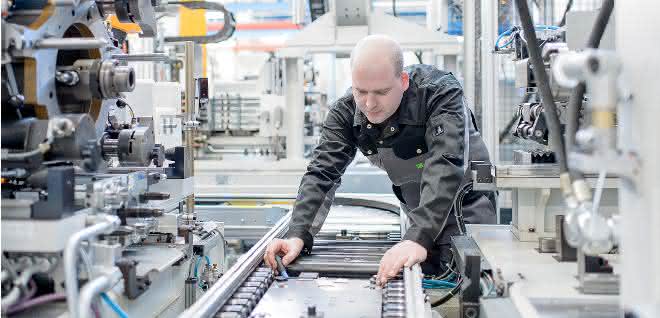
Anyone who has ever moved house knows how much work it involves: everything has to be carefully dismantled, packed and then transported in one place and then, of course, unpacked and - ideally complete and undamaged - reassembled. Once you have had the benefit of a professional removal company, you will never want to do without them again. Perlon has also had this experience. The global group of companies, which specializes in the production of synthetic filaments, manufactures filaments for applications in the paper machine industry, the brush industry, for technical textiles as well as for cosmetics and dental applications at its plants in Germany, the USA and China. When the production plant in South Korea was closed, the company commissioned the Wisag Industrie Service Group, one of Germany's largest industrial service providers, to relocate machine and plant components to Munderkingen in Baden-Württemberg, Wald-Michelbach in Hesse and the USA.
What applies to any average move is all the more true in these dimensions: preparation is everything! "If you organize properly, you save time and therefore money," says Jörg Gollasch, Head of Maintenance, Plant Engineering and Industrial Assembly at Wisag Produktionsservice GmbH in Donaueschingen. "The duration of the preparation phase for such a move cannot be generalized - it varies depending on the machine type, location, user industry and plant size. For Perlon, we spent a total of six weeks planning the move. One thing that should not be underestimated is the time it takes to obtain an entry and work permit. Fortunately, this is much less of a problem in South Korea than in other Asian countries such as Indonesia or India."
Other countries, other regulations
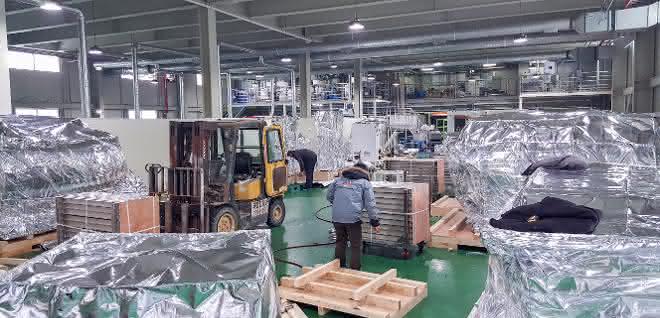
Three employees from the Donaueschingen branch, including two lead fitters, were on site in Sejong, South Korea, to manage the project and coordinate the local packaging team. "When transporting goods across borders, it is essential to familiarize yourself with the country in question, its laws and regulations, as well as the people living there and their culture," emphasizes Gollasch. "For example, there are country-specific differences in customs clearance, work permits, transport regulations and insurance - and, of course, occupational health and safety." Depending on the user industry and installation project, many Wisag assignments are therefore preceded by a briefing by a trainer who takes part in a meeting with the customer beforehand, during which possible risks relating to the installation and location are identified and measures to minimize them are defined.
Wisag relocated a total of ten containers, each with a floor area of around 28 square meters, from Sejong to Germany and the USA within around two months. The experts spent a good three weeks dismantling and packing the systems. After the long sea voyage, it took four Wisag employees just under two weeks to reassemble the machines at their destination. The service provider took care of all steps of the industrial assembly: starting with the preparation of the dismantling, the dismantling itself, the packaging, the transportation of the system to the new location and the preparation of the reassembly, with the subsequent final work for commissioning being carried out by Hahl Filaments, based in Munderkingen. "Wisag Produktionsservice was the general contractor for this order," explains Gollasch. "However, dismantling the machines was our main task. For sea packaging, sea transportation and customs clearance, we worked with Leschaco/Lexau from Bremen, a reliable partner with many years of experience in the Asian region."
Disassembly in a small space
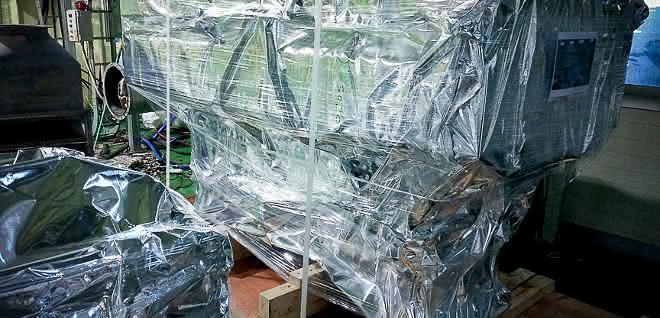
The biggest challenge for the industrial service provider was the confined space. Even before dismantling, the space between the machines was limited - but now they had to be dismantled, packed and moved into the containers in the 800 square meter hall. "Naturally, dismantled systems take up significantly more space than assembled ones. We also had to accommodate the transport floors for the containers in the hall. As it was not possible to load more than one container in front of the hall, the arrivals and departures of the sea containers had to be planned very precisely. Seamless organization and logistical skill were essential here!" Coordinating the employees on site was also a major challenge for the experienced service provider: "Even though we can now look back on many decades of experience in industrial assembly, it is always a challenge to work in a different culture," explains Gollasch. "Like every other country, South Korea has its very own mentality, a different approach to tasks and simply a different way of working. Working hours are different to those in Germany, and the way we deal with sickness, public vacations and vacation days is fundamentally different to what we are used to - a big change for our employees every time, but one that we were able to master successfully this time too."
The customer is also satisfied with how smoothly the relocation went: "We are happy to have found a competent service provider in Wisag, who has decades of international experience and knows which approach makes the most sense for such a complex task," says Wolfgang Fuchs, Head of TQM, MDK & AFF and Manager Procurement at Perlon. "The duration of the relocation was in line with the previous calculation, and with Wisag taking over the project management, we could be sure that all steps would be carried out as planned. We will certainly continue to work with Wisag in the future when it comes to the planned relocation of further assembly lines."
Nora Eckert, Corporate Communications Officer at Wisag / am


You might also be interested in
Conrad continues to grow
Conrad Electronic now generates 80% of its sales with business customers and has successfully developed from a traditional technology retailer into a B2B procurement platform. The company aims to become Europe's leading procurement platform for...
 read more...
AI finds its way into automotive customer service
In addition to computer solutions for vehicle diagnostics, Getac now also offers AI-based digital tools that support customer contact in service operations.
read more...SMC: "Preferred Supplier" from Bosch
The technology and service company Bosch has recognized SMC for the performance of its automation technology in factory and process automation and awarded it the status of "Preferred Supplier" in the material group "Standardized Pneumatic Devices".
read more...Combined ERP forces
The medium-sized ERP providers Step Ahead Software, Godesys and Informing merge to form the Step Ahead Group.
read more...Cybersecurity for asset-intensive companies
Forge Cybersecurity Platform, the new software platform from Honeywell, has been developed for the cybersecurity of asset-intensive companies and critical infrastructures. The platform is available in three versions.
read more...Automated machine tool as a success factor
Industry 4.0 is the hot topic of the moment. For small and medium-sized companies and contract manufacturers, it holds great potential for increasing production efficiency step by step. The focus here is on efficient and user-specific automation...
read more...Nemo hand vacuum lifts all materials
A new addition to the Eurotech portfolio is the battery-operated Nemo vacuum cleaner, which is suitable for handling almost all surfaces.
read more...Future-oriented cobot projects
Three pillars of successful cobot initiatives
What is important if cobot projects are to be future-oriented? Automation and robotics expert Omron has identified three aspects for human-machine collaboration.
read more...Short-stroke linear actuator instead of pneumatic cylinders
The new short-stroke linear actuator from Ketterer Antriebe and halstrup-walcher is characterized by high dynamics and a large stroke in a compact size. Thanks to the integrated electronics, the drive is easy to control compared to pneumatic...
read more...