
Rotary brakes from ACE
You can get across the slopes even without snow
Pistenbock-Cross is a recreational sport for the snow-free months. The vehicle is steered in a similar way to a toboggan. High-quality vehicle components such as ACE rotation brakes help to dampen unexpected steering impacts and smooth out the steering.
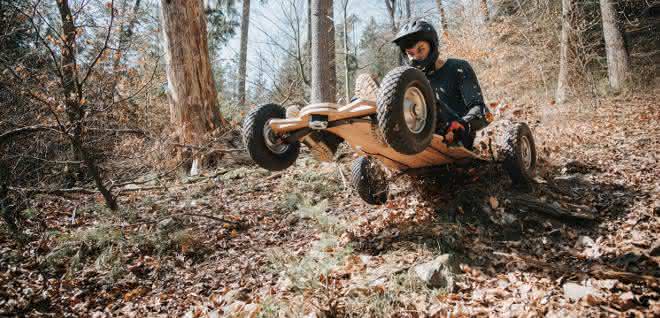
To ski in areas where snow is guaranteed, winter sports fans have to climb to ever higher altitudes, as snow cannons are not a viable alternative when temperatures are too warm. It's no wonder that the Pistenbock-Cross attracted so much interest from experts at Interalpin 2017. The innovative leisure device was invented by Stefan Bock and his company bock machining. The company, based in Alzenau in Lower Franconia, is both a special machine manufacturer and a specialist in plastic seals. Company boss Stefan Bock founded the company Pistenbock specifically for his sports vehicle.
No driving pleasure without rotation brakes
The product portfolio now includes three winter models for the commercial sector and two for end customers, which are offered exclusively via the company's own web store. The flagship model is the Pistenbock-Cross, a counterpart to the winter models, specially manufactured for the snow-free period with wheels and disc brakes.
Braking and cushioning play a particularly important role compared to tobogganing on snow. This is because snow-covered pistes have a natural balancing element due to the white carpet, which protects the riders from roots and other unevenness. During the design phase of the Pistenbock-Cross, a great deal of attention was therefore paid to solutions that would compensate for these unevennesses in order to ensure a high level of riding fun and safety. Roots or other obstacles running on one side or at an angle to the direction of travel played a major role in the considerations. After all, it was important to avoid sudden steering movements.
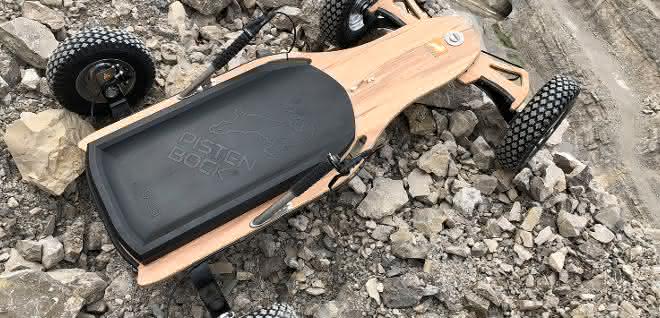
For this reason, the technical product design team at Pistenbock opted for a combination of a robust, simple and maintenance-free design, a wide wheelbase to minimize the risk of tipping, hydraulic disc brakes and steering damping. Design engineer Christian Wilms explains: "As forces in the wild cannot be predicted exactly, there was a lengthy test phase in which the rotary brakes chosen for this had to prove their functionality for the Pistenbock-Cross in all possible and impossible steering maneuvers."
For optimum damping for safety and driving comfort, the company turned to ACE, with whom they have been cooperating for several years. The Langenfeld-based company specializes in damping solutions of all kinds and offers a service that extends from planning to product delivery. This was also the case during the test phase for the Pistenbock.
Rotating brakes on both sides
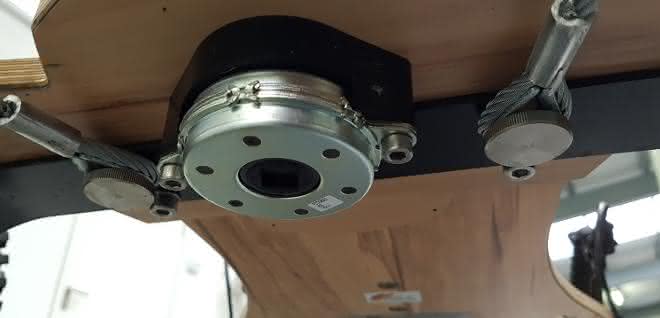
It was clear that ACE rotary brakes would be a very good option for steering damping on the steering column. It was also obvious that from the right, left or double-sided versions available from ACE, only the types that work on both sides would be considered. After all, the impacts on the slope can come from all directions. However, it was interesting to see how ACE's components would have to be dimensioned. After all, they should be neither too big nor too small. With different speeds depending on the slope and large differences in the weight of the tobogganers, this was a task that could not be calculated but required long test runs.
Stefan Bock is very satisfied with the results: "At the end of the test phase, we decided to use the FDT-70 rotary brakes supplied by ACE for series production to dampen the steering process in the Pistenbock-Cross. This is steered with the feet via the steering bracket, on which both the leaf spring with axles and wheels and the rotation brakes are mounted. This design prevents the steering from suddenly snapping when hitting a major obstacle, thus offering the driver greater safety on rough roads. This is because when steering, the steering column and its attachments rotate around a steering bolt via plain bearings. Two rotary brakes are mounted concentrically to this in opposite directions using spacers underneath the steering column. A square engages in the rotation brake and thus enables the steering behavior to be optimized." as


You might also be interested in
BS Rollen Strengthens Its Presence in North Rhine-Westphalia
With the groundbreaking ceremony, BS Rollen is launching the construction of a new company facility in Hückeswagen. The new building will house administrative offices, an assembly line, and a high-bay warehouse, and is intended to facilitate further...
 read more...
Micro motors as the driving force behind intralogistics
Suitable transport structures in intralogistics are a prerequisite in all industries in order to withstand competitive pressure in the future. The basis for this is comprehensive automation, which would be inconceivable without an armada of powerful...
read more...E-scooter with customizable damping
The startup Scuddy has significantly improved the flexibility, performance, customizability and ergonomics of its second-generation foldable e-scooter of the same name - thanks in part to damping technology from ACE.
read more...Electric multidirectional counterbalanced...
360-degree steering on three wheels
Hubtex has given its FluX electric multidirectional counterbalanced truck an update: The new generation for the three-ton capacity class.
read more...New FLUX: 360-degree steering on 3 wheels
HUBTEX presents the new generation of the FLUX 30 electric multidirectional counterbalanced truck (load capacity 3 t). The innovative 2-in-1 stacker is both a front and sideloader. With its patented 360-degree HX steering, it transports both long...
read more...Norelem supports VDI Racing Camp
Mastering the challenges of e-mobility
Promoting young talent has been a priority at Norelem for many years: the company supports young talents with components and the necessary know-how and provides schools with illustrative material.
read more...igus:bike honored with German Design Award 2023
A wide, angular frame made of plastic, black wheels with Y-spokes: The futuristic look of the bicycle designed by Dutch bicycle developer mtrl with motion plastics from Igus can look forward to the prestigious German Design Award 2023.
read more...Floating garbage trap cleans up the Rhine
Every day, a ton of garbage flows down the Rhine. To catch some of it, the Cologne-based Krake association has now inaugurated a floating garbage trap. One of the sponsors of the so-called Rhine octopus is the plastics specialist Igus.
read more...Torwegge presents FlexO rollers
Visitors to the FMB - Supplier Fair for Mechanical Engineering can once again look forward to a new product at the Torwegge stand this year: the FlexO rollers.
read more...