

Safety brakes
No free fall on linearly moving axes
With the LGR-3 linear gantry robot, Fibro Läpple offers a modular system for machine loading and workpiece handling. The company relies on Roba linear stop safety brakes from Mayr to safeguard the vertical axis of the gantry.
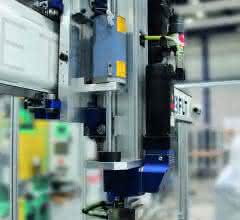
Whether for loading and unloading machine tools or machining centers, transferring parts or transporting devices, tools or machining systems - the modular axis and gantry system from Fibro Läpple Technology (FLT) is designed for use in a wide range of industrial applications. "The special thing about FLT is that we produce automation solutions for a wide range of industries and for all machining and handling processes," explains Boris Bind, Head of Mechanical Design & Development at FLT in Hassmersheim. "With our modular concept, we can respond flexibly to customer requirements."
One component of the modular system is the new LGR-3 linear gantry robot for machine loading and workpiece handling. "We can use the linear gantry robot to automate individual process cells," says Bind, describing the area of application. "The advantage of the gantry design is that it is installed above the machine tool. This means that access to the machine and the work area remain free - unlike with a classic robot, which takes up space. Depending on the design and construction, the gantry robot version can also span larger work areas. This means that the gantry can also be used to traverse areas where people are present," explains Bind. "The linear brake in the vertical axis reliably prevents the axis from dropping and people from being harmed. The gantry is therefore also safe for these applications."
In the electrical version of the linear gantry robot, FLT relies on the electromagnetic Roba linear stop brake from Mayr Antriebstechnik, the specialist for brakes and clutches. In the event of a power failure or emergency stop, the brake reliably holds the axis in any position. It works according to the fail-safe principle, i.e. it is closed in a de-energized state. The braking force is generated by compression springs.
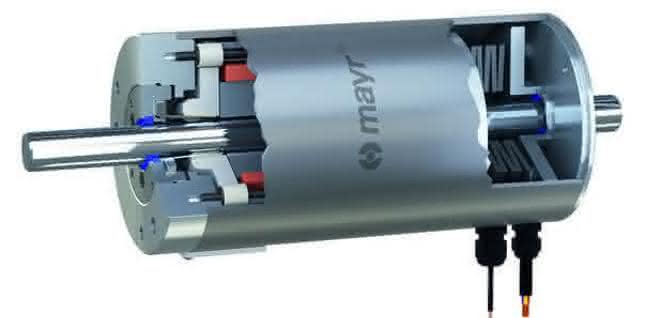
As a compact brake unit, the Roba-Linearstop can also be integrated into existing machine and system designs quickly, easily and without time-consuming adjustment work. It acts on a separate brake rod. When the brake closes, the rod is held without play.
The Roba-Linearstop works without a self-reinforcing wedge effect and therefore works in both directions of movement. By generating force without a self-amplifying wedge effect together with very short reaction times, the axle does not sag when closing. Other linear braking systems that work with a self-amplifying wedge effect generate a high braking force. However, the wedge effect only works in one direction, and to generate the wedge effect, the brake has to "follow suit" when closing.
If the wedge effect of the brake is not limited, the braking force increases to infinity. The machine design must absorb this impact. In addition, the clamp often has to be released with enormous force to release the brake. This is not necessary with the Roba-Linearstop. "It is important for us that the peak load that occurs during braking is not too high," adds Boris Bind. "We need a constant force curve when braking, then the bracket can be smaller. The brake also has to be compact, as there is little space available overall."
The linear brakes available on the market today mostly function as static clamping units and are designed to keep the axes at a standstill. However, people can also be under suspended loads during commissioning, maintenance or even during the production process without the load having been transferred to the mechanical linear brake beforehand. If a complete failure of the drive occurs in these operating states, the linear brake is solely responsible for safely decelerating the load. This is why the safety brakes, which are available in pneumatic or hydraulic versions as well as electromagnetic versions, are more than just clamping units. They are designed to hold the load securely and are also suitable for emergency braking. Before a brake leaves the Mayr factory in Mauerstetten, the required force is set with the appropriate level of safety. This value is tested and documented and can therefore be traced back to each serial number. To make this possible, the company has a wide range of modern testing options and can draw on decades of experience in development and design. The electronic database, in which the measured values are archived together with the corresponding serial numbers of the product, guarantees 100% traceability. as


You might also be interested in
Further simplify assembly processes
In addition to the proven racks with a length of one meter, Wittenstein alpha now offers optional two-meter racks for linear systems. They are particularly suitable for use in short axes, for example, in order to simplify assembly even further.
 read more...
Hiwin manufactures its own shaft gearboxes
Have you ever waited several months for an urgently needed corrugated gearbox? Hiwin has too. That's why the Offenburg-based drive specialist has decided to produce its own space and weight-saving reduction talent.
read more...Human-robot interaction at the trade fair
Sumitomo Drive Technologies is presenting its drive solutions for automation and robotics at Automatica 2023 together with the Lafert Group. The company will be showcasing two different applications of the Tuaka drive system for robot applications...
read more...Partial automation with robots
At Automatica, Promess will be showcasing its modular individual workstations and how these can be partially automated with robot support. The servo press manufacturer will also be providing information about the latest features of its Revolution X...
read more...A new benchmark for collaborative robots
At this year's Automatica, Denso Robotics will be showcasing its innovations in the field of robotics. The collaborative Cobotta Pro product family will be the focus of the presentations. Visitors to the trade fair can see all variants in various...
read more...Clamping system for a new milling machine
Investments in machinery often lead to further purchases - as is the case at Joma-Maschinenbau, whose modern production facility has recently been supplemented by a 5-axis milling machine.
read more...Schunk wants to simplify processes in automated production
The declared aim of automation specialist Schunk is to make its customers' processes comprehensible, simple and efficient. Data transparency plays an important role in this. It enables reliable processes and provides the basis for resource-saving...
read more...Festo and Hahn Automation develop battery tester for greater safety
The success and reputation of electric vehicle manufacturers depend on the safe and flawless functioning of batteries. Hahn Automation has therefore developed a battery tester that performs a fully automated 100% test of mobile energy storage...
read more...SPN Schwaben Präzision presents gearbox solutions for automation and industrial robotics
Short cycle times, robust technology, wear-free surfaces and compact designs have always been relevant for automation and robotics solutions. This year's Automatica trend topics include "Sustainable production" and "Digitalization and AI". SPN aims...
read more...