

Industrial automation
Robots and linear technology cooperate
The clever combination of robotics and linear technology allows production processes to be implemented more efficiently and with higher quality, argues Nicole Hezinger from Item.
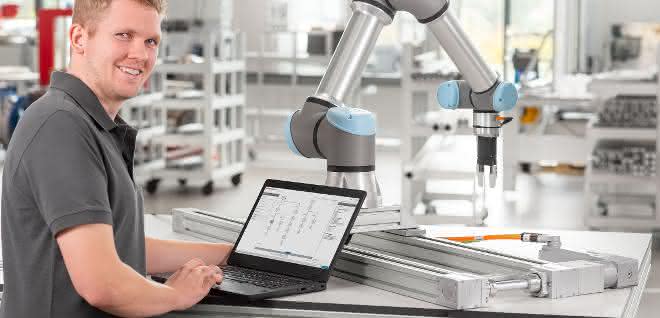
Linear technology is always used when production processes require fast and precise movements along a path and high positioning accuracy or when large loads need to be moved. Robots also perform many tasks in production lines and material handling. They are freely movable and flexible, making them ideal for a variety of tasks. In terms of robustness, speed and precision, however, linear technology scores highly - and is easier and more cost-effective to commission.
Linear technology
Linear technology has become an integral part of process automation. The basic concept is based on movable carriages that are moved along a linear path on a carrier profile. However, linear technology can do much more. By combining several linear units, many projects can be implemented that involve multidimensional movements on a surface or freely in space. Linear technology from item can be used to create single-axis Linear Units as well as 2D surface gantries and 3D spatial gantries. The specialist for modular systems for industrial applications offers numerous components that can be used to implement various automation processes quickly and easily. In addition to various linear guides and slides as well as drives and control units, the Solingen-based company's portfolio also includes pre-configured linear units and complete solutions.
Multiple solutions for different applications
Single-axis linear units are often used in production to move tools along a path, for example to drill holes or perform screw connections. Heavy loads can also be moved easily with single-axis linear units. For more complex applications, synchronized linear axes are the method of choice. Synchronization enables the production of multi-axis systems (gantries) in order to implement multi-dimensional applications. In 2D gantries, for example, print heads, nozzles, sensors or scanners are guided over a surface. Cross tables can be used to move heavy tools and perform sorting or filling processes. Material and load tests, for example, can be carried out using cantilever axes. Three-dimensional processes can also be implemented with linear technology components from item, such as stacking, palletizing or various sorting tasks. Whether single-axis, two- or three-dimensional - maximum positioning accuracy and fast movements can be achieved with linear technology solutions. Other advantages include simple commissioning, a long service life, low maintenance requirements and low investment costs.
Robots - collaborative and non-collaborative
Automated processes are easy to implement using linear technology, but linear systems have a limited range of motion compared to robots. With robots, a distinction is made between collaborative and non-collaborative applications. Non-collaborative robots carry out work steps completely independently. They move freely in the room and must therefore be equipped with protective enclosures or separated from the employees' work area by fences. These non-collaborative robots are often used for welding work or for repetitive tasks in the production process.
Programming robots is sometimes very expensive and time-consuming. Collaborative robots (cobots) work together with humans. The machine is not intended to replace the employee, but to support their skills and relieve them of strenuous tasks. In order to prevent injuries to the employee, the robot is equipped with sensors that cause it to switch off if touched. Protective devices and fences are therefore not necessary. "Many of the systems are still at the testing stage at the moment," explains Uwe Schmitz, Product Manager Machine Automation at item. "Robots reach their limits when it comes to fine details or estimating the accuracy of fit of components and taking component tolerances into account." For example, during pressing processes in production, the employee checks whether the components fit precisely on top of each other. The cobot, on the other hand, presses the components together directly. It has its defined processes and cannot accelerate processes at short notice. "When working with cobots, humans often have to wait for the robot," says Uwe Schmitz. "That is inefficient."
Linear technology and robotics in comparison
Robots can move freely and can therefore be used flexibly. They can carry out many different tasks, such as changing tools independently. However, the use of robots is associated with high investment costs. Due to the large number of motors required for the individual joints, increased maintenance is also necessary. Robots are less suitable for some applications. Control via joints, for example, means that the robot is not able to perform a perfect linear movement. This is where linear technology comes into play. Linear units are based on robust technology and enable fast, linear movements. The system is easy to put into operation, stable, durable and low-maintenance. The linear unit can absorb even heavy loads and high torques. The programming of linear systems is also much simpler compared to robotic systems.
A perfect addition for maximum efficiency
In many production lines, raw parts are still fed manually. A combination of linear technology and robotics enables a significant increase in efficiency in the areas of assembly and material handling. For example, the robot can be mounted on a linear unit and moved from one production station to another. Another variant is also possible, in which the robot stands on a conveyor belt and works in motion, i.e. it is carried along with the product to be manufactured. In addition, systems can be implemented in which the robot is suspended from the linear unit and carries out its work steps. Classic welding work can be carried out efficiently in this way, as can gripping and sorting work on a production line.
Other useful combinations can be created to optimize processes. The linear unit can increase the precision of the robot by practically acting as an end device on the robot arm. Tools such as drill heads are moved flexibly in space, while the final process step is completed with extreme precision using linear technology. These processes in particular - straight approach, positioning and rapid movement of tools - can be perfectly controlled with linear units. The length of the linear axes is not limited and the linear units can be individually configured for the task at hand.
Outlook
The combination of robotics and linear technology leads to increased efficiency. There is also significant potential for savings: for example, where several robots initially performed tasks on a production line, the use of linear axes means that only one robot is required. This can be moved on the linear axis to carry out different work steps. "We see great potential for these combined systems," says Uwe Schmitz. "Companies will recognize the advantages and increasingly rely on these joint solutions in the future." Automation leads to success when technology and people work together perfectly. The aim is not to replace employees with robots, but to create the infrastructure to better organize workflows and implement efficient processes.


You might also be interested in
Motors, gearboxes and encoders: Faulhaber expands Ø 16 mm portfolio
Faulhaber is expanding its portfolio with new DC motors from the SXR and GXR family, a 16 mm planetary gearbox and the IEX3 magnetic encoder for compact drive solutions.
 read more...
New drive solutions for industrial automation and robotics
Faulhaber presents drive solutions with the new GXR and SXR motor family, which offer high efficiency and flexibility in combination with powerful gearboxes and encoders. These optimized components open up new possibilities for applications in...
read more...Marco Altherr becomes new Chief Financial Officer
The Supervisory Board of Ziehl-Abegg has appointed Marco Altherr as the company's new Chief Financial Officer (CFO). Altherr will take up his post in May 2025.
read more...Hydrogen storage in metal hydride
With its focus on storage systems for green hydrogen in solid form (metal hydride), GKN Hydrogen presents itself as a pioneer in safety and efficiency for the industry. GKN Hydrogen offers safe storage systems for green hydrogen and focuses on two...
read more...INDUSTRIAL Production Products of the year...
2nd place, Robotics category: EGS Automation
The SUMO automation systems from EGS Automation - economical standard solutions for automating a wide range of processes in plastics and metalworking - took second place in the robotics category in the competition for Product of the Year 2024.
read more...More productivity with Drive Intelligence
The trends in automation are productivity, sustainability and connectivity. Baumüller is launching new products on the market that address these trends, including new tools for smart energy monitoring, condition monitoring in the drive and new...
read more...Intelligence in Motion
At SPS, Koco Motion will be showcasing its expertise in customized drive solutions based on DC and BLDC motors, stepper motors, servo motors, linear drives and controllers.
read more...Nomination Products of the Year 2024
EGS Automation: SUMO automation systems
The SUMO automation systems from EGS Automation, economical standard solutions for automating a wide range of processes in plastics and metalworking, have been nominated in the Robotics category in the competition for Product of the Year 2024.
read more...Transport technology from the modular system
Many transport tasks can be realized with the help of linear technology. Pre-configured solutions are available to simplify the interaction between the linear unit, motor, gearbox and controller. This minimizes the effort required for research and...
read more...