
ACE shock absorber
Practical examples: Shock absorption for automation tasks
If you want to efficiently reduce mass forces in the automation of industrial production processes, there is no getting around miniature shock absorbers in many applications. Four applications show the possible uses.
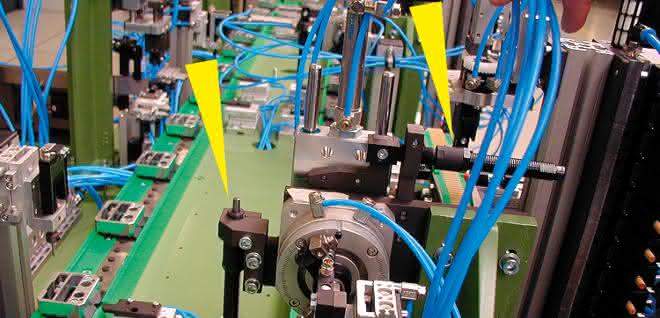
Consistent characteristic curves ensure precise deceleration of mass forces and therefore faster cycle times in industry. These advantages had to be exploited when installing SC190EUM miniature shock absorbers in a production line in the first case study. Here, integration into the existing line was of crucial importance in order to avoid cost-intensive modifications to the system, in which electronic components are fed to the assembly line by means of a linear unit.
The aim here was to increase the cycle time to 3,600 cycles per hour. This would not have been possible without optimum, soft end-position damping in view of the very fast movements. With the help of ACE 's small shock absorbers, the production line could be optimized with comparatively little effort, whereby the costs of the improvement could be reduced by 50 percent and the operating costs by 20 percent through energy savings compared to the integration of new pneumatic modules. The operating noise was also reduced by 30 dB/A.
Movements in an ultrasonic press
In the second case, the task was to start up and brake the pneumatically driven movements in a high-quality ultrasonic press as quickly and gently as possible. For the latter function, ACE miniature shock absorbers are used as protective machine elements at the top and bottom of the vertical movement at the end of the path. After all, even proven and sophisticated designs and the best pneumatics are not immune to the consequences of a power failure, operating error or cyber attack.
For braking and protection in the upper end position, self-adjusting MC75EUM miniature shock absorbers and MA35EUM models that are adjustable in the lower area were selected. In this application, the engineers made sure that the dimensions of the small shock absorbers were similar in order to facilitate integration into the elegant, slimline system. Both have the same stroke and identical piston rod and outer body diameters.
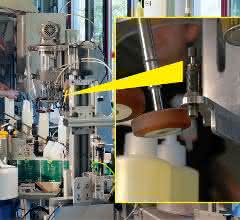
Small shockabsorbers keep things tight
In the third case of a universal capper for bottles with different attachments, the aim was to avoid maintenance work. MC150EUMH miniature shock absorbers are therefore used in all functions of the system, both in the upper and lower end positions. In contrast to the other applications, the small shock absorber type used here is not only larger and therefore stronger, but also has a different sealing technology. This is due to the transverse forces acting in the lower end position. This is due to an arm of the system that is not completely free of bending.
In order to be equipped for lateral forces, the MC150EUMH miniature shock absorber works with a rolling diaphragm seal. In contrast to shock absorbers that are secured with a grooved ring, the piston rod is not pressed away from the seal, which enables a service life of up to 25 million strokes.
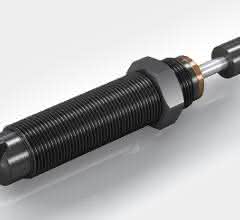
Integrated in linear modules
The improved cost-effectiveness of the ACE miniature shock absorbers was also the decisive factor for their use in the fourth application. Here, the use of MC30EUM miniature shock absorbers integrated into linear modules saves money. In many industrial applications, the braking process for pneumatically driven modules is handled by pneumatics. In this case, however, the engineers opted for hydraulic deceleration in the end positions, as the one-off investment costs for the machine elements from ACE are offset by savings of several thousand euros in operating costs. These result, among other things, from the fact that the masses can be moved with the smallest possible pneumatic cylinder thanks to miniature shock absorbers, which means that smaller valves and maintenance units can be used.
In addition, compressed air and the electricity required to distribute it for the braking process are saved in the long term. Pneumatic end-position damping, for example, requires around three to four cubic centimetres of air, which is often compressed to up to 70 bar. With miniature shock absorbers, the necessary operating costs are no longer an issue, as the delicate mechanical components from ACE brake the inertial forces safely and quickly when the end position is reached, with the added benefit of significantly lower machine loads by converting the kinetic energy into heat that is dissipated to the outside.


You might also be interested in
Free online tools from ACE in practice
In many companies, digitalization and the lean management approach are seen as a welcome slimming cure. How digital progress is simplifying design processes is demonstrated above all by solutions designed from the user's perspective. Configuration...
 read more...
ACE small shock absorbers secure wheelchair test bench
The demands on the quality and functional safety of wheelchairs are high. This also applies to the test series carried out by manufacturers during the development or further development of models. As part of their training, three mechanical...
read more...E-scooter with customizable damping
The startup Scuddy has significantly improved the flexibility, performance, customizability and ergonomics of its second-generation foldable e-scooter of the same name - thanks in part to damping technology from ACE.
read more...ACE vibration dampers: protected against vibrations step by step
Autonomous driving - what is still being perfected for road traffic is already part of everyday life when it comes to transporting materials from the warehouse to assembly. In fact, manufacturer-independent special kits for converting commercially...
read more...Key factor: energy efficiency
Sumitomo Drive Technologies, together with Invertek Drives and the Lafert Group, will be presenting its complete drive solutions for automation and Industry 4.0. Visitors to the stand will learn how they can achieve their sustainability goals and...
read more...ACE structural and crash dampers: Safety on the road 7
The seventh axis is used in manufacturing and production systems to make robots more agile and increase their reach. As an additional traversing axis, this linear axis brings robots quickly into the workspace or guides them precisely to parallel...
read more...Mechanical and plant engineering
Incoming orders in November: economic dampener takes effect
In the final months of 2022, the various economic downturns were also reflected in the order books of the mechanical and plant engineering sector.
read more...Safe protection for handling systems
Small shock absorbers protect linear axes in the semiconductor industry.
read more...ACE TUBUS structural dampers protect compact sliders
The requirements in automotive manufacturing in terms of product quality, precision and durability are high. Design engineers at voestalpine Camtec GmbH have therefore opted for structural dampers from ACE to protect compact slides.
read more...