
Linear guide system
Precise fine grinding
GV3 linear guide system in sanding machine. Peitzmeier Maschinenbau has developed a machine that grinds 40,000 washbasins made of thin sheet metal fully automatically every year. In order not to damage the one-millimetre-thin workpieces, the machine manufacturer relies on GV3 from HepcoMotion - the linear guide system enables precise alignment of the grinding tool in the range of hundredths of a millimetre.

Peitzmeier from Gütersloh, which specializes in the construction of grinding machines, has developed a system, the Omni-Grind Twin 3100 AC, with which customers from the metalworking industry can grind and polish workpieces fully automatically. One of the users of such a grinding system is a Dutch company that processes stainless steel washbasins. Before the system was commissioned in 2016, those responsible placed some unusual demands on the grinding machine: The three-tonne system was to grind 40,000 stainless steel washbasins per year in the fully automated expansion stage and proceed with particular care, as the washbasins are made of thin sheet metal that is only one millimeter thick. The tool must therefore never grind in one place for too long, otherwise the workpiece will be damaged.
Peitzmeier had to adapt the sanding machine to meet these requirements. The heavy sanding tool, which is normally mounted on a double-stranded U-rail, had to make way for a lighter tool that can be aligned with absolute precision on just one guide rail. The previous guide system was unsuitable for this. Peitzmeier went in search of a manufacturer of suitable guide rails and found what they were looking for at Hepcomotion.
Movements in the range of hundredths of a millimeter
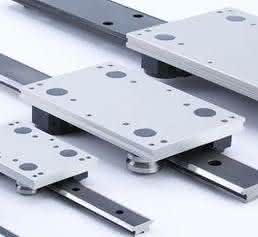
Peitzmeier opted for the GV3 linear guide system. The system consists of precision-ground guide rails and a carriage equipped with special rollers. The rollers have so-called V-groove bearings, which engage with their notches from above and below in the tapered rails and, thanks to low friction, enable movements in the range of hundredths of a millimeter - at a maximum speed of eight meters per second. At the same time, the guide rails have sufficient rigidity to withstand the contact pressure of the grinding tool. Peitzmeier was looking for this combination of precision and resistance to elastic deformation. The low-noise operation of the system proved to be a further advantage.
Modularity reduces installation height
In addition to the precision and resilience of the linear guide system, the space-saving design also saves space. The GV3 system has a modular design; the rollers were purchased separately and mounted directly on the adapter plate of the grinding tool. By dispensing with the remaining components of the carriage, it was possible to save almost 40 percent of the installation height and still achieve a high load-bearing capacity. The Hepco guide system is suitable for use in harsh environments as it is self-cleaning and therefore protected against rapid wear. The V-groove bearings simply wipe deposits off the rail, ensuring smooth and reliable operation.
The special feature is the modular design
Three washbasins are transported to the processing table in the sanding machine via a feed belt. There, the basins are clamped by pneumatic cylinders and fed to the sanding belt with the table feed, which moves in a trapezoidal circulation system. The sanding tool, which moves horizontally on the guide system between the feet of the machine, then presses the sanding belt with a roller onto the surface of the workpiece to achieve the desired sanding effect. The precise alignment of the sanding tool ensures that the machine never sands in one place for too long. A second guide rail with a polishing module is located behind the sanding tool.
The entire machine is made from laser-cut components; all screw-on surfaces and screw-on holes can be integrated directly into the basic machine with little effort - for example, a second guide rail for a deburring module or a rounding module. pb


You might also be interested in
Plagiarius 2024 negative prize
On January 26, 2024, the Plagiarius campaign awarded its dreaded "Plagiarius" negative prize for the 48th time to manufacturers and retailers of particularly brazen counterfeits and fakes.
 read more...
Ivalua honors winners of the Generative AI...
AI-supported "add-ons" for buyers within 48 hours
Ivalua, provider of cloud-based spend management solutions, announced the winners and innovations of the first Generative AI Innovation Cup. The competition took place in December 2023. It was open to all Ivalua partners and employees - more than...
read more...Efaflex celebrates 50 years of high-speed...
The emphasis is on "fast"
Since day one, Efaflex has wanted to use new technologies as early as possible and drive progress in the industry. This year, the family business is celebrating its 50th anniversary under the motto "Fast Forward".
read more...Security of supply even during power outages
In the winter of 2022, Germany was worried about energy shortages. The drugstore retailer dm did not paint any horror scenarios, but nevertheless saw the possibility of controlled, temporary, regional power cuts (brownouts).
read more...Safety technology in mechanical engineering
Modules with new functions
Euchner's product highlights at EMO 2023 include the communication-capable solenoid interlocks.
read more...Transforming the paper industry towards climate neutrality
Together with partners from industry and research, Voith is developing a project for the optimization of energy and material flows in paper production. The aim of the research project is to develop a digital framework that enables effective process...
read more...Up to 95 percent less flue gas thanks to direct extraction
The requirements for occupational safety measures and safety technology are also constantly increasing in welding technology. The Technical Rules for Hazardous Substances (TRGS) stipulate that welding fumes and harmful substances must be extracted...
read more...Competitive advantages with large machines
Whether 3D-printed components for machines and systems, prototypes or aids for design: additive manufacturing is almost indispensable for modern companies in mechanical and plant engineering and automation if they want to play in the premier league.
read more...Transport technology from the modular system
Many transport tasks can be realized with the help of linear technology. Pre-configured solutions are available to simplify the interaction between the linear unit, motor, gearbox and controller. This minimizes the effort required for research and...
read more...