
Linear actuator
Integrated synchronization
Thomson Industries has added a new synchronization option to the integrated control technology of its Electrak-HD electromechanical linear actuators. Designers of devices where large or awkwardly distributed loads need to be moved repeatedly and evenly can now optimally distribute this load across up to four actuators - such as large solar panels, heavy engine hoods on construction machinery, doors on industrial furnaces or lifting tables in medical treatment.
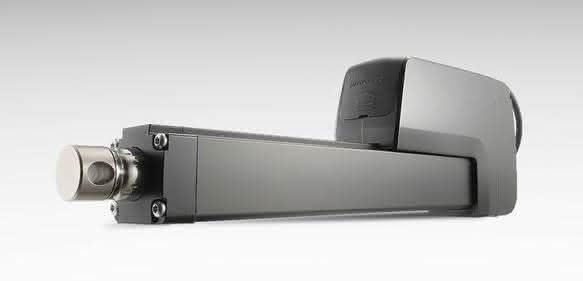
Thomson implements this synchronization by embedding the entire load coordination in a single electromechanical actuator, which is then connected in series with up to three other, similarly equipped actuators. This solution is used wherever a linear movement is required that does not require external assemblies. As soon as the actuators are installed, customers can synchronize them immediately by wiring them and actuating them by switching one of the devices. During operation, the system electronics detect any changes in speed that may indicate an unevenly distributed load and eliminate any jerking or other negative effects. By using several actuators, synchronization increases the travel speed of a system particularly efficiently. For example, a larger load that would normally require a heavy-duty actuator can be moved faster by combining several smaller actuators.
All the mechanical properties of the Electrak HD are retained during synchronization: whether it is the handling of bidirectional loads of up to ten kilonewtons with maximum strokes of 1,000 millimetres or the accuracy of one percent of the stroke from 100 to 1,000 millimetres. The high-quality ball screws installed ensure efficient power consumption and support speeds of up to 43.5 millimetres per second in the 1.7-kilonewton version, for example. pb


You might also be interested in
Plagiarius 2024 negative prize
On January 26, 2024, the Plagiarius campaign awarded its dreaded "Plagiarius" negative prize for the 48th time to manufacturers and retailers of particularly brazen counterfeits and fakes.
 read more...
Ivalua honors winners of the Generative AI...
AI-supported "add-ons" for buyers within 48 hours
Ivalua, provider of cloud-based spend management solutions, announced the winners and innovations of the first Generative AI Innovation Cup. The competition took place in December 2023. It was open to all Ivalua partners and employees - more than...
read more...Efaflex celebrates 50 years of high-speed...
The emphasis is on "fast"
Since day one, Efaflex has wanted to use new technologies as early as possible and drive progress in the industry. This year, the family business is celebrating its 50th anniversary under the motto "Fast Forward".
read more...Security of supply even during power outages
In the winter of 2022, Germany was worried about energy shortages. The drugstore retailer dm did not paint any horror scenarios, but nevertheless saw the possibility of controlled, temporary, regional power cuts (brownouts).
read more...Safety technology in mechanical engineering
Modules with new functions
Euchner's product highlights at EMO 2023 include the communication-capable solenoid interlocks.
read more...Transforming the paper industry towards climate neutrality
Together with partners from industry and research, Voith is developing a project for the optimization of energy and material flows in paper production. The aim of the research project is to develop a digital framework that enables effective process...
read more...Up to 95 percent less flue gas thanks to direct extraction
The requirements for occupational safety measures and safety technology are also constantly increasing in welding technology. The Technical Rules for Hazardous Substances (TRGS) stipulate that welding fumes and harmful substances must be extracted...
read more...Competitive advantages with large machines
Whether 3D-printed components for machines and systems, prototypes or aids for design: additive manufacturing is almost indispensable for modern companies in mechanical and plant engineering and automation if they want to play in the premier league.
read more...Transport technology from the modular system
Many transport tasks can be realized with the help of linear technology. Pre-configured solutions are available to simplify the interaction between the linear unit, motor, gearbox and controller. This minimizes the effort required for research and...
read more...