
Simulation technologies
Why you should focus more on simulation
The use of simulation has undergone rapid development in recent years. This will continue in 2020, as software will undergo decisive changes in many areas this year and have a significant impact on the industry.
As in many other industries and technologies, artificial intelligence (AI) and machine learning (ML) will play a major role in the coming year. For simulation, there is an opportunity to use AI and ML to speed up basic processes and administrative tasks in order to save time or simplify procedures. Setting parameters is one such area. A machine learning engine can observe experienced engineers using simulation tools and how they set parameters. It can then replicate this process to a certain degree of accuracy to allow less experienced engineers to use the tool more efficiently.
If only 5% of an aerospace company with hundreds or even thousands of employees currently use simulation technologies, AI and ML can make it easier for other employees to access the software. Perhaps 15 to 20 percent of the workforce could then benefit from the solutions instead of just 5 percent. This would clearly be a win for the company, as it can now invest more time and energy in the simulation process without having to hire more senior engineers.
Another area that AI and ML can assist in simulation is the use of data-driven or physically informed neural network solvers to speed up simulation by several orders of magnitude. Instead of solving second-order partial differential equations (PDEs) using traditional numerical methods such as finite element or finite volume methods, these newer AI and ML methods use neural networks to solve PDEs. It has been proven that these methods work with simple geometries and boundary conditions. Now we are working on applying these new methods to complex problems in practice.
Multiphysical interaction, microservices and hyper-scaling
The concept of multiphysics has been around for 50 years. In the course of its development, it has been confronted with many challenges. The challenge today is the interaction between the different physics tools. In the past, an engineer would use different physics simulation tools to solve a variety of design problems in a single product. Take a computer chip, for example: You would first simulate the heat given off by the chip, then analyze how it affects the circuit board it sits on, and finally come up with a solution on how to cool the chip to protect the circuit board from cracking. While the aforementioned step-by-step approach was the best option for many years, engineers today are demanding a way to solve these problems simultaneously.
This multidisciplinary optimization reduces the time needed to analyze the product, whether it is a chip or another product, and finds the right solution for each problem the engineers face. This leads to better products and lower costs.
For example, we have acquired Dynardo, a leading provider in the field of simulation process integration and design optimization. As a company, this has brought us one step closer to multiphysics interactions and enabled our customers to identify optimal product designs faster and more cost-effectively. Additional efforts will be made this year to further advance the technology.
We will also see progress in the area of "microservices for simulation". Here, the main parts of the simulation, for example geometry, then meshing, followed by solver and finally post-processing - are transformed from a monolithic process to dedicated separate parts. The steps required for the simulation are independent of each other. Instead of a single process, many services are provided, such as for geometry, meshing, solver and post-processing.
These services can then be used by different products that communicate with each other via APIs (Application Programming Interfaces) and can be executed in a scalable manner on cloud computing platforms such as Microsoft Azure or AWS. The result is better accessibility, more flexibility and better reusability to solve many different tasks. With the help of APIs, simulation users can, for example, connect Ansys tools with other companies' systems to create a truly open platform.
One of the biggest challenges for users of many types of software is the runtime. They are increasingly demanding faster runtimes. Simulation is no exception here. In 2020, we will see that the focus on this will increase significantly.
One way to improve runtime is through parallel computing. Over time, parallel computing has taken many different forms. For example, it has evolved from shared memory processing (SMP) to message passing interface (MPI) to fine-grained GPU-based parallelism and task-based parallelism. The idea for Hyper Scale is that we use all forms of algorithms on supercomputers. If customers can run Hyper Scale simulations, it means that they are likely to be able to run simulations in minutes or hours that might previously have taken 10,000 hours.
There is still a lot to do in this area. 2020 will be too early to see hyper-scaling on the scale I have described, but we can definitely expect it within the next decade.
In an effort to achieve efficiency and cost savings, many manufacturers and service providers have eliminated over-engineering and instead focused on minimalist design. Where 10 centimeters of asphalt are needed for a highway, exactly 10 centimeters are used, not 20 centimeters as was common in the past - "just in case". The problem is that deviations occur with all materials. This means that the calculation of the required asphalt volume can vary from project to project. Therefore, 10 centimetres of asphalt would be sufficient in one case, but not in another.
Forward-looking and robust design
Robust design through simulation addresses such uncertainties and will be increasingly used this year. Using simulation to evaluate materials and calculate uncertainty prevents both over- and under-development of products and services. While a safety factor of 500 centimeters percent would be too high and therefore inefficient, 100 percent leaves no room for material variations. Based on different information, the safety factor for robust design would be 110 percent, for example.
The key to understanding material variables and then being able to calculate the ideal safety factor is material intelligence. This was the reason for Ansys to purchase Granta Design. Granta extends Ansys' capabilities in this area, enabling users of our simulation tools to quantify, validate and verify their products and services in the presence of uncertainty and ensure the optimum safety factor.
Digitization of the physical world
Simulation is already digital, right? Yes, but simulation also increasingly encompasses the physical world. Thanks to the Internet of Things (IoT), the use of digital twins has increased recently and will continue to do so in the future. Engineers digitize information from a physical part so that they can analyze its performance and monitor systems. This allows them to avoid problems with the real component or machine before they even occur. Now that the technology has become established and proven to minimize downtime and the associated costs, digital twins will increasingly find their way into companies.
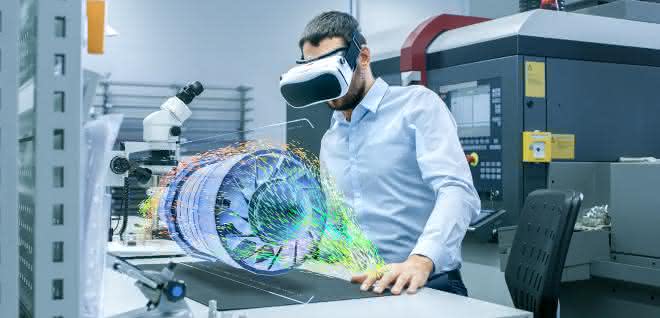
Augmented (AR) and virtual reality (VR) must also be taken into account. Engineers currently visualize their simulated designs on 2D screens. However, as VR and AR technologies become faster and more accessible, designs can soon be visualized in a 3D environment on an AR or VR headset, as shown in the Oculus portfolio. The data can then be analyzed more easily and the designs are easier to understand, edit and test. This leads to a leaner and more effective process.
Design, testing, maintenance - simulation plays a crucial role in these processes. But what happens if a product or part fails? How can simulation help? By digitally mapping their processes, manufacturers can coordinate all their activities from initial design to production to sales and track every part. So if a problem occurs with the brakes on a particular vehicle model, this can be traced back to the original simulation design. This design is then reviewed to quickly identify the fault. If the model is then recalled, the problem can be fixed faster and more cost-effectively than through a manual testing process. Digital transformation is a big task for most companies, but many are already tackling it. I expect the transformation to accelerate this year and that large manufacturers will be able to complete the change before the end of the year.
New areas of application through simulation
Simulation is well established in a number of areas with real multi-physical conditions. This year, simulation software providers will push the boundaries of the technology to solve problems in more areas of physics. Healthcare chemistry is currently an area that is not yet sufficiently covered by multiphysics simulation, but would benefit significantly from it.
What could this look like in practice? Clinical trials for new drugs require tests on humans, but one day the trials could be replaced by simulations. The need to test the drug on thousands of test subjects would then be eliminated, as would the enormous costs of the studies. And where studies cannot be carried out, for example on children, the potential uses for simulation are enormous. Even in healthcare, where a blood clot can lead to a heart attack, simulation could be used to identify the right drugs to dilute the blood and dissolve the clot.
Focus on innovation protects against external disruption
Today's technology makes it possible for products and tools that previously took years to develop to be manufactured overnight. For example, a new start-up could develop a completely new way to accomplish a task or solve a problem, disrupting existing processes. Many forgotten companies have failed to prepare for such a situation. But instead of ignoring the remote possibility of this happening, companies need to address the risks directly by innovating. True to the motto: "Don't wait to be disrupted - disrupt yourself!" The iPhone is an excellent practical example of this. Apple replaced its own products with even more advanced products. Simulation is no different. We strive to improve our own simulation with new technologies and thus minimize the chance that someone will catch up with us.
Prith Banerjee, Chief Technology Officer at Ansys / ag


You might also be interested in
ESTIA aims to strengthen Europe's cloud
New tech alliance for EU sovereignty
Twelve companies, including Dassault Systèmes, are founding the European Sovereign Tech Industry Alliance (ESTIA). The initiative aims to strengthen Europe's technological independence and define requirements for sovereign cloud services. The start...
 read more...
Deutsche Telekom and Nvidia launch one of Europe's largest AI factories
With the Industrial AI Cloud in Munich, Deutsche Telekom and NVIDIA are creating one of the largest AI factories in Europe. Companies can train AI models, carry out simulations and access 10,000 GPUs.
read more...Leveraging data potential with AI and streaming
Huge data treasures are still lying dormant in many manufacturing companies. And yet it is high time that these treasures were unlocked. There is often a lack of resources and capacity to make data usable in real time. Streaming production data can...
read more...More awareness of noise
Dematic offers solutions that are tailored to different cloud environments and reduce environmental impact through reduced material consumption and improved energy efficiency.
read more...Generative AI in the automation environment
The mechanical engineering and automation industry is undergoing profound change. This transformation is being driven by more volatile global trade, geopolitical crises and increasing market pressure, which demands greater agility, technological...
read more...Rigid data structures have had their day
The traditional data center is no longer the center of data. A hybrid cloud storage approach enables manufacturing companies to both meet the current requirements of data-intensive processes and future-proof their infrastructure.
read more...Software as a service in three stages
CIM Database Cloud is a new out-of-the-box solution from Contact for end-to-end digital product development.
read more...How production can benefit from AI
Together with AI technology, IIoT networking makes it possible to better control machine parameters and optimize quality with predictive quality. Downtimes and set-up times can also be further minimized. Cloud platforms also make these technologies...
read more...More expertise for digital engineering
Altair, a computational science and artificial intelligence (AI) company, has acquired OmniV, a technology from Michigan, USA-based software company XLDyn.
read more...