
Inside the Smart Factory - Part 3
The nerve pathways of the Smart Factory
Digitalization is the dominant topic in the manufacturing industry. At the same time, there is a great deal of uncertainty due to different definitions of terms and unclear demarcations. The "Inside the Smart Factory" series of articles clarifies misunderstandings and obstacles on the path to the digital factory. In the third installment: driverless transport systems.

A few months ago, the Chinese retail group JD announced the opening of its first fully automated warehouse on the outskirts of Shanghai. Where previously 180 people were employed, robots and machines now process around 9,000 orders per hour. The secret stars in the accompanying video clip are the several hundred small transport robots that independently transfer parcels from the packaging lines to the designated shipping containers. They are emblematic of the automation of warehouse logistics and mark one of the most important technology trends around the smart factory at the moment.
But is it even possible to talk about a trend when the technology behind it has been in use in industry for over 50 years? In the case of Automated Guided Vehicles (AGV) - or driverless transport systems (AGVs) - you have to. After all, hardly any other technology in the Industry 4.0 environment is experiencing similar demand, as the example of Mobile Industrial Robots shows. The manufacturer of collaborative, mobile robots more than doubled its turnover in 2018 for the second year in a row. Other manufacturers are recording similar increases in orders. One man's joy is another man's sorrow - companies that want to expand their intralogistics with similar systems often have to put up with long delivery times at the moment.
The right transport system for every application
There are various reasons for the enormous increase in demand for driverless transport systems: On the one hand, the cost of purchasing and operating AGVs has fallen noticeably in recent years, which is due to both the technical development of the systems and the large number of new providers, such as the US manufacturer Kiva Systems, which is now part of Amazon. On the other hand, the greater availability of computing power in the vehicles themselves (edge computing) has meant that the systems are becoming increasingly powerful and flexible to use in the production environment. And finally, the discussion about the smart factory itself has also fueled interest in AGVs at decision-maker level. For many companies, AGVs are seen as the ideal entry point into Industry 4.0, as they allow immediate productivity gains to be realized with relatively little implementation effort. In other words: driverless transport systems as a plug-and-play element for the smart factory. But is this assumption even true?
Automated guided vehicles differ fundamentally in terms of size, performance and range of functions. Small parts, for example, are typically transported in small load carriers. Large parts can either be transported in large load carriers or as individual parts on special containers. In addition to the pure transportation of loads, AGVs can also be used for lifting, stacking and storage in racks. Modern AGVs are generally electrically powered, whereby battery technology has made considerable progress in recent years and enables operating times of up to one shift.
Navigation using environmental features
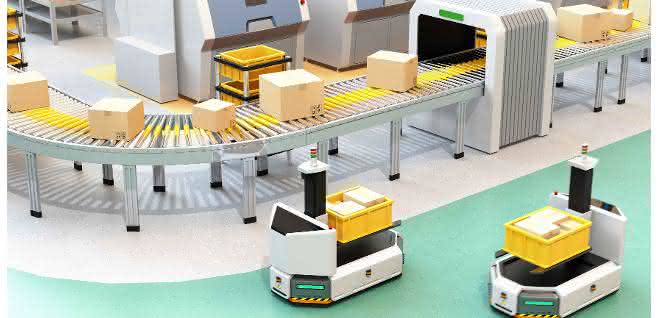
However, the greatest technological developments in recent years have been in the field of navigation. This is also one of the most sensitive and important areas for the operation of automated guided vehicles. This is because they can only be used successfully in intralogistics and order picking if the conveyors are able to orientate themselves safely in space and recognize the pick-up and delivery points. Various systems have emerged here in recent years:
Optical, magnetic or inductive guidelines in the floor area:
For a long time, previously available AGVs relied on optical, magnetic or inductive guidelines that were embedded in or glued to the hall floor. Due to the comparatively high installation costs and the very limited flexibility, this technology is virtually no longer used in newer generations of AGVs.
Transponders and magnets for grid navigation:
With grid navigation, the vehicles orient themselves using reflectors, magnets or other reference points that form a grid over the storage or production area. By attaching new reflectors, new routes and changes to the layout can be taken into account relatively quickly and easily.
Laser navigation:
The most commonly used method today is laser navigation, or more precisely laser triangulation. Reflectors on the hall walls and columns can be used to determine the position in the area. Travel paths are adapted and extended exclusively via the corresponding control software.
Navigation using environmental features:
The latest generation of autonomous AGVs (aAGV) uses integrated laser scanners or GPS systems to create a complete 3D image of the hall plan and is therefore able to orient itself independently in space. Instead of moving exclusively along predefined routes, aAGVs search for their own route to get from A to B.
The central prerequisite for this type of "free navigation in space" is a high computing capacity in the device, which enables it to process the data collected by sensors in real time and plan its route accordingly. This optimized navigation enables a much more flexible use of AGVs beyond predefined routes and thus creates the basis for a decentralized or self-organized system of replenishment control.
From central control to decentralized intelligence
Such a system not only allows the AGVs to orient themselves independently in space, but also to intelligently coordinate the allocation and assignment of transport orders in the swarm. At present, this order allocation usually works via a central control station, which distributes the transport orders to the available AGVs in a similar way to a cab control center. Powerful algorithms or software agents ensure that the orders are assigned to the available vehicles that are closest to the object to be transported. Modern systems not only include the next order in the calculation, but also - similar to a good chess computer - other pending orders. Various system settings are possible, depending on whether the focus is on even utilization of the AGVs or a specific maximum duration for the individual transport process. Due to this predictive calculation logic, centralized systems are currently still superior to decentralized order control. This is because in order to apply the same calculation logic to swarm-intelligent systems, the computing capacity in the individual vehicles would have to be considerably higher. In the long term, however, it can be expected that decentralized systems will prevail, as they are superior to centralized systems, particularly in terms of scalability and reliability.
Autonomous replenishment control
The productivity benefits of driverless transport systems compared to conventional forms of warehouse logistics are obvious. This applies both to the degree of utilization of the individual vehicles and to occupational safety. The Continental plant in Regensburg, which received the "Industry 4.0 Award" from ROI in 2015, shows what such a system can look like in practice. There, a completely automated replenishment process was implemented at KLT level, in which the machine independently requests the materials required for the respective order from the warehouse. These are then transported to the production line without human intervention using AGVs.
Keeping an eye on the overall business result
However, in order to implement a comparable solution, the appropriate framework conditions must first be created. Companies often underestimate the effort and costs involved in introducing driverless transport systems. This is because the vehicles themselves are only one part of the overall business calculation. In order to be able to integrate them sensibly into your own logistics processes, an IT connection is just as essential as the adaptation of the relevant material flow interfaces, for example transfer points. The rule of thumb is therefore: vehicle costs multiplied by two equals the total implementation costs.
If mistakes are made in this phase, AGVs often turn from a quick efficiency booster into a technical gimmick. Because in the factory of the future, the flow of goods and the flow of information can no longer be separated. In this sense, driverless transport vehicles must also be part of the information flow in the factory. Only then will they become the nerve pathways of the smart factory.
Prof. Dr.-Ing. Werner Bick, Chief Representative of ROI Management Consulting AG and Professor at OTH Regensburg / ag


You might also be interested in
Plagiarius 2024 negative prize
On January 26, 2024, the Plagiarius campaign awarded its dreaded "Plagiarius" negative prize for the 48th time to manufacturers and retailers of particularly brazen counterfeits and fakes.
 read more...
Ivalua honors winners of the Generative AI...
AI-supported "add-ons" for buyers within 48 hours
Ivalua, provider of cloud-based spend management solutions, announced the winners and innovations of the first Generative AI Innovation Cup. The competition took place in December 2023. It was open to all Ivalua partners and employees - more than...
read more...Efaflex celebrates 50 years of high-speed...
The emphasis is on "fast"
Since day one, Efaflex has wanted to use new technologies as early as possible and drive progress in the industry. This year, the family business is celebrating its 50th anniversary under the motto "Fast Forward".
read more...Security of supply even during power outages
In the winter of 2022, Germany was worried about energy shortages. The drugstore retailer dm did not paint any horror scenarios, but nevertheless saw the possibility of controlled, temporary, regional power cuts (brownouts).
read more...Safety technology in mechanical engineering
Modules with new functions
Euchner's product highlights at EMO 2023 include the communication-capable solenoid interlocks.
read more...Transforming the paper industry towards climate neutrality
Together with partners from industry and research, Voith is developing a project for the optimization of energy and material flows in paper production. The aim of the research project is to develop a digital framework that enables effective process...
read more...Up to 95 percent less flue gas thanks to direct extraction
The requirements for occupational safety measures and safety technology are also constantly increasing in welding technology. The Technical Rules for Hazardous Substances (TRGS) stipulate that welding fumes and harmful substances must be extracted...
read more...Competitive advantages with large machines
Whether 3D-printed components for machines and systems, prototypes or aids for design: additive manufacturing is almost indispensable for modern companies in mechanical and plant engineering and automation if they want to play in the premier league.
read more...Transport technology from the modular system
Many transport tasks can be realized with the help of linear technology. Pre-configured solutions are available to simplify the interaction between the linear unit, motor, gearbox and controller. This minimizes the effort required for research and...
read more...