
System diagnostics
The secret power of Industry 4.0
Production processes and capacity utilization are constantly being improved. Individual customer requirements are implemented more efficiently. Production costs and personnel costs are reduced.
Maintenance, inspections and system improvements are planned and carried out in an optimized manner. New business models and new customer groups are developed more quickly. Customers, partners and suppliers are directly involved in business and value creation processes.
These goals for future production form the basis of Industry 4.0. A closer look at the details reveals that this involves networking system components, digitalizing process chains and determining and analysing large volumes of data. It is therefore to be expected that the number of system components and their functionalities will increase significantly. In addition, the networking of distributed components will increase. And finally, it is not only the industrial plants themselves, but also their connections to upstream or downstream technical systems that will lead to increasing complexity.
This increase in complexity has an impact on system behavior and requires additional tasks in system development. For example, new, more efficient strategies for maintenance, inspection and servicing need to be developed. New or extended functionalities for software, data and variant management are necessary. The existing safety and protective measures must be checked and adapted. The solutions to these tasks lie in an area that has received little attention to date - that of system diagnostics.
System diagnostics is the secret power and the decisive driver for the successful implementation of Industry 4.0. In contrast to its reputation a few years ago, it is often ignored, ridiculed, forgotten or not recognized today. It is not as "sexy" as autonomous driving, parking apps, AI, big data, IoT or digital twins. In order to bring system diagnostics back into the deserved spotlight, we venture the following thesis: "In the background of Industry 4.0, technical system diagnostics makes innovations possible in the first place."
The history of system diagnostics in the automotive industry
Since the turn of the millennium, the number of functions in vehicle development has been steadily increasing, as has the number of subcomponents involved and their interconnectedness.
This has led to two developments: Firstly, the number of potential errors is increasing. Not only with the number of functions, but also with the degree of their networking, as additional sources of error lurk here. Secondly, errors in sub-components in these increasingly complex overall systems - often insidiously and unnoticed - continue across several functions. The actual cause can often no longer be directly identified via error memory entries.
As a result, the time and effort required for troubleshooting has increased significantly. To counteract this, some automotive manufacturers standardized diagnostic objects, diagnostic communication and diagnostic descriptions for their control units and their subsystems as early as 2005. At the same time, the diagnostic functionalities were expanded. The digitalization of system diagnostics was born, and it was possible to counteract the increasing analysis effort caused by the increase in complexity.
What is technical system diagnostics?
The basic idea behind system diagnostics was developed to support fault analyses of technical systems. In the event of a fault, a technical system provided simple fault codes or measured values that were analyzed by a mechanic with the help of an external system. This established the opinion that "system diagnostics is troubleshooting". This view persists to this day. However, system diagnostics has changed significantly over the last 20 years and now covers numerous tasks across the entire product development process.
Today, experts define the term system diagnostics in a correspondingly comprehensive manner: "System diagnostics is the science and art of recording, adjusting and describing the states of systems in a structured manner. This includes all methods, algorithms, data formats, processes, procedures and tools whose aim is the development, manufacture, repair and maintenance of an electronic component.
The application of system diagnostics includes conceptualizing, specifying, developing, testing and producing as well as functioning, updating, repairing and maintaining the system."
Generally speaking, technical system diagnostics today therefore includes all functionalities that a technical system does not perform in its actual function.
Objectives of technical system diagnostics
The central questions of system diagnostics are:
- How can commissioning and update times be reduced?
- How can errors in the system be avoided?
- How can system reliability be increased?
- How can ease of operation and maintenance be increased?
- How can maintenance and servicing costs be reduced?
- How can customer service and support be simplified and accelerated?
- How can customer satisfaction be increased?
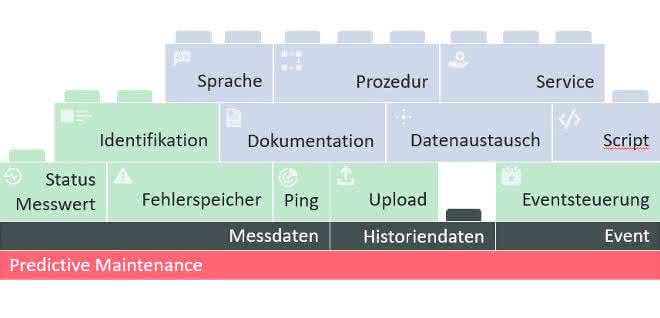
All developments in the field of system diagnostics aim to answer these fundamental questions. One example of this is "predictive diagnostics". It is a powerful maintenance strategy in terms of achieving the objectives of system diagnostics. It avoids errors in the system, increases system reliability, maintenance costs and downtimes are reduced. Customer satisfaction is increased. The increased effort required to analyze and develop predictive diagnostics quickly pays off.
Tasks of system diagnostics
The areas of application of system diagnostics can be found throughout the entire life cycle of a technical system. System diagnostics plays a major role in the product development phase, especially when testing and updating systems.
In the product manufacturing phase, the most important use cases are data supply, version management and commissioning. In special cases, troubleshooting, device settings and product quality assurance are carried out using system diagnostic methods.
In the subsequent sales and distribution phase, system diagnostics are primarily used to transport the product and activate special customer functions.
In the application phase, monitoring functions are now often activated to record data for special analyses, which can then be used for future developments.
In the customer service phase, the main tasks of system diagnostics are repair, inspection, maintenance, function updates and subsequent technical and functional enhancements. Data, software, function and variant management also play a major role, as well as translating information into specific languages, resetting to factory settings and system calibration. Not forgetting the safety and security tasks. In the final phase of recycling, diagnostic methods are also used in individual cases.
The complexity of technical systems with their internal networks and connections to upstream and downstream systems will continue to increase significantly. This is accompanied by a constantly growing number of tasks and data that can only be managed with intelligent methods, algorithms and tools.
The development of system diagnostics in vehicle technology over the last two decades has been geared towards enabling technical innovations over the entire life cycle in the first place. The learning experience here was that the focus on functions that can be experienced by the customer is not enough.
If the industry transfers the developed, tested and established functionalities to its technically highly complex systems, it can be expected to master the revolution to 4.0 and achieve success - especially economic success - quickly.
Heino Brose, Managing Director Synostik


You might also be interested in
From risk to resilience
NIS2 significantly increases the requirements for industrial security concepts. In addition to cyber resilience, physical access protection is becoming increasingly important.
 read more...
Security Operations Center module
When cyber attacks reach production
Adlon is further developing its Security Operations Center and adding another module to the existing Managed SOC for Microsoft 365 environments (based on Managed XDR): Managed SOC Advanced.
read more...Lifecycle management and safe IO-Link communication
At SPS, Pilz will be presenting solutions that combine safety and security in production. The focus is on the digital Myzel Lifecycle Platform, a SaaS offering for the management of machinery and personnel over the entire lifecycle.
read more...The basics of warehouse safety
Safety in the warehouse primarily relates to the employees. However, goods must also be transported safely and transport equipment must not be damaged.
read more...Environmental containers and fire protection
Companies can choose from a wide range of environmental containers for storing chemicals and other hazardous substances.
read more...Secure focus on access
To ensure comprehensive safety, holistic safety concepts for safety and industrial security on machines are required. Authorizations and access must be clearly regulated.
read more...Added value through safety and productivity
Machine malfunctions can have serious consequences and put people's health at risk. Functional safety therefore plays a central role in industry. With control and inverter technology including integrated safety functions from ABB, plant operators...
read more...Protect Ethernet interfaces
Pilz is expanding its portfolio of operating and signaling devices with the control element PIT oe ETH. It is equipped with an Ethernet port that can be activated and protects freely accessible Ethernet interfaces in industry against unauthorized...
read more...Protective tool in everyday life
Cybershield is a company founded in 2021 with a focus on operational technologies and has set itself the goal of significantly advancing IT security in the OT sector and supporting customers.
read more...