
OMS - Object Management System
Smart bridge between production and office
Information is one of the most important economic factors and plays a central role in the implementation of Industry 4.0. Every machine, every object, every production hall can become a digital source of information as a real object. With the help of IoT and an object management system, the real and virtual worlds can also be linked more efficiently in the manufacturing industry.

According to a survey conducted by the industry association Bitkom in 2016, 69% of industrial companies surveyed invested in new technologies to digitalize their business processes. Their motivation: to reduce costs, increase efficiency and boost productivity. They should also look beyond the production halls and into the company's offices. After all, the digital workplace is becoming increasingly important as a central information and work platform and involves more than just the ability to check emails on the go using a smartphone. Rather, it is about setting up an information management system that is designed to provide information independently of structured sources such as documents. A system is therefore needed that overcomes the boundaries between the real and virtual worlds and enables overarching communication via the Internet of Things, or IoT for short. Linking the two worlds is possible with an object management system (OMS) by virtually defining and managing any number or complexity of real objects and thus using them as digital information sources.
Physical objects become smart
An OMS is a fully autonomous but connectable system that can be easily integrated into the company's existing IT infrastructure. The actual bridge between the real and virtual worlds is built by first equipping physical objects with a sensor. These small components form the basis of networking, as they can basically be built into any object in any form, making it smart in the process. Communication and interaction between physical and virtual objects can then take place via long-range technology, which is particularly suitable and energy-efficient for small amounts of data, as well as via Wi-Fi or other internet protocol connections.
The data measured by the sensors is both factual information about the properties of the physical object - a cup, for example, is a cylindrical, hollow object with a handle - but also about its functions and behavior. A cup can therefore also be described as a fillable vessel for combustion-free drinking. The collected data is forwarded to a data center. The OMS then reads the key information from this and defines the physical object as a virtual object. In a final step, it can be connected to a variety of document and process-processing systems, such as ERP or CRM software, via open APIs.
Linking with documents and processes
For example, as a basic option, you can define a production hall as a virtual object and link it to specific information, for example in the form of documents. Everything you need to know about the property is stored in the OMS. This can be properties such as the address and number of square meters, but also information about the actual intended use, for example that the hall is not empty, but - as rental contracts, invoices for machines and written safety measures show - is actively used for the production of automotive parts.
One step further is to link the object to specific processes within the company: a 3D printer in the production hall is equipped with a sensor that transmits the following message to the OMS: "Cartridge of printer with ID 123 is empty". The system recognizes the printer as a defined, virtual object and is in turn connected to a case management system or another process-processing solution of the company, so that flexible process processing is started in the back office. Connected to the ERP solution used in the company, the printer can, for example, independently pass on the information "My cartridge is empty" and the responsible employee receives the order to order and insert a new one.
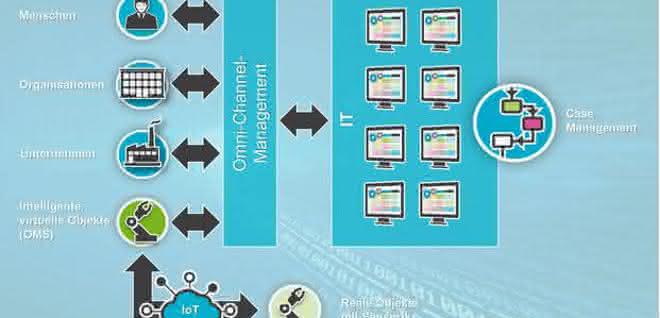
In the long term, M2M technology can also be connected to an OMS. The 3D printer can then independently contact the supplier to place an order. The central point remains that an OMS enables semantic context analysis in order to increase knowledge about the object. In other words, the artificial intelligence of the system ensures that certain behavior can be read out. For example, the collected data reveals that more is printed in the winter months than in the summer, meaning that more material is required for period X. The context analysis of the OMS can thus generate economically useful knowledge and the connected processes can be adapted to the behavior of the intelligent object.
Simple integration into existing IT structures
As a separate software component, an OMS can be easily connected to the existing IT infrastructure via Open APIs and ensures that requests from objects are responded to more quickly. Because - and this is the important aspect - objects should be as intelligent as employees and send their requests to the company independently. Integration into existing processes is also made easier by the fact that an OMS can be used in the form of a website, a portal or an app. It is also important to be able to adapt it flexibly to the respective needs and requirements of the users.
The ability to communicate and interact between users and systems via new interfaces significantly increases the exchange of data and information. When it comes to security, however, the responsibility does not lie solely with the company, but also with software, cloud and other providers. At developer level, attention is paid to compliance with specific security measures in accordance with the "Security by Design" and "Privacy by Design" methods. In addition, access is restricted by means of identity access management: each defined object can only be viewed by authorized employees, who must identify themselves accordingly using access data, for example.
Objective: To make everyday working life easier
In April 2017, Bitkom published that German industry will invest EUR 5.9 billion in hardware, software and IT services in that year - 21% more than in 2016. This is a welcome development that will further strengthen connectivity and the general exchange of information. In private life, audio devices and cars have long been connected to smartphones. However, the IoT also offers industrial companies exciting opportunities for data transfer, monitoring and, consequently, communication between objects and people, as well as with each other. With an object management system, they are establishing a solution that turns physical objects into digital sources of information. The aim is to make employees' day-to-day work easier, control and link processes more efficiently and use information profitably.
Math Huntjens, Manager Technology at BCT Germany


You might also be interested in
ESTIA aims to strengthen Europe's cloud
New tech alliance for EU sovereignty
Twelve companies, including Dassault Systèmes, are founding the European Sovereign Tech Industry Alliance (ESTIA). The initiative aims to strengthen Europe's technological independence and define requirements for sovereign cloud services. The start...
 read more...
Deutsche Telekom and Nvidia launch one of Europe's largest AI factories
With the Industrial AI Cloud in Munich, Deutsche Telekom and NVIDIA are creating one of the largest AI factories in Europe. Companies can train AI models, carry out simulations and access 10,000 GPUs.
read more...Leveraging data potential with AI and streaming
Huge data treasures are still lying dormant in many manufacturing companies. And yet it is high time that these treasures were unlocked. There is often a lack of resources and capacity to make data usable in real time. Streaming production data can...
read more...More awareness of noise
Dematic offers solutions that are tailored to different cloud environments and reduce environmental impact through reduced material consumption and improved energy efficiency.
read more...Generative AI in the automation environment
The mechanical engineering and automation industry is undergoing profound change. This transformation is being driven by more volatile global trade, geopolitical crises and increasing market pressure, which demands greater agility, technological...
read more...Rigid data structures have had their day
The traditional data center is no longer the center of data. A hybrid cloud storage approach enables manufacturing companies to both meet the current requirements of data-intensive processes and future-proof their infrastructure.
read more...Software as a service in three stages
CIM Database Cloud is a new out-of-the-box solution from Contact for end-to-end digital product development.
read more...How production can benefit from AI
Together with AI technology, IIoT networking makes it possible to better control machine parameters and optimize quality with predictive quality. Downtimes and set-up times can also be further minimized. Cloud platforms also make these technologies...
read more...More expertise for digital engineering
Altair, a computational science and artificial intelligence (AI) company, has acquired OmniV, a technology from Michigan, USA-based software company XLDyn.
read more...