
Industrial communication
Private standalone 5G network in an industrial environment
Siemens and Qualcomm Technologies have implemented the first stand-alone private 5G network in a real industrial environment using the 3.7 to 3.8 GHz frequency band. Siemens is providing the real industrial test conditions and end devices such as Simatic controllers and IO devices, and Qualcomm is supplying the 5G test network and the associated test devices.
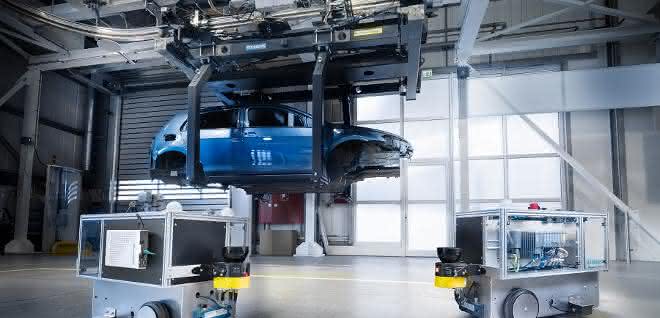
The 5G network was installed in Siemens' automotive showroom and test center in Nuremberg. Driverless transport systems (AGV), which are primarily used in the automotive industry, are on display here. New production options and methods are co-developed, tested and presented before they are implemented at the customer's premises. This gives Siemens customers, such as AGV manufacturers, the opportunity to experience the interaction of the products live.
In the automotive showroom and test center, Siemens and Qualcomm can test the various technologies in an independent 5G network under real conditions and develop solutions for future applications in the industrial environment. Siemens is providing the complete real industrial setup, including Simatic controllers and IO devices.
"Industrial 5G opens the door to comprehensive wireless networking of production, maintenance and logistics. High data rates, ultra-reliable transmission and ultra-short latency times will enable a significant increase in efficiency and flexibility in industrial value creation," says Eckard Eberle, CEO of the Siemens Process Automation Business Unit. "We are therefore very pleased about the cooperation with Qualcomm Technologies, which will enable us to drive the development and technical realization of private 5G networks in industry. Our decades of experience in industrial communication and our industry expertise combined with the know-how of Qualcomm Technologies pave the way for the wireless networking of the factory of the future."
"This project provides us with important real-world insights that both companies can use in future applications and is an important milestone on the journey of 5G technology into industrial automation," said Enrico Salvatori, Senior Vice President & President, Qualcomm Europe/MEA. "The combination of our 5G networking capabilities and Siemens' deep industry expertise will help us deploy the technologies, enhance solutions and work to make the smart industrial future a reality."
In Germany, the Federal Network Agency has reserved a total of 100 MHz of bandwidth in the frequency range between 3.7 GHz and 3.8 GHz for local use in industrial environments. This gives companies in Germany the opportunity to rent spectrum for an annual fee and use it exclusively within their own premises in a private 5G network and to ensure optimum data protection. On this basis, industrial protocols such as OPC UA and Profinet are also evaluated and tested in the Siemens Automotive Showroom and Test Center in combination with wireless communication via 5G.
The two companies have been working together for many years with a focus on technological cooperation in the field of wireless communication technologies. Among other things, this has led to the development of the Siemens Scalance portfolio for industrial wireless communication. With Qualcomm's expertise in 5G technology, this collaboration continues to evolve seamlessly, leading to the first private standalone 5G network under industrial conditions. Solutions are being tested and developed here that will be usable for industry with the future release 16 of the 5G standard.


You might also be interested in
Plagiarius 2024 negative prize
On January 26, 2024, the Plagiarius campaign awarded its dreaded "Plagiarius" negative prize for the 48th time to manufacturers and retailers of particularly brazen counterfeits and fakes.
 read more...
Ivalua honors winners of the Generative AI...
AI-supported "add-ons" for buyers within 48 hours
Ivalua, provider of cloud-based spend management solutions, announced the winners and innovations of the first Generative AI Innovation Cup. The competition took place in December 2023. It was open to all Ivalua partners and employees - more than...
read more...Efaflex celebrates 50 years of high-speed...
The emphasis is on "fast"
Since day one, Efaflex has wanted to use new technologies as early as possible and drive progress in the industry. This year, the family business is celebrating its 50th anniversary under the motto "Fast Forward".
read more...Security of supply even during power outages
In the winter of 2022, Germany was worried about energy shortages. The drugstore retailer dm did not paint any horror scenarios, but nevertheless saw the possibility of controlled, temporary, regional power cuts (brownouts).
read more...Safety technology in mechanical engineering
Modules with new functions
Euchner's product highlights at EMO 2023 include the communication-capable solenoid interlocks.
read more...Transforming the paper industry towards climate neutrality
Together with partners from industry and research, Voith is developing a project for the optimization of energy and material flows in paper production. The aim of the research project is to develop a digital framework that enables effective process...
read more...Up to 95 percent less flue gas thanks to direct extraction
The requirements for occupational safety measures and safety technology are also constantly increasing in welding technology. The Technical Rules for Hazardous Substances (TRGS) stipulate that welding fumes and harmful substances must be extracted...
read more...Competitive advantages with large machines
Whether 3D-printed components for machines and systems, prototypes or aids for design: additive manufacturing is almost indispensable for modern companies in mechanical and plant engineering and automation if they want to play in the premier league.
read more...Transport technology from the modular system
Many transport tasks can be realized with the help of linear technology. Pre-configured solutions are available to simplify the interaction between the linear unit, motor, gearbox and controller. This minimizes the effort required for research and...
read more...