
Modern communication culture
Setting and achieving goals
Objectives and Key Results, or OKR for short, is a management system for employee management and serves as a framework for setting objectives and measuring key performance indicators. OKRs can be used to motivate employees and establish a modern communication culture within the company. Because only those who set themselves goals can achieve them.

How committed are employees to their company? A decisive factor here is the interplay of awareness and responsibility for one's own goals. What sounds banal at first, however, goes unnoticed in many companies: Most employees, from workers to IT managers, are exposed to a constant flood of tasks that are difficult to keep track of and prioritize sensibly, not least thanks to modern communication tools.
Employees often lack two crucial pieces of information for focused and therefore motivating work:
1. what goal am I pursuing with my current task?
2. what progress is achieved as a result?
One way of tackling this problem is to create constant transparency on precisely these issues. This can be done with the help of generally visible dashboards on which so-called OKRs are defined: Objectives and Key Results.
The term OKR refers to an agile management method whose core idea is to leverage the potential hidden behind employees' attitudes towards their work: if employees are informed about current goals and the path to achieving them, this makes every step they take more meaningful. This is also due to the fact that jointly defined goals are accompanied by a focus that is absolutely necessary in the face of the constant flood of tasks.
The so-called objective is a qualitative goal that an entire company or department defines for itself. This could be, for example, an increase in performance in a specific area of activity. The purpose of the objective must be recognizable to all those involved, but it should not be directly measurable.
The key results, three of which are assigned to each objective, are concrete and measurable. They define measurable criteria for achieving the objective, for example growth, turnover, participation or performance.
Motivate and create trust
The image shows how an OKR dashboard works schematically: Objectives are briefly formulated and the corresponding key results are listed. The current progress is documented for each key result, which is aggregated at the top to form overall progress.
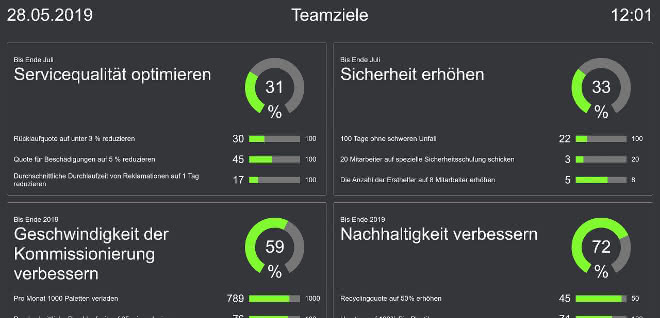
Objectives must be defined for a fixed time frame so that they are included as a clear goal - as can be seen in the example, the deadlines can also vary from one another. The associated key results should be ambitious but achievable so as not to demotivate employees. The theory says that key results should be achieved at an appropriate level at the end of the period at a rate of around 60-80 percent in order to achieve maximum motivation.
Once a team has set an OKR, key results must be reflected on in regular feedback meetings: The team members analyze together where they stand in relation to their goals, what actual progress or lack of progress can be attributed to and what they need to adjust if necessary. Involving all employees in strategic tasks in this way sends a message of appreciation and trust to the workforce, which acts as a further motivating factor.
This combination of defined goals and self-organized interactions is what makes OKRs so agile and therefore a key strength.
OKRs can also fail due to certain errors. Therefore, avoid too many OKRs that are broken down too finely. This quickly leads to old problems of too many and too unimportant tasks recurring and the necessary focus being lost. Furthermore, no specific instructions for action should be included in the key results. As a result, the method loses its character, which helps employees to take more personal responsibility and motivation, and your OKR quickly becomes an old-fashioned to-do list again.
Also avoid tying payment to OKRs. The actual goal, namely to develop a sense of purpose, progress and success in one's own work, is lost. Instead, the aim must be to establish OKRs in such a way that there is such a strong commitment among employees that an increase in performance occurs, which may give employees enough reason to guarantee a salary increase in the medium or long term.
Modern communication culture
The decisive aspect for successful OKRs is the clear communication of goals and the public tracking of progress. This also includes ensuring that all data sources that map progress are connected live on the respective boards.
This brings progress into the public eye and gives employees a sense of the effectiveness of their own work. This gives all those involved an opportunity and a basis for discussion, both informally about company goals and to make a meaningful contribution in the respective feedback meetings.
Patrick Theobald, CTO and founder of Peakboard / ag


You might also be interested in
Alternative to optical positioning methods
Solutions for workplace and intralogistics systems
With the SensorBoard for detecting the position and orientation of components, RK Rose+Krieger is integrating a technology commonly used in television studios into its modular system for customized system solutions.
 read more...
Schubert System Elektronik at the embedded...
Industrial computer technology "Made in Germany"
This year, Schubert System Elektronik (SSE) will once again be exhibiting at embedded world in Nuremberg. From March 14 to 16, 2023, SSE will be presenting innovative, industrial computer technology "Made in Germany" for various sectors and...
read more...The tiger among processors
Since the move towards the Industrial Internet of Things (IIoT) and Industry 4.0 has picked up speed, processor boards and modules must be able to process exponentially growing amounts of data.
read more...IFR publishes "World Robotics R&D Programs"
Countries around the world are investing in robotics to promote the further development of the technology for industrial and social applications. But what are the current goals of the official funding programs in Asia, Europe and America? The...
read more...App ensures safety during maintenance
The "5i.Maintenance" application improves transparency and occupational safety during machine maintenance.
read more...Compact computer for industry
As a versatile and compact computer, the Raspberry Pi is also interesting for industry. However, appropriate adaptations to the harsh production environment are necessary to bring the Raspberry Pi world into factories.
read more...Changes to the Executive Board
The Supervisory Board of Schaeffler has appointed Claus Bauer (55) as Chief Financial Officer (CFO). At the same time, Sascha Zaps (46) will become Regional CEO Europe.
read more...Work safely on the machine
The most dangerous workplace accidents occur outside of normal machine operation - for example during maintenance and cleaning. The cause is usually residual energy in the system that has not been switched off.
read more...Isra Vision with a new management team
Isra Vision has entered into a strategic partnership with the Swedish industrial group Atlas Copco, forming the core of the new Machine Vision Solutions division. With a new management team, the course is now being set for further business...
read more...