

Material call-off system
Radio networks for the flow of information
How do you integrate moving components and load carriers into the internal information flow? A radio-supported automatic material retrieval system (AMS) is available for this task, which also precisely records the stocks of goods in the (material) flow.
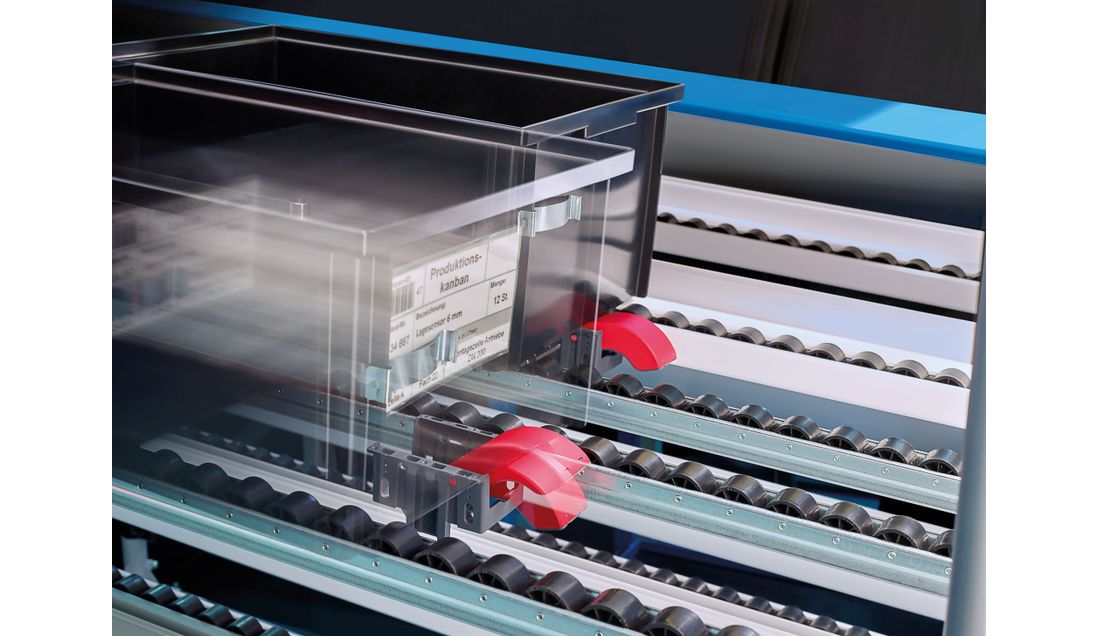
The basis for all production logistics is a data image of the processes that is as accurate as possible. Ideally, this image - the digital twin of the current material stocks and material flow - contains every product and every load carrier.
In theory, an ERP system takes on this task. In practice, however, this usually only applies to the core components. For small parts such as fastening elements and assembly aids, the inventory is only determined approximately, which is partly due to a temporal and spatial "information gap". Although the ERP system determines the current receipts and issues and initiates replenishment, several hours pass between the determination of requirements. The excess stock on site is therefore high. In addition, the ERP system does not record the containers in transit. In practice, this means that the actual quantities of material available deviate more and more from the values determined by IT. This is why many companies - especially those with extensive assembly activities - see the need to close this gap in the information flow.
Radio network for stocktaking
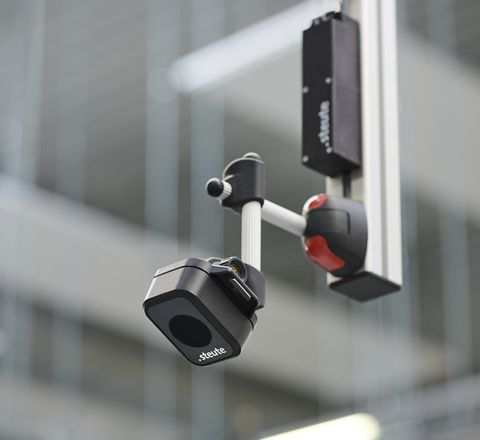
A radio-based automatic material retrieval system (AMS) developed by Steute's Wireless division fulfills precisely this task. The system, called Nexy, spans a radio network that works stably even under the rather unfavorable environmental conditions of the industrial environment (radiation, other radio networks). Access points "collect" the signals from wireless sensors, which act as end devices to record the stocks of containers, crates and packaging units, and pass them on to a sensor bridge, which serves as a link to the customer-specific IT infrastructure - usually to the user's ERP system.
To keep the system "lean", the containers themselves are not continuously monitored. Instead, the storage locations and channels in the assembly area or in the material supply "supermarkets" are equipped with wireless sensors. In addition, the wireless laser sensors can also monitor pallet storage locations or detect the fill level in containers such as GLTs and initiate replenishment accordingly. As the sensors send their signals by radio, the AMS also integrates stocks that are currently located in mobile units such as tugger trains or eKanban racks. Special versions of the sensors are also available for detecting dollies in monorail lanes. The radio system is adapted to the special requirements of industrial production. It works with high reliability and transmission security even under unfavorable conditions.
One system, multiple applications
This radio-based AMS is already working in many different applications. In some cases, several thousand wireless sensors are communicating. One of the major advantages of the Nexy system is the ability to operate different applications via a common radio platform. In addition to its (main) task as an AMS, the radio system can also control Andon systems or monitor automated material transfer to AGVs. The system can be flexibly adapted to changing conditions. For example, additional sensors can be quickly integrated and configured.

But is such a system economical? Yes - model profitability calculations showed an amortization period of just a few months. One of the reasons for the short amortization period is the simple implementation of the preconfigured eKanban application. The concrete benefit of a radio-based AMS that docks onto the ERP or PPS is the greater transparency and improved controllability of the material flow. The wireless sensors also record the processes in and on mobile units and enable a reaction in real time. This enables a needs-based material supply and a reduction in the error rate. Precise inventory management that reflects reality lowers capital costs without increasing the risk of bottlenecks or production downtime. With Nexy, the Kanban concept is reinterpreted according to the principles of IIoT and industry.


You might also be interested in
Handling and storage solution from Viastore
Hardware and software for the fully automated warehouse
As part of the restructuring of its plant in Curitiba, Brazil, household appliance manufacturer Electrolux has switched to a fully automated warehouse. The literal verticalization of stocks increased productivity, reduced costs and standardized the...
 read more...
Drives for autonomous mobile robots
Fast delivery thanks to powerful drives
Knapp's Open Shuttles, autonomous mobile robots (AMR), enable the automation of in-house transportation without having to adapt the existing infrastructure. The installed drive solutions from Dunkermotoren and gearbox manufacturer Framo Morat enable...
read more...Flexibility in the warehouse
Autonomous mobile robots make it possible to automate in-house transportation without having to adapt the existing infrastructure. The built-in drive solutions allow even bulky and heavy loads to be transported safely.
read more...Measure, report, optimize
Trouble-free system control is the basis for efficient production - and this in turn requires seamless, precise monitoring of important parameters.
read more...Modular storage concept
Gebhardt will be presenting the new Gebhardt Upstream at its LogiMat trade fair stand. The proven software solutions, warehouse technology solutions and conveyor technologies such as Galileo IoT, StoreWare and SpeedSorter can also be seen there.
read more...Four automation tips for SMEs
Cobots and mobile robots support automation projects in SMEs. What to look out for when taking the first steps.
read more...Scara robots change the profitability of automation
The introduction of low-cost robots to supplement human capabilities can increase the speed and quality of production. Yamaha uses the example of automated quality control of injection molded parts to show how this can be achieved.
read more...Energy supply, motors and drives
Customized drive technology for intralogistics
ABM Greiffenberger will be presenting complete drive solutions at LogiMAT (April 25 to 27). The system provider adapts these to specific applications and customers - always in close and cooperative partnership with the customer.
read more...Recycling chips and cooling lubricants
At Intec, Ruf Maschinenbau will be using the example of two high-quality briquetting systems to show why they quickly pay for themselves for metalworking companies. Metal chips and their adhering cooling lubricants are valuable raw materials.
read more...