
Digital transformation
Manufacturing trends 2018
These trends will change the manufacturing industry in 2018: the Internet of Things and 3D printing are coming of age, while services are increasingly becoming a revenue driver. According to IFS, these three developments will shape the manufacturing industry in 2018.
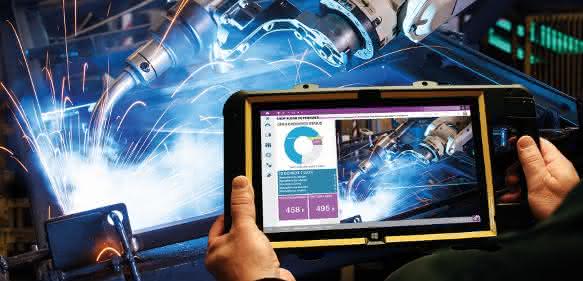
1 IoT becomes an integral part of product design
Until now, manufacturing companies have mainly used IoT technology as a supplement. Finished products were equipped with sensors to send information from the periphery of the systems, machines or devices via the Internet of Things. This will change fundamentally in 2018. Manufacturing companies will increasingly incorporate the possibilities of the IoT from the outset and make them an integral part of their product design. The IoT will become the brain of products, sending or receiving data from inside them throughout their entire life cycle. In this way, smart manufacturing will be further advanced, remote diagnostics and remote maintenance will be optimized or assets and inventories will be tracked for more efficient and transparent supply chains.
2. servitization continues to gain momentum
In times of increasingly competitive markets, differentiation and customer loyalty are becoming ever more important for manufacturing companies. Servitization - the addition of innovative services to their products or even the implementation of completely service-oriented business models - is the way forward. Some manufacturing companies are already successfully using digitalization technologies to "servitize" their offering. These include, for example, a mechanical engineering company that uses the IoT to sell its customers operating times rather than machines; or a furniture manufacturer that has expanded its offering to include cloud services for consulting services; or an automotive supplier that no longer just supplies systems for a car manufacturer but also operates its spare parts warehouse based on big data evaluations. These types of models will become more widespread in 2018, meaning that in just a few years, most manufacturing companies will generate more than half of their revenue from services.
3. 3D printing is coming of age
Similar to the Internet of Things, 3D printing will also enter a more mature phase in 2018 and begin to develop its full potential. To date, this technology has mainly been used on a small scale, for example in the manufacture of hearing aids or jewelry. The main obstacles to widespread use to date have been the time-consuming pre- and post-processing and the fact that 3D printers could only produce comparatively small capacities. These obstacles are now increasingly being removed by new, highly innovative 3D printing companies. Stratasys, for example, has developed a solution that combines three printers in one stack. The solution is highly scalable and can produce 1,500 to 2,000 components per day, achieving a level of profitability that will act as a catalyst for the success of 3D printing technology. "Smart manufacturing and service-oriented business models are the two central promises of digitalization to the manufacturing industry," says Peter Schulz, Team Manager Presales at IFS. "In 2018, IoT technology, 3D printing and servitization will become more widespread and thus make a decisive contribution to delivering on these promises. If manufacturing companies want to benefit from this, they need business software that can flexibly support these technologies and business models."


You might also be interested in
ESTIA aims to strengthen Europe's cloud
New tech alliance for EU sovereignty
Twelve companies, including Dassault Systèmes, are founding the European Sovereign Tech Industry Alliance (ESTIA). The initiative aims to strengthen Europe's technological independence and define requirements for sovereign cloud services. The start...
 read more...
Deutsche Telekom and Nvidia launch one of Europe's largest AI factories
With the Industrial AI Cloud in Munich, Deutsche Telekom and NVIDIA are creating one of the largest AI factories in Europe. Companies can train AI models, carry out simulations and access 10,000 GPUs.
read more...Leveraging data potential with AI and streaming
Huge data treasures are still lying dormant in many manufacturing companies. And yet it is high time that these treasures were unlocked. There is often a lack of resources and capacity to make data usable in real time. Streaming production data can...
read more...More awareness of noise
Dematic offers solutions that are tailored to different cloud environments and reduce environmental impact through reduced material consumption and improved energy efficiency.
read more...Generative AI in the automation environment
The mechanical engineering and automation industry is undergoing profound change. This transformation is being driven by more volatile global trade, geopolitical crises and increasing market pressure, which demands greater agility, technological...
read more...Rigid data structures have had their day
The traditional data center is no longer the center of data. A hybrid cloud storage approach enables manufacturing companies to both meet the current requirements of data-intensive processes and future-proof their infrastructure.
read more...Software as a service in three stages
CIM Database Cloud is a new out-of-the-box solution from Contact for end-to-end digital product development.
read more...How production can benefit from AI
Together with AI technology, IIoT networking makes it possible to better control machine parameters and optimize quality with predictive quality. Downtimes and set-up times can also be further minimized. Cloud platforms also make these technologies...
read more...More expertise for digital engineering
Altair, a computational science and artificial intelligence (AI) company, has acquired OmniV, a technology from Michigan, USA-based software company XLDyn.
read more...