
Advanced Planning and Scheduling
Interview: Using machine learning correctly

A machine and plant manufacturer wants to use artificial intelligence (AI) for itself. How does he make the right choice from the multitude of options?

Every company is individual and faces its own unique requirements. Nevertheless, it makes sense to start with a standardized software solution. Over time, this can then be adapted to the specific needs of your own company or expanded accordingly. To do this, project managers can take a look at what established providers already offer on the market. As a rule, it is also worth taking a look at what other companies are already implementing in this direction.
In terms of timing, the weakening order situation offers a good opportunity to address the issue. Manufacturing companies can see the phase of a quieter economy as an opportunity to dedicate themselves to such digitalization projects and emerge stronger.
How do manufacturing companies choose the right solution provider for AI projects?
When choosing a solution provider, companies should look for a balanced combination of industry expertise and development skills. On the one hand, it is important to know the specific needs of the user companies, while on the other hand, technical know-how is required with regard to the algorithms.
What does machine learning actually mean for machine and plant manufacturers?
First of all, it is important to understand that ML does not just make machines smarter. Many people immediately think of classic use cases such as predictive maintenance when they hear the term - but this is only a small part of the overall picture. ML can also be used to optimize processes and services. For example, ML-supported systems can use historical data to make reliable predictions about developments, such as the replenishment time for purchased parts or the duration of certain work processes. ML thus enables more precise planning and improves both process quality and adherence to deadlines. This gives machine and plant manufacturers a decisive competitive edge in a highly competitive market. A major advantage is that the data required for this is usually already available in the company, for example in the context of an ERP system.
Which existing company data can generally be used for ML?
Which data can be used for the ML application also depends on the company in question. Companies are often surprised at the valuable data they already have at their disposal. For example, order data from previous years is stored in the ERP system. An ML algorithm can use this data to forecast future delivery dates or replenishment times and thus enable more precise production planning.
In general, companies often think too much about their data quality. In many cases, relatively coarse data is sufficient, and some data is not even needed - for example, the buffer times between individual processing steps. Manufacturing companies should therefore not allow such concerns to deter them from important digitization projects, but should rather tackle the matter with the support of a service provider.
What role do ERP systems play in connection with AI technology and when and where do they reach their limits?
ERP systems are ideal for collecting and managing data. With this in mind, they are essential for the efficient coordination of complex production processes. However, they do not contribute to extracting increased added value from the available data. They therefore reach their limits at the latest when it comes to evaluating, let alone optimizing, data. AI-supported systems then take the next step: they build on the ERP system and compensate for its planning weaknesses through precise production control.
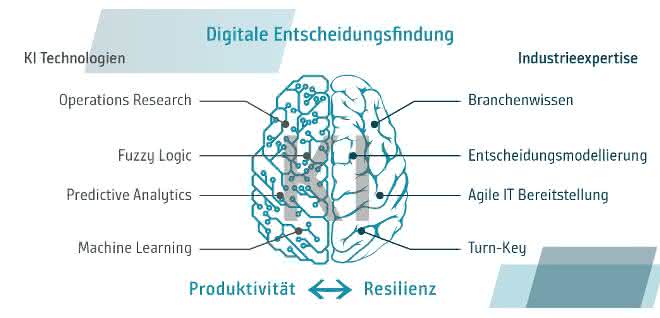
Production doesn't just consist of one production area. How can I use APS (Advanced Planning and Scheduling) systems to control the individual areas in a comprehensive manner?
The large number of orders and the permanent synchronization between the individual departments - from purchasing to production to sales - simply overwhelms human planners. You have to realize what potential companies are wasting in the face of this coordination effort. Only AI enables cross-divisional control that takes all relevant factors and variables into account at the same time. Thanks to an integrated ML component, APS systems such as our Felios system can recognize dependencies between areas and calculate an optimal production plan with the help of powerful algorithms. This allows manufacturing companies to benefit from increased adherence to deadlines and reduced throughput times without having to create additional resources.
What exactly do APS systems offer that other production planners cannot? Where exactly is the AI in this?
APS systems enable realistic production optimization, which compensates for the deficits of the ERP system. This includes, for example, the fact that they can compare even widely branched order networks with the actual available capacities and schedule them dynamically - a feature that traditional ERP systems lack. They also plan backlog-free. Although the functionalities are often equated, a simple planning system has no comparable features. It is neither intelligent nor does it offer the user suggestions for action. Thanks to the ML process described above, APS systems are also able to reliably forecast data relevant to the process, such as purchasing dates, and therefore plan more precisely. Particularly in the variant-rich individual and small series production of mechanical and plant engineering, they make it possible to maintain an overview and optimally utilize capacities.
The AI in such a system consists of intelligent algorithms that get the most out of the given framework conditions. At Inform, we rely on a hybrid approach that combines data-driven and knowledge-driven processes. This enables the APS to make planning and scheduling decisions and show the human planner optimal recommendations for action. In this way, the individual departments receive a recommendation on what to work on next in order to achieve the best overall result for the company. For example, the system suggests which orders the purchasing department should deal with most urgently so that deliveries are not delayed, which resource requires how much additional capacity or whether the right orders are being focused on.
In the end, the planner can always decide for themselves whether or not to accept the suggestions for action. Because as intelligent as the system may be, in the end it's all about directing this intelligence in the right direction.


You might also be interested in
Plagiarius 2024 negative prize
On January 26, 2024, the Plagiarius campaign awarded its dreaded "Plagiarius" negative prize for the 48th time to manufacturers and retailers of particularly brazen counterfeits and fakes.
 read more...
Ivalua honors winners of the Generative AI...
AI-supported "add-ons" for buyers within 48 hours
Ivalua, provider of cloud-based spend management solutions, announced the winners and innovations of the first Generative AI Innovation Cup. The competition took place in December 2023. It was open to all Ivalua partners and employees - more than...
read more...Efaflex celebrates 50 years of high-speed...
The emphasis is on "fast"
Since day one, Efaflex has wanted to use new technologies as early as possible and drive progress in the industry. This year, the family business is celebrating its 50th anniversary under the motto "Fast Forward".
read more...Security of supply even during power outages
In the winter of 2022, Germany was worried about energy shortages. The drugstore retailer dm did not paint any horror scenarios, but nevertheless saw the possibility of controlled, temporary, regional power cuts (brownouts).
read more...Safety technology in mechanical engineering
Modules with new functions
Euchner's product highlights at EMO 2023 include the communication-capable solenoid interlocks.
read more...Transforming the paper industry towards climate neutrality
Together with partners from industry and research, Voith is developing a project for the optimization of energy and material flows in paper production. The aim of the research project is to develop a digital framework that enables effective process...
read more...Up to 95 percent less flue gas thanks to direct extraction
The requirements for occupational safety measures and safety technology are also constantly increasing in welding technology. The Technical Rules for Hazardous Substances (TRGS) stipulate that welding fumes and harmful substances must be extracted...
read more...Competitive advantages with large machines
Whether 3D-printed components for machines and systems, prototypes or aids for design: additive manufacturing is almost indispensable for modern companies in mechanical and plant engineering and automation if they want to play in the premier league.
read more...Transport technology from the modular system
Many transport tasks can be realized with the help of linear technology. Pre-configured solutions are available to simplify the interaction between the linear unit, motor, gearbox and controller. This minimizes the effort required for research and...
read more...