
Industry 4.0
Great interest in Forcam's Innovation Day
"Why do we need Industry 4.0?" On September 25, 2018, Industry 4.0 practitioners from the manufacturing industry met at Forcam's Innovation Day and took part in lectures, workshops and the presentation of a digital learning factory. The professional tips on the digital factory met with great interest.
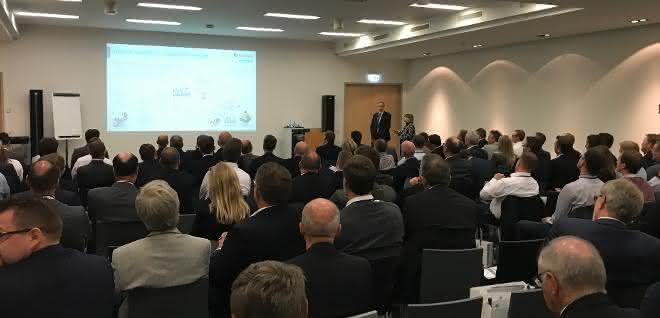
"Why do we actually need Industry 4.0?" Heinrich Munz from Kuka provided several answers to this surprising question right at the beginning of his presentation. One of them was: "We need Industry 4.0 for our well-being and for the future of our children." Because, according to the Kuka manager and "Lead Architect Industry 4.0" at the Augsburg-based robot manufacturer: "If we continue to produce as we do now, we will not be able to meet the product needs of a world population of 7.9 billion people in 2025, 53 percent of whom will belong to the 'consuming class', taking into account environmental and resource conditions."
Surprising insights dominated the 15th Forcam Innovation Day on September 25, 2018 at DXC.Technology in Böblingen. Practitioners from top companies in the manufacturing industry spoke to more than 100 guests about their experiences as well as the opportunities and risks associated with specific Industry 4.0 projects. The clear opportunities include higher productivity, greater efficiency and a clearer view of costs.
Several million data records in two seconds
In his presentation, Kuka manager Heinrich Munz presented megatrends in the course of global digitalization. One megatrend is: "Software Defined Everything" (software-centered services). This also applies to the factory in the 21st century. With the right software, enormous increases in efficiency and flexibility are possible.
Alexander Stappert from BorgWarner Europe, for example, reported that the primary objective of the digital control system for one of the automotive supplier's factories in Poland was the seamless traceability of all parts and processes. The result: the data records from seven months - several million in total - are now displayed in two seconds.
Greater transparency, higher productivity
For BorgWarner manager Alexander Stappert, the answer to the question "Why Industry 4.0?" is very simple: "Customers are demanding this from us. We need seamless traceability of all processes. Above all, it's about minimizing liability risks. Because as a supplier, the burden of proof lies with us in the event of damage." A pleasant "side effect" of seamless traceability: BorgWarner has been able to increase productivity in various factories by between 5 and 15 percent.
Tanja Knechtskern from Group Operations Controlling at Grammer AG reported similar successes through optimized transparency. "Above all, we wanted to make costs visible. To do this, we had to bring production and controlling together." Grammer now offers this by seamlessly linking real-time data from production with corporate management using SAP. "This actual feedback to SAP is a real asset for us in Controlling," says Tanja Knechtskern.
No more flying blind and hunting for information
Raynald Richard from the Swiss company MPS Micro Precision Systems AG in Biel, a leading manufacturer of precision parts for medical technology, watches, automation, aviation and optics, spoke of "flying blind" before the introduction of digital manufacturing. "Before the introduction of Forcam technology, we had no real cost transparency and didn't know exactly what our products actually cost." Scrap documentation and detailed planning were carried out manually. "We were constantly on the hunt for information and could only react rather than act," says Raynald Richard. Following the switch to digital production, the production status of 700 products is now displayed visually. Top and store floor are seamlessly interlinked, there is maximum cost transparency thanks to real-time data, and efficiency is continuously improved. MPS Assembly Manager Richard: "We are now planning the further rollout of Forcam technology at other locations."
Industry 4.0 with starter kit
Denis Shoshi, Production Manager at Swiss furniture specialist Peka-Metall, demonstrated how to get started with intelligent production quickly and effectively. "We started with the starter kit from Forcam. This meant we didn't have to commit ourselves immediately and could test everything." We started with a system and individual discussions with the employees at the machines. Denis Shoshi: "The close information and training of our 80 employees in production was and is very important. As a company, you hand over responsibility to the employees, who are expected to operate their machines independently in future. Even older employees are happy to accept this." The results were convincing: Eight months after starting with the starter kit, working with smart technology was the norm at Peka-Metall. In just a few years, the new technology, new systems, training and continuous information have increased efficiency in all departments by between 20 and 25 percent, in some cases by 50 percent.
"Overall integration is important"
Despite everything, those responsible for digital transformation should never lose sight of the eagle eye when it comes to managing production. Martin Rainer from DXC.Technology advocated this. "It is important to keep an eye on the overall integration. We call this solution orchestration." Above all, this orchestration should take into account the fact that new 'musicians' are constantly being added - in other words, new technologies should be connected. "This is why open source solutions, i.e. open architectures, are necessary," says Martin Rainer.
Forcam Managing Director Franz Gruber thanked all guests, customers and business partners. He concluded with the words: "Our 15th Forcam Innovation Day has also shown that Industry 4.0 is not an academic round trip, but can be explained in concrete terms by practitioners for practitioners. Companies that get it right and introduce integrated digital solutions for planning, processes and production step by step will increase their productivity by 20 to 30 percent in a short space of time."
Further lectures, workshops and the presentation of a digital learning factory, a cooperation between the companies Festo Didactic, SAP, Forcam and others, rounded off the FID 2018.


You might also be interested in
Conrad continues to grow
Conrad Electronic now generates 80% of its sales with business customers and has successfully developed from a traditional technology retailer into a B2B procurement platform. The company aims to become Europe's leading procurement platform for...
 read more...
AI finds its way into automotive customer service
In addition to computer solutions for vehicle diagnostics, Getac now also offers AI-based digital tools that support customer contact in service operations.
read more...SMC: "Preferred Supplier" from Bosch
The technology and service company Bosch has recognized SMC for the performance of its automation technology in factory and process automation and awarded it the status of "Preferred Supplier" in the material group "Standardized Pneumatic Devices".
read more...Combined ERP forces
The medium-sized ERP providers Step Ahead Software, Godesys and Informing merge to form the Step Ahead Group.
read more...Cybersecurity for asset-intensive companies
Forge Cybersecurity Platform, the new software platform from Honeywell, has been developed for the cybersecurity of asset-intensive companies and critical infrastructures. The platform is available in three versions.
read more...Automated machine tool as a success factor
Industry 4.0 is the hot topic of the moment. For small and medium-sized companies and contract manufacturers, it holds great potential for increasing production efficiency step by step. The focus here is on efficient and user-specific automation...
read more...Nemo hand vacuum lifts all materials
A new addition to the Eurotech portfolio is the battery-operated Nemo vacuum cleaner, which is suitable for handling almost all surfaces.
read more...Future-oriented cobot projects
Three pillars of successful cobot initiatives
What is important if cobot projects are to be future-oriented? Automation and robotics expert Omron has identified three aspects for human-machine collaboration.
read more...Short-stroke linear actuator instead of pneumatic cylinders
The new short-stroke linear actuator from Ketterer Antriebe and halstrup-walcher is characterized by high dynamics and a large stroke in a compact size. Thanks to the integrated electronics, the drive is easy to control compared to pneumatic...
read more...