
Factory planning
Digital factory in 3D
Factory planning is a top priority for OEMs due to the changes in production structures. After all, the automotive industry is undergoing the biggest transformation in its more than 100-year history. Up-to-date building data forms the basis for effective and efficient factory planning.
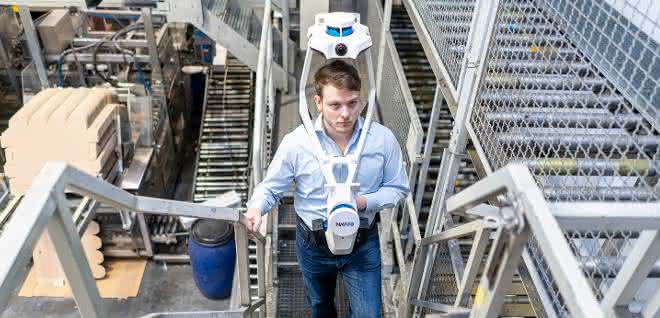
The production structure in automotive plants is currently changing due to new products. The task in this context is often quite pragmatic: a new production line is planned in an existing factory, but it is not known in detail what is in the factory: Where are the machines, the columns or the pipes? After all, continuous improvement involves constant improvements and conversions, but the changes are not always incorporated into the systems. "This affects medium-sized companies just as much as large ones. Corona has also meant that it is sometimes impossible to travel to plants and carry out the necessary measurements for factory planning on site," explains Finn Boysen, Chief Revenue Officer at Navvis.
What's more, poor data quality often means enormous additional costs and lost time. One example in the automotive industry concerns a Navvis customer: it has a large factory in Eastern Europe and was switching to a new model there. However, the entire planning was carried out on the basis of incorrect data. Eight weeks before implementation, it was realized that three centimetres were missing and therefore there was no space for an important machine. This poor data quality cost the company a lot of money. This is by no means an isolated case. In this context, Navvis is talking about everyday life, which can also be found time and again at innovative, large and well-known companies. "Companies must be able to trust the data on the basis of which they make far-reaching decisions. To do this, they need to be up to date and reflect the reality of the factory," emphasizes Boysen. "We see our core competence not only in collecting high-precision data in the millimeter range, but also in making it 'intelligent' and making it available to users. This is why Navvis has long been an advocate of digital transformation in production planning and control." The Munich-based specialist offers companies high-performance
The laser scanners offer the possibility of creating and operating customer-specific digital twin solutions for entire production plants in order to optimize their planning and operating processes. The data obtained with laser scanners can be used in a variety of ways, including for maintenance and continuous improvement processes. In addition to the automotive sector, customers primarily come from the consumer goods, electronics and process industries.
Capturing data with laser scanners
Navvis offers two mobile indoor mapping systems: The Navvis M6 is a laser scanner that can be pushed. It is particularly useful in large, flat factories. The Navvs VLX laser scanner is portable. Both systems can be used to record a digital twin of the building, the machines and all other inventory. This is done using the cameras and lidar sensors in high resolution. Everything is then converted into a consistent image. One of the technical patents for this is based on the so-called SLAM algorithm, which is known from autonomous driving. The Munich-based company has further developed the SLAM technology in order to deliver the required data quality.
The data must be made available to users in a comprehensible form so that they can work with it easily: "With Navvis, the data is available in the browser - anyone who has the rights can access it and it is very easy to use. However, the data must also be complete and consistent," says Finn Boysen. "With previous technologies, it would probably have taken a year. Not only would this have incurred high costs, but the data would no longer have been up to date after twelve months." When it comes to data collection, customers have the choice of either doing it themselves or commissioning Navvis to do it. The Munich-based company handles the latter with the support of a network of global partners who collect the data and merge it into a digital twin, which is made available as a complete solution in the Navvis software. Around 10,000 to 20,000m2 can be recorded per day. The decisive point for purchasing Navvis hardware is that a customer wants to keep their digital twin up to date. After all, there are areas in which things are constantly changing. Especially as the use cases of the system are diverse beyond factory planning: These include documentation for conversions or new builds, as well as maintenance support. "With large customers, we sometimes see 20 or 30 applications. However, the focus is on global operations - working with factories worldwide. With our technology, users can view these virtually," says Boysen.
Quick solution at a low price
Navvis solutions have established themselves in the automotive industry. They are characterized above all by their speed and correspondingly low costs as well as by the topicality and availability of the data with Navvis Ivion. This allows the data to be viewed and made available to all users. In addition, Ivion and the Ivion Go app provide interactive support for planning processes. Navvis sees the benefits of its technology in making existing processes more digital, more sustainable and more accurate, as well as saving costs, converting production lines more quickly and solving problems faster.
Finally, the Chief Revenue Officer addresses the topic of the cloud: "The point cloud basically describes the factory, it combines the measurements as on a 3D map, and the panoramic images we generate of the entire factory are also stored in HD quality in it. The data sets create the overall picture of the factory," says Boysen. With the help of the navigation graph, users know how to move through the building. In principle, there is an interactive 3D map of the factory and the building. In addition, individual objects can be identified using AI technology and extracted from the images. However, this is still largely future potential, as the model still needs to be trained. The reality, however, is that the huge amount of collected data is intuitively made available to the user in the browser.


You might also be interested in
ESTIA aims to strengthen Europe's cloud
New tech alliance for EU sovereignty
Twelve companies, including Dassault Systèmes, are founding the European Sovereign Tech Industry Alliance (ESTIA). The initiative aims to strengthen Europe's technological independence and define requirements for sovereign cloud services. The start...
 read more...
Deutsche Telekom and Nvidia launch one of Europe's largest AI factories
With the Industrial AI Cloud in Munich, Deutsche Telekom and NVIDIA are creating one of the largest AI factories in Europe. Companies can train AI models, carry out simulations and access 10,000 GPUs.
read more...Leveraging data potential with AI and streaming
Huge data treasures are still lying dormant in many manufacturing companies. And yet it is high time that these treasures were unlocked. There is often a lack of resources and capacity to make data usable in real time. Streaming production data can...
read more...More awareness of noise
Dematic offers solutions that are tailored to different cloud environments and reduce environmental impact through reduced material consumption and improved energy efficiency.
read more...Generative AI in the automation environment
The mechanical engineering and automation industry is undergoing profound change. This transformation is being driven by more volatile global trade, geopolitical crises and increasing market pressure, which demands greater agility, technological...
read more...Rigid data structures have had their day
The traditional data center is no longer the center of data. A hybrid cloud storage approach enables manufacturing companies to both meet the current requirements of data-intensive processes and future-proof their infrastructure.
read more...Software as a service in three stages
CIM Database Cloud is a new out-of-the-box solution from Contact for end-to-end digital product development.
read more...How production can benefit from AI
Together with AI technology, IIoT networking makes it possible to better control machine parameters and optimize quality with predictive quality. Downtimes and set-up times can also be further minimized. Cloud platforms also make these technologies...
read more...More expertise for digital engineering
Altair, a computational science and artificial intelligence (AI) company, has acquired OmniV, a technology from Michigan, USA-based software company XLDyn.
read more...