
ERP software for production planning
Late manufacturing creates production space
With over 200 employees, the Wesemann Group manufactures high-quality laboratory equipment, scientific specialist room equipment and sophisticated workplace systems for personal and product protection. Customers come from the food' pharmaceutical' petrochemical industry or from biotechnology and research. When it comes to ERP software, the company also relies on ProAlpha' in production. There, ProAlpha Advanced Planning and Scheduling (APS) brings together the right amount of material at the right time with the right tools and the right personnel. So well, in fact, that Wesemann has been able to massively reduce its stocks as a result.

Wesemann's projects are spread all over the world: Europe, Asia, the Arab world and even the southernmost laboratory to date in Antarctica. There are no limits to the freedom of design: Wesemann tailors each facility to measure, according to the customer's wishes and requirements. Wesemann uses a modular system for this project business. Combined with custom-made products, this results in individual facilities with up to several thousand square meters of usable space, which are also perfectly adapted to the geographical conditions. For Wesemann, such demanding projects require production to be as optimized as possible in order to minimize costs and inventories. Especially as the laboratory fitter usually only has six weeks to procure the material and manufacture the parts after the production planning of the customer projects.
What is needed first on the construction site is also produced first
The core of production planning and control at Wesemann is ProAlpha APS (Advanced Planning and Scheduling). This enables Wesemann to plan its production optimally. Based on assembly planning, production orders are divided into logical delivery groups for the construction site - for example according to floors or rooms of the building to be set up or according to product groups.
Each delivery group is assigned a specific production date. A production order therefore specifies which components make up an assembly, which work activities are to be carried out by which people and which tools and materials are required. In addition, production can be prioritized according to the previously defined delivery groups. For example, Wesemann manufactures the parts that the company needs first on site for the construction of a laboratory. The predictive resource planning also displays the material flow clearly and in real time.
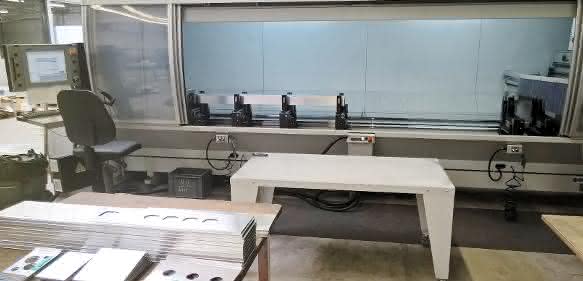
This allows utilization and resource allocation to be reliably estimated. ProAlpha APS also displays scarce or overloaded resources and suggests alternative resources if necessary. Thanks to multi-resource planning, dispatchers can schedule overloads and competing orders, synchronize the availability of resources and provide the required material. "With APS, we can now plan finely, realistically and quickly," summarizes Harald Wienberg, Head of ERP/Organizational Development at Wesemann.
Without detailed planning, corridors and halls would be blocked
ProAlpha APS gives the laboratory fitter yet another advantage. This is because it not only allows the company to plan its production very flexibly, but also to start production very late in principle. "Unfortunately, postponements are part of everyday life for us," explains Wienberg. "If we were to produce with a normal lead time, all of our aisles and halls would soon be full." This is because orders are repeatedly delayed due to construction delays. In these cases, Wesemann would not be able to deliver the manufactured furnishing parts to the construction site. As a result, the parts would remain at the site, where they would take up a lot of space. At the same time, a lot of work would have been invested in one order and another, similarly time-critical order might have had to be postponed. Therefore, the lab setter's goal is to start production orders at the latest possible date in order to minimize such negative effects. He also schedules more orders than there is capacity for. "That way, we don't have any problems if orders are delayed. On the one hand, the detailed planning clearly shows all postponements. Secondly, we can reschedule in the shortest possible time so that we can deliver the parts to the construction site on time," explains Wienberg.
No more "scare stocks", but more production space
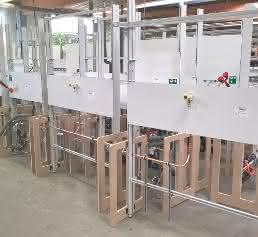
Thanks to ProAlpha, Wesemann has already been able to reduce shelf space by 75% in some areas and convert it into production space. As a result of the detailed planning, the material flow can be optimized and material stocks reduced. "There is no longer any fear of stock levels as there was a few years ago," says Wienberg. The reason: Wesemann now produces a considerable proportion of its prefabricated parts, such as connecting struts for media systems, in such a way that they are only in the warehouse for a week before they are installed for an order. The company used to keep the same parts in stock for five weeks. This meant that around half of the storage space consisted solely of safety buffers. "Former storage space was used to set up a new, larger powder coating system, which can achieve 50 percent more output and with which significantly faster color changes are possible in order to be able to implement individual customer requests with precise timing. The same procedure is also used in the area of cell, electrical and sanitary pre-assembly as well as in fume cupboard production in order to create additional assembly stations, which on the one hand bring us additional added value, but also ensure better planning and more adherence to deadlines," Wienberg is pleased to report.
Goal: Just-in-time production
Wesemann's old production planning was geared towards producing as early as possible. The laboratory fitter wanted to be prepared for everything and compensate for the lack of detailed planning. Thanks to ProAlpha APS, Wesemann is already producing much more efficiently. Looking ahead, Wienberg reveals another of the company's ambitious goals: "In the medium term, we want to establish just-in-time production à la the automotive industry. ProAlpha's detailed planning laid the foundation for this. The internal project "Wesemann 2017 factory planning" was then launched in 2013. Under the direction of a planning office, all production processes were analyzed and a completely new production layout was developed for the entire site. The conversion of the metal construction began in January 2016. Pipe lasers, welding robots, the complete aluminum processing with milling center and all other workstations were rebuilt "on the fly", so to speak, and a new, significantly larger powder coating facility was built.
The further conversion was completed by the end of 2016. With the help of more precise assembly planning and detailed planning from ProAlpha, it was possible to establish "production at the customer's pace". This means that "just-in-time" production is not just a realistic goal, but rather the solution for Wesemann to counter the uncertainties of the project business. am


You might also be interested in
Plagiarius 2024 negative prize
On January 26, 2024, the Plagiarius campaign awarded its dreaded "Plagiarius" negative prize for the 48th time to manufacturers and retailers of particularly brazen counterfeits and fakes.
 read more...
Ivalua honors winners of the Generative AI...
AI-supported "add-ons" for buyers within 48 hours
Ivalua, provider of cloud-based spend management solutions, announced the winners and innovations of the first Generative AI Innovation Cup. The competition took place in December 2023. It was open to all Ivalua partners and employees - more than...
read more...Efaflex celebrates 50 years of high-speed...
The emphasis is on "fast"
Since day one, Efaflex has wanted to use new technologies as early as possible and drive progress in the industry. This year, the family business is celebrating its 50th anniversary under the motto "Fast Forward".
read more...Security of supply even during power outages
In the winter of 2022, Germany was worried about energy shortages. The drugstore retailer dm did not paint any horror scenarios, but nevertheless saw the possibility of controlled, temporary, regional power cuts (brownouts).
read more...Safety technology in mechanical engineering
Modules with new functions
Euchner's product highlights at EMO 2023 include the communication-capable solenoid interlocks.
read more...Transforming the paper industry towards climate neutrality
Together with partners from industry and research, Voith is developing a project for the optimization of energy and material flows in paper production. The aim of the research project is to develop a digital framework that enables effective process...
read more...Up to 95 percent less flue gas thanks to direct extraction
The requirements for occupational safety measures and safety technology are also constantly increasing in welding technology. The Technical Rules for Hazardous Substances (TRGS) stipulate that welding fumes and harmful substances must be extracted...
read more...Competitive advantages with large machines
Whether 3D-printed components for machines and systems, prototypes or aids for design: additive manufacturing is almost indispensable for modern companies in mechanical and plant engineering and automation if they want to play in the premier league.
read more...Transport technology from the modular system
Many transport tasks can be realized with the help of linear technology. Pre-configured solutions are available to simplify the interaction between the linear unit, motor, gearbox and controller. This minimizes the effort required for research and...
read more...