

Digital twins
Digital twin for pumps
The digital twin processes sensor data generated from a plant in operation and uses simulation to predict faults and diagnose inefficiencies. This enables engineers to take action to fix problems immediately and further optimize the plant's performance.
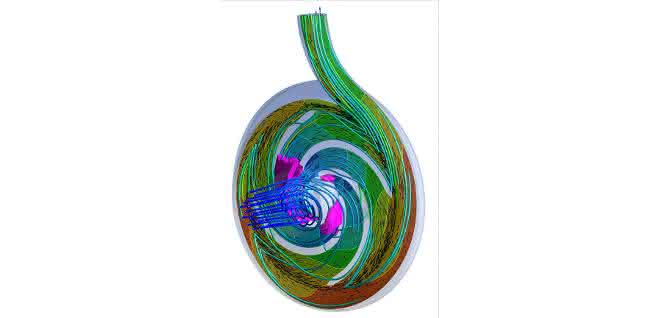
Simulation has long been an integral part of the product development process. It improves product performance, reduces development and manufacturing costs and significantly shortens the time to market. The technologies behind the Internet of Things (IoT) are now enabling the next step: integrating simulation into existing and in-use products to capture real-time data. This marks the beginning of a whole new era of value creation for companies. Simulation using a digital twin helps to optimize operations and maintenance. The data can be integrated into the company's digital information about the product in order to optimize the current status of the product or system. In a collaboration with PTC, Flowserve, National Instruments and HPE, Ansys demonstrated how a digital twin of an active pump can be used to diagnose and resolve operational faults much more quickly.
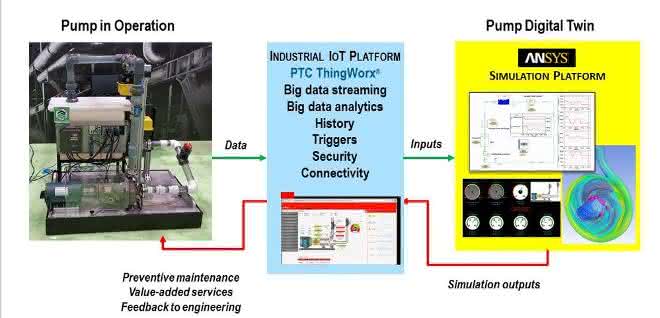
For this purpose, the pump in operation was equipped with pressure sensors at its inlet and outlet. In addition, acceleration sensors were installed on the pump and bearing housing to measure vibrations and flow meters were fitted on the discharge side. An actuator controlled the discharge valve, while the valve on the suction side was operated manually. The sensors and actuators were connected to a data acquisition device that recorded the data at 20 kHz and relayed it to a Hewlett-Packard Enterprise (HPE) IoT EL20 edge computer system. PTC's ThingWorx platform created an ecosystem to connect devices and sensors to the IoT, demonstrate the value of IoT data, develop enterprise-level IoT applications, and empower end users through augmented reality. ThingWorx was used as a gateway between the sensors and digital data - including the simulation model of the pump. A layer of machine learning in ThingWorx, running on the EL20, controlled the sensors and other devices and automatically learned the normal state of the pump in operation. Machine learning was also used to identify operational anomalies and generate insights and predictions. The ThingWork platform was also used to create a web application that displays sensor and control data as well as analytics. For example, the app indicated input and output pressure and predicted bearing life. An augmented reality front-end overlaid an image of the pump displayed on the user's smartphone, tablet or data glasses with sensor data and analytics, as well as parts lists, repair instructions and other personalized information.
Simulation - secrets and added value of the digital twin
Using Ansys Simplorer design software, the Ansys team created a reduced system-level model of the pump running on the HPE Edge computer. Using PTC ThingWorx, the system model connected to sensor data and mimicked the operation of the hydraulic system. The system model also connected to a human-machine interface (HMI) developed with Ansys SCADE, which included the same gauges and scales as the physical pump. With this configuration, the system model could be separated from the physical pump and operated offline to investigate operating scenarios. The system model could also be equipped with virtual sensors to measure, for example, the downstream and upstream pressure of the valves. Using computational fluid dynamics (CFD), Ansys created a 3D model of the pump within the cloud, which was linked to data from the plant (online) or from the system model (offline). This 3D model was not only the source for the pump performance curves used for rapid system-level simulations, but also formed the basis for more detailed interrogation and diagnosis of off-design operation, as well as performance evaluation under abnormal conditions.
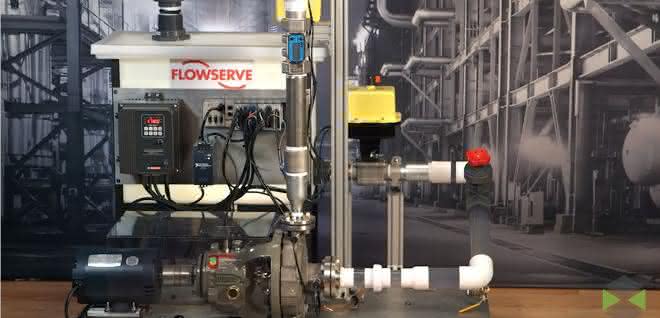
To demonstrate the added value of the digital twin, the pump was initially operated normally. An anomaly was initiated manually by closing the suction valve to 50 percent. The sensor readings showed that the suction pressure, discharge pressure and discharge volume decreased drastically, while the acceleration sensors vibrated strongly. Red warning messages were displayed, while predictive analysis predicted that the pump bearing life would drop to just a few days if this condition continued. However, it was not clear from the sensor readings and analysis how the irregular flow conditions were affecting the operation of the pump, i.e. why the pump was vibrating or what possible solutions could be considered. Under reduced inlet and outlet pressure and flow rate, the connected system model showed the same MQL values as the physical pump. A 3D simulation model, which was connected to the physical pump in the cloud, was activated via the "Simulate 3D" button. The team wanted to find out why the vibrations occurred and how the change in flow condition affected pump operation. The 3D simulation showed that the pressure drop inside the pump caused cavitation and vapor bubbles formed. In the higher pressure ranges of the pump, the bubbles imploded and generated vibrations.
Combining the real and virtual worlds
By separating the system model from the physical pump, several potential corrections could be tried out with the system model's MMS. For example, the system model had predicted that opening the inlet valve would solve the problem. To validate the potential solution, a second 3D simulation was performed on the offline system model with the valve open. The 3D results showed no vapor bubbles. The problem was thus solved by opening the inlet valve on the physical pump and normalizing the performance. The IoT allows simulation models to connect to products that are already in operation via a platform such as ThingWorx. This gives industrial companies the opportunity to better understand and optimize product performance. The digital twin enables companies to identify and isolate faults, carry out diagnostics and troubleshooting and suggest corrective measures. In addition, an ideal maintenance plan can be determined based on the specifics of the individual plant, plant operation can be optimized and insights can be generated that can help improve the next generation of products.
The advantages of digital twins are enormous. Short-term successes include maintenance optimization and operational troubleshooting. However, as soon as customers start demanding results and not just products, the digital twin has the potential to unlock this added value for both product manufacturers and their customers.
Chris MacDonald, Senior Director, Analytics GTM Strategy & Business Development, ThingWorx Analytics at PTC; Bernard Dion, Chief Technical Officer, Systems Business Unit at Ansys; Mohammad Davoudabadi, Principal Engineer at Ansys / ag


You might also be interested in
ESTIA aims to strengthen Europe's cloud
New tech alliance for EU sovereignty
Twelve companies, including Dassault Systèmes, are founding the European Sovereign Tech Industry Alliance (ESTIA). The initiative aims to strengthen Europe's technological independence and define requirements for sovereign cloud services. The start...
 read more...
Deutsche Telekom and Nvidia launch one of Europe's largest AI factories
With the Industrial AI Cloud in Munich, Deutsche Telekom and NVIDIA are creating one of the largest AI factories in Europe. Companies can train AI models, carry out simulations and access 10,000 GPUs.
read more...Leveraging data potential with AI and streaming
Huge data treasures are still lying dormant in many manufacturing companies. And yet it is high time that these treasures were unlocked. There is often a lack of resources and capacity to make data usable in real time. Streaming production data can...
read more...More awareness of noise
Dematic offers solutions that are tailored to different cloud environments and reduce environmental impact through reduced material consumption and improved energy efficiency.
read more...Generative AI in the automation environment
The mechanical engineering and automation industry is undergoing profound change. This transformation is being driven by more volatile global trade, geopolitical crises and increasing market pressure, which demands greater agility, technological...
read more...Rigid data structures have had their day
The traditional data center is no longer the center of data. A hybrid cloud storage approach enables manufacturing companies to both meet the current requirements of data-intensive processes and future-proof their infrastructure.
read more...Software as a service in three stages
CIM Database Cloud is a new out-of-the-box solution from Contact for end-to-end digital product development.
read more...How production can benefit from AI
Together with AI technology, IIoT networking makes it possible to better control machine parameters and optimize quality with predictive quality. Downtimes and set-up times can also be further minimized. Cloud platforms also make these technologies...
read more...More expertise for digital engineering
Altair, a computational science and artificial intelligence (AI) company, has acquired OmniV, a technology from Michigan, USA-based software company XLDyn.
read more...