
Data web service
Always the right data
Data is usually provided as required for the specific application. As a result, relevant information is often missing in the subsequent process steps. A cross-domain web service can provide a remedy here.

It is said that data is the raw material of the 21st century. Alternatively, it is referred to as the gold of the digital age. In order to utilize the raw material or gold, the so-called artificial intelligence (AI) of machine learning obtains the required process data directly from the machines and systems in operation. However, data on the components to be installed in the application is required in the engineering phase. This information can already be found on the engineering tool manufacturers' portals - but only in the form required for the respective software tool. A general, cross-domain provision in standardized data formats would be better.
In addition to the familiar engineering environments, configurators also require article data so that they can combine several individual articles into a complete product. In doing so, the configurators take on a level of complexity that is familiar from engineering tools.
Nevertheless, they only include the article data that they need for their often very specific task. Saved configuration objects can therefore only be used for the intended tasks or can be imported into other tools via specialized interfaces.
Control of the level of detail via access rights
Currently, there are already cross-domain description formats such as AutomationML and eCl@ss Advanced, which can even be combined with each other. One example is the terminal strip configurator Clip Project from Phoenix Contact, which can be used to configure assembled mounting rails. The tool also allows data to be exchanged with engineering tools via interfaces. However, Clip Project also only stores the article data that is absolutely necessary for the configuration task and the exchange with other engineering environments. This includes the article number, width of the terminal block or number of electrical connections.
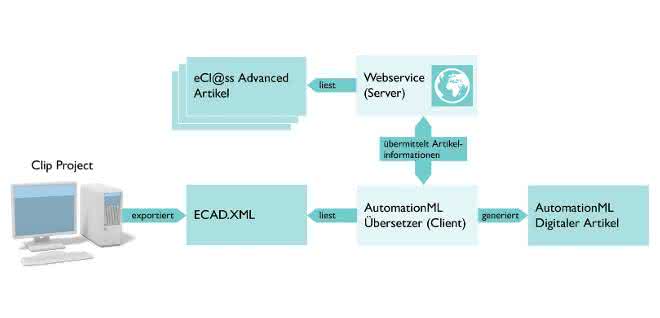
Theoretically, the configuration result is a model of the product, which should also be usable for other tasks such as automated labeling or wiring. However, the relevant information on the labeling and wiring positions is missing. It would therefore be conceivable to enter this data into the article knowledge of the configuration tool. However, this would add an additional application domain. Complete data records, such as those available in the manufacturer's master data system, would in turn unnecessarily bloat the configuration tool. An alternative to this scenario is the subsequent enrichment of article information using a web service, where the level of detail can even be controlled via access rights.
To make the result of a configuration tool applicable for a continuous engineering chain, the direct export of the configuration result to AutomationML is a good option. Alternatively, an existing export could be translated into AutomationML. Using the Clip Project terminal strip configurator as an example, it is initially sufficient to describe the items used with their article number and relative position to each other. These are, for example, the mounting rail, terminal blocks and end clamps as well as the label plates.
The first challenge now is to identify suitable system unit or role classes in AutomationML. In the best, but also very unlikely case, an eCl@ss-based system unit class library is available for this purpose, which can be read like a product catalog. However, as this is not normally the case, the use of placeholder role classes with just two attributes is sufficient in the first step: Article number and manufacturer name. In the instance hierarchy, which describes the structure of the equipped mounting rail, there are then only hierarchically organized elements of the placeholder castor class with additional position information.
Translation of the configuration into an AutomationML file
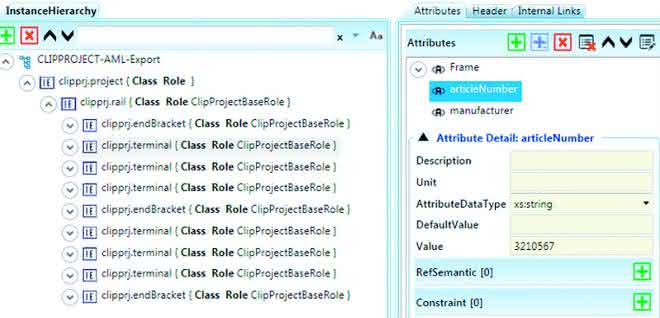
However, this does not provide a classification of the components on the mounting rail. This is because it is not formally clear whether it is an end clamp, a terminal block or, for example, a power supply. In order to obtain the missing information, the individual article numbers used in the instance hierarchy are transferred to a web service, which retrieves a BMEcat export (eCl@ss data) for precisely these articles from the component manufacturer's PLM (Product Lifecycle Management) system. In the next step, the web service translates the BMEcat into an AutomationML system unit class library, adds the required eCl@ss-based role classes and sends the generated AutomationML file back to the calling client.
The system unit class library can be understood as a product catalog in which the requested items are described in technical detail. The client now replaces the placeholder role classes in the instance hierarchy with the new system unit classes and also inserts the role class libraries received from the web service into the AutomationML translation. The result is a translation of the configuration result into a syntactically correct AutomationML file with a unique and standardized (eCl@ss-based) article classification.
Avoid teaching processes with the help of a web service
The translation of configuration results into a cross-domain data exchange format is just one use case. The delivery and use of standardized article information also proves to be helpful in other scenarios. For example, the web service can be used directly by engineering and configuration tools in the future, making subsequent data enrichment superfluous. If it is connected to versatile production systems, for example, teaching processes can be avoided.

For the automated labeling of equipped mounting rails, it is also necessary to know the individual positions of the labeling surfaces of the terminal blocks exactly. Therefore, the established procedure today is to manually measure the terminal blocks and store the position data in the machine. Alternatively, the machine is moved manually to the position in which marking can be carried out in order to teach in this position (teaching). If the manufacturer provides the article data on a daily basis, both methods can be implemented more easily via a web service. The advantages for the user are obvious: significant time savings and a considerable increase in data quality at the same time.
Dipl.-Inf. Olaf Graeser, employee in the Corporate Technology & Value Chain department, Phoenix Contact / am


You might also be interested in
Everything accurate in switch cabinet construction
To ensure smooth work processes, tools for processing enclosures and housings must function flawlessly and reliably. Häwa rounds off its punching range with the Multi-Press 500.
 read more...
Fast connection
In addition to the XTV terminal blocks with side conductor routing, the first terminal blocks with front Push-X connection are now also available from Phoenix Contact.
read more...Automate without control cabinets
Beckhoff wants to revolutionize the market with the MX modular automation system. Andrea Gillhuber spoke to Product Manager Daniel Siegenbrink about the possibilities that the system offers users, what experiences have already been made and where...
read more...Simply assemble cobots
Grip Handhabungstechnik focused primarily on aesthetics when designing its new cobot tables. However, functional and ergonomic aspects also played a major role in creating a perfect working environment for the operation of lightweight robots.
read more...3D printing drone supports fire department in operations
Every day, firefighters risk their lives in unknown environments. With the help of 3D-printed parts, David Häusermann and his team at Empa have spent six months developing and testing a heat-resistant reconnaissance drone. The "fire drone" is...
read more...Wago platform for 3D printing ideas celebrates its birthday
3D printing is in vogue. This is also demonstrated by the digital think tank and 3D printing community Wago Creators. It is celebrating its second birthday this year. Since then, the online community has grown to almost 4,000 users - time for a look...
read more...More efficiency in the control cabinet
clipx Engineer, the engineering software from Phoenix Contact, is the software for control cabinet construction that optimizes data consistency from the circuit diagram to the control cabinet.
read more...Printing and appliqué in one step
Good legibility and permanent marking are of the utmost importance for industrial marking. At the same time, it is considered time-consuming and laborious to assemble the individual markers, especially when many conductors and cables need to be...
read more...Resource-saving plastics processing
Efficient all the way to the cloud
PC-based control, the PC- and Ethercat-based control and drive technology from Beckhoff, offers the potential to make machines and systems for the plastics processing industry work more sustainably.
read more...