

Industry 4.0
Benefits of digitization for small and medium-sized enterprises
Many small and medium-sized companies in the metalworking industry are confronted with a constantly changing market environment. Marketing often touts new or even disruptive technologies under terms such as "digital transformation" or "Industry 4.0". They are supposed to revolutionize entire sectors of the economy from the ground up - but what is really behind the "Industry 4.0" hype?
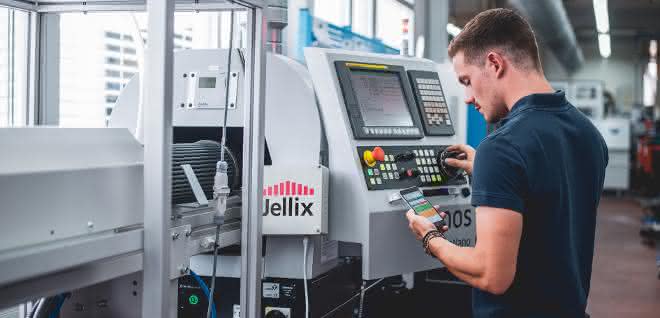
Above all, how can small and medium-sized companies benefit from this trend and equip themselves for the future, despite their heavy workloads in day-to-day business and limited know-how in the field of information technology? One user example can be found in Tectri SA from the Swiss canton of Bern, a manufacturer of precision parts that has digitized its production processes with the help of Brütsch/Rüegger tools.
Globalization and its cost transparency are increasingly forcing even highly specialized companies to reduce their prices in order to remain competitive. In the medium term, falling sales prices require internal processes to be rationalized in order to achieve savings in manufacturing costs. Tectri has also looked into process optimization and found a high level of process maturity and master data quality as a starting point thanks to continuous improvements and automated sub-processes. This benefited Tectri during the gradual digitalization process.
With around 50 employees, Tectri is a typical SME that specializes in the production of medium-sized series of sophisticated turned and milled parts. As most of its customers are in high-tech industries such as medical or measurement technology, the company has to react flexibly to the highest quality requirements for a wide range of material specifications. Tectri also produces complex geometries for hard and brittle materials as well as soft and elastic plastics. The medium-sized quantities also require an extremely high level of coordination in production planning. The various customer requirements to be covered entail an extremely wide variety of machines and a very heterogeneous machine park. So what are the benefits of digitalization for a highly specialized company that is largely working to capacity with its day-to-day business and is managed profitably?
Step-by-step to the smart factory
In an initial phase, computerized storage systems replaced tool and measuring equipment management. The aim was to reduce the costs of tool provision. In addition, the aim was to automate all non-value-adding parts of the tool management process in order to gain additional personnel capacity for customer orders with an existing workforce. With the quality of the master data provided by Tectri, it was possible to digitize the entire tool management system within a month. The storage system takes over the inventory management tasks by recording the withdrawals and returns and charging them to the respective cost center.
Storing minimum stock levels also allows the system to send purchase requisitions to the purchasing department in good time. This ensures the timely supply of tools to the workshop. The numerous new search options enable employees to search by specific designations such as article number, supplier, tool specification, etc., as well as via the respective tool categories.
Considerable time savings are possible with constantly changing orders with new tools. In the medium term, stock levels and tied-up capital as well as warehousing costs can be reduced, depending on the company and stock turnover frequency from two to six months after commissioning. Tectri was able to reduce its tool provisioning costs by around 30 percent. In particular, the increase in tool availability and thus the elimination of delays or downtimes in the production of customer orders made a major contribution to the aforementioned savings.
Manufacturer-independent communication for process optimization
The second phase of the project involved connecting the existing machines from different manufacturers, control types and years of manufacture to an "Industrial Internet of Things" platform - in Tectri's case, the "Jellix" from Brütsch/Rüegger Tools. It links all machines and programs involved in production to display the data in real time. The aim was to digitally record the store floor meetings that were previously held regularly in the company in order to generate more reliable data. Various machine and machine control manufacturers had already offered Tectri corresponding software solutions. However, these were always isolated solutions that could only communicate with the systems of other manufacturers to a limited extent. As Jellix is a manufacturer-independent platform, it was now possible to support the actual process on the machine. The data that is most useful for optimization purposes could thus be collected in a targeted manner.
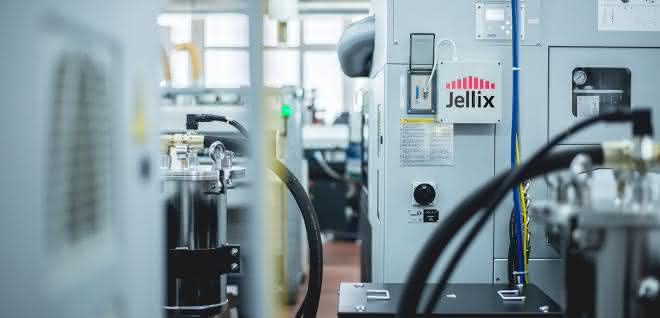
The stored software logic makes it possible to generate information based on the recorded data and display it transparently for all employees. This transparency, which can be called up practically in real time, identifies and rectifies weak points in the process directly without the need for lengthy, labor-intensive data collection. The effectiveness of the measures can be seen after just a few days. The overall aim is to use cost-intensive machine hours as efficiently as possible and to increase machine utilization. In the case of Tectri, the degree of utilization of the production facilities was increased by an average of 9 percent across the entire machine park. With 30 machines originally in use, this means that Tectri has generated new capacity to the value of 2.7 machines without making any additional purchases.
Open error handling and greater motivation
In addition to the purely economic added value, positive effects in terms of lean management have been observed. Dealing with errors and problems is now more open and positive, and their causes are analyzed directly within the team. The effects of countermeasures are also immediately apparent and provide additional motivation. Daily goals and visions can be communicated more easily by managers. The fact that employees always have access to the relevant information means that they can be guided and motivated by quantitative values. Interfaces to enterprise resource planning bring the order data directly to the machine. Target and actual planning can be compared at a glance so that bottlenecks can be responded to immediately. This simplifies the coordination of production planning and at the same time allows employees a higher degree of self-organization.
If chaotic circumstances prevail in the company, processes are massively optimized and process costs are reduced. In such cases, amortization can be achieved in less than 12 months. If, on the other hand, the critical processes are already standardized and the employees are self-disciplined, amortization can take longer. Fixed costs of the production plant can be spread over more workpieces produced, which either increases the margin or the sales price can be reduced while the margin remains the same. In other words: constant fixed costs, a small increase in variable costs (component-related) and 10 percent higher output lead to an increasing margin and thus to increasing profitability. This also depends on internal factors.
As data is only rarely collected prior to digitalization in the company, it is only possible to make limited statements about verifiable quantitative added value. However, if you consider that the greatest potential only arises through access to empirical data and the derivation of future scenarios, you can see the great potential that "Industry 4.0" offers companies. The predictability of events or the adaptation of production systems to certain recorded operating data is also the ultimate vision to be achieved in the medium term. For reliable future forecasts, however, it is essential to have access to as long a database of experience as possible. Tectri has already successfully mastered these first important steps.
Raphaël Müller, Head of Industrial Solutions, Brütsch/Rüegger Tools


You might also be interested in
Plagiarius 2024 negative prize
On January 26, 2024, the Plagiarius campaign awarded its dreaded "Plagiarius" negative prize for the 48th time to manufacturers and retailers of particularly brazen counterfeits and fakes.
 read more...
Ivalua honors winners of the Generative AI...
AI-supported "add-ons" for buyers within 48 hours
Ivalua, provider of cloud-based spend management solutions, announced the winners and innovations of the first Generative AI Innovation Cup. The competition took place in December 2023. It was open to all Ivalua partners and employees - more than...
read more...Efaflex celebrates 50 years of high-speed...
The emphasis is on "fast"
Since day one, Efaflex has wanted to use new technologies as early as possible and drive progress in the industry. This year, the family business is celebrating its 50th anniversary under the motto "Fast Forward".
read more...Security of supply even during power outages
In the winter of 2022, Germany was worried about energy shortages. The drugstore retailer dm did not paint any horror scenarios, but nevertheless saw the possibility of controlled, temporary, regional power cuts (brownouts).
read more...Safety technology in mechanical engineering
Modules with new functions
Euchner's product highlights at EMO 2023 include the communication-capable solenoid interlocks.
read more...Transforming the paper industry towards climate neutrality
Together with partners from industry and research, Voith is developing a project for the optimization of energy and material flows in paper production. The aim of the research project is to develop a digital framework that enables effective process...
read more...Up to 95 percent less flue gas thanks to direct extraction
The requirements for occupational safety measures and safety technology are also constantly increasing in welding technology. The Technical Rules for Hazardous Substances (TRGS) stipulate that welding fumes and harmful substances must be extracted...
read more...Competitive advantages with large machines
Whether 3D-printed components for machines and systems, prototypes or aids for design: additive manufacturing is almost indispensable for modern companies in mechanical and plant engineering and automation if they want to play in the premier league.
read more...Transport technology from the modular system
Many transport tasks can be realized with the help of linear technology. Pre-configured solutions are available to simplify the interaction between the linear unit, motor, gearbox and controller. This minimizes the effort required for research and...
read more...