

Quality control via sound
Acoustic quality assurance with AI
Many companies are reluctant to use artificial intelligence models, as they can quickly become confusing. However, this means they leave a lot of potential for quality control untapped. The new IDMT-ISAAC software now makes it possible for users without expert AI knowledge to benefit from artificial intelligence.
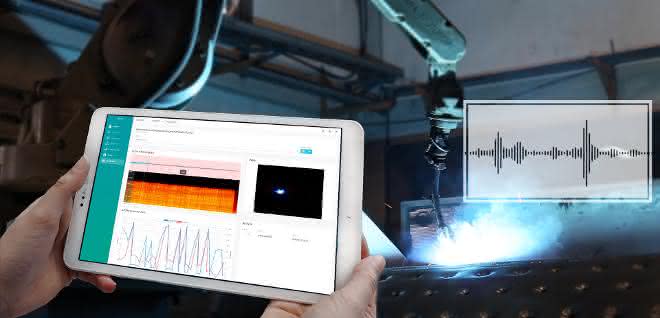
Artificial intelligence offers great potential, for example in the quality control of manufacturing companies. However, training AI models is difficult and requires mathematical knowledge, as there are countless parameters that can be included in such an analysis. The barriers to entry are therefore high - small and medium-sized companies that do not have their own development department often shy away from AI applications. Expertise is also required during operation: if an AI algorithm has been trained and the product design or geometry of the component is then changed slightly, the algorithm initially recognizes this as an error. In this case, the AI must be retrained.
AI can also be operated without expert knowledge
The IDMT-ISAAC software from the Fraunhofer Institute for Digital Media Technology IDMT in Ilmenau helps users without expert AI knowledge to overcome these hurdles. IDMT-ISAAC stands for Industrial Sound Analysis for Automated Quality Control. "We want to enable SMEs to adapt and customize the AI algorithms themselves," says Judith Liebetrau, Group Manager Industrial Media Applications at Fraunhofer IDMT. "They can apply IDMT-ISAAC to their own audio data, retrain it and thus obtain fast and reliable results and decision-making aids for their quality assurance."
As experienced machine operators know, errors can often be recognized by the sound of the process. IDMT-ISAAC also relies on acoustics: the researchers have trained the system with recorded acoustic data from welding processes, the AI analyzes the typical process noises and draws conclusions about the quality of the respective weld seam from the audio data. At the heart of IDMT-ISAAC is a framework that allows users to change various parameters with just a few clicks, for example to teach the AI to change the geometry of the product. In summer 2021, the software should be adapted to live operation - meaning it could then immediately analyze real-time data from production and optimize quality assurance. In three to four years, it should also be able to actively intervene in production. However, the framework does not only offer new analysis options for welding. "We have integrated various methods into the modular system in order to be able to map other processes relatively quickly," explains Liebetrau. In the future, it should also be possible for companies to use their own software and access the Fraunhofer IDMT's AI via an interface on its server. However, regardless of whether the companies integrate the AI via the framework or access it via an interface: Data protection and data security are always observed, as the data is processed anonymously.
Understanding the AI's decisions
The software can be adapted to different user groups via various user profiles: AI beginners as well as AI experts. For example, it is very interesting for developers of AI algorithms to get a feel for how the AI makes its decisions and which sounds it uses to make them. "With the framework, we are therefore also moving towards explainable AI to make AI more comprehensible," says Liebetrau.


You might also be interested in
Plagiarius 2024 negative prize
On January 26, 2024, the Plagiarius campaign awarded its dreaded "Plagiarius" negative prize for the 48th time to manufacturers and retailers of particularly brazen counterfeits and fakes.
 read more...
Ivalua honors winners of the Generative AI...
AI-supported "add-ons" for buyers within 48 hours
Ivalua, provider of cloud-based spend management solutions, announced the winners and innovations of the first Generative AI Innovation Cup. The competition took place in December 2023. It was open to all Ivalua partners and employees - more than...
read more...Efaflex celebrates 50 years of high-speed...
The emphasis is on "fast"
Since day one, Efaflex has wanted to use new technologies as early as possible and drive progress in the industry. This year, the family business is celebrating its 50th anniversary under the motto "Fast Forward".
read more...Security of supply even during power outages
In the winter of 2022, Germany was worried about energy shortages. The drugstore retailer dm did not paint any horror scenarios, but nevertheless saw the possibility of controlled, temporary, regional power cuts (brownouts).
read more...Safety technology in mechanical engineering
Modules with new functions
Euchner's product highlights at EMO 2023 include the communication-capable solenoid interlocks.
read more...Transforming the paper industry towards climate neutrality
Together with partners from industry and research, Voith is developing a project for the optimization of energy and material flows in paper production. The aim of the research project is to develop a digital framework that enables effective process...
read more...Up to 95 percent less flue gas thanks to direct extraction
The requirements for occupational safety measures and safety technology are also constantly increasing in welding technology. The Technical Rules for Hazardous Substances (TRGS) stipulate that welding fumes and harmful substances must be extracted...
read more...Competitive advantages with large machines
Whether 3D-printed components for machines and systems, prototypes or aids for design: additive manufacturing is almost indispensable for modern companies in mechanical and plant engineering and automation if they want to play in the premier league.
read more...Transport technology from the modular system
Many transport tasks can be realized with the help of linear technology. Pre-configured solutions are available to simplify the interaction between the linear unit, motor, gearbox and controller. This minimizes the effort required for research and...
read more...