

Automated data analysis in real time
Data management: achieving the maximum

The analysts at Juniper Research assume that the total number of sensors and devices connected to the IoT will rise to over 50 billion by 2022. According to Juniper, this figure is currently estimated at 21 billion. The number of companies that want to invest in IoT technologies in the future will continue to grow rapidly due to technological progress, which is constantly producing smaller, cheaper and more effective sensors. The challenge today is no longer the implementation of the technology, but the added value that companies can derive from the collected data. However, IT teams that need to deploy new IoT solutions and deliver this value face several obstacles in accomplishing this task. Gaining the desired value by making insights from data quickly and easily accessible to the business has always been difficult. Adding more data, data sources, data types and streaming data to the existing data mix can make this nearly impossible with existing methods of data processing, storage and analysis. To get the most out of their IoT investments, organizations need to align necessary tactics within their strategy.
Automation
Due to the many connected devices and the resulting volumes of data, automation is the only realistic solution to deal with the enormous amounts of IoT data. From raw IoT data, automation helps organizations receive, process and deliver valuable data and derived insights for use in real time. It can ensure that IT teams can manage astronomical volumes of data and are able to deliver insights in a way that an organization can use and derive value from. Automation reduces the need for human interaction by eliminating the manual programming and repetitive, time-consuming requirements of data infrastructure projects. This has several key benefits: Insights from data can be delivered in much less time at a lower cost with significantly improved quality and reliability of results. In addition, it allows the responsible employees to concentrate on the more strategic content of their work.
But it is not enough to simply automate the processing of data. The only way to process data efficiently is to stream it on site. And as soon as it is created, not at a later point in time. An example from a transportation company illustrates why it's important to use live data streaming to leverage real-time analytics:
Imagine a bus company that has hundreds of buses on the road every day. The company wants to understand how its bus fleet is running as close to real-time as possible to maximize the overall efficiency of the service. With IoT data collected from on-board sensors, the bus company can analyze this data in real time in the field to diagnose problems immediately. In the past, data was downloaded from the on-board sensors at the end of the working day. This was problematic as a bus could have been out of service for a whole day or behind schedule for other reasons. So there was no way to use data for a whole day to avoid problems later on. With streaming data, however, the problem could be detected by sensor units in real time and action could then be taken. For example, if a bus is at risk of failure. By processing the data in real time, the bus company could immediately detect if the brake pads were thinning and then notify the mechanical department to replace them before the bus could break down.
Data types generated by the IoT
Hundreds of sensors on buses, thousands of sensors on a modern airliner, video surveillance cameras, machines in a factory - there is a huge amalgamation of different data sources and formats, all coming from IoT devices. Some of this is traditional, structured data, but there is a rapidly growing amount of semi-structured and unstructured data that needs to be processed in real time at best. But before all this information can be turned into actionable insights, it needs to be collected and put into a manageable form. A task far too complex to be carried out by humans - automation is the only way to do this efficiently.
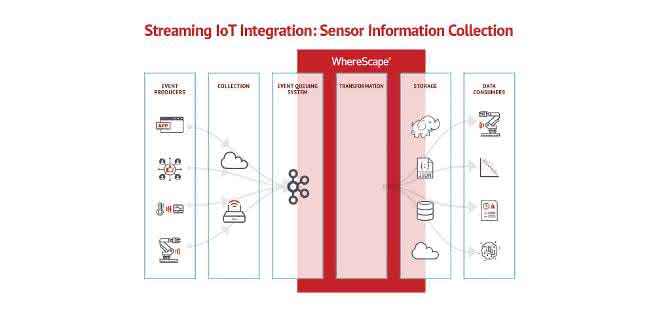
By using complete data streams, some of their value can be increased. These data sets can be stored in full and can be analyzed later in order to identify trends, for example. In general, it is more advantageous to filter and process all data during recording. In order to understand exactly what to do with the various IoT data streams, companies need to establish an accurate information flow that provides an overall view of what critical, time-sensitive information may mean. At the same time, companies need to ensure that they store the right historical information to help identify future developments.
A data lake architecture can be useful as a storage location to store the entire amount of structured, semi-structured and unstructured data in its original format. However, in this case, automation tools are needed to transform the data from a conglomerate of ones and zeros into valuable insights.
The impact of the IoT on data storage
When it comes to the infrastructure of IoT environments, the first reaction to the enormous increase in data is usually to buy a lot more data storage. However, as the growth of IoT data is exponential, this is a costly and short-term strategy. Instead, companies need to think about how to transform - and therefore reduce - the data in the process of storing it. Real-time data analysis means that companies can store condensed data rather than huge transaction tables for future analysis. This not only saves storage costs, but also speeds up future reporting and improves the quality and reliability of insights. It's about finding out what is valuable and what is not. It often makes sense to store the raw data for a certain period of time in order to test new workloads. For this, cloud storage can be a cost-effective short-term option as part of a data lake infrastructure. But again, it will be critical to use automation to organize this information, manage the schemas and be able to analyze, query and search the data in the most effective format.
The IoT market continues to grow
Sensors for every conceivable purpose are now affordable. The economic value of the market is expected to reach 11.1 billion US dollars by 2025. IoT environments are no longer only used by large companies with corresponding budgets. Many smaller companies are also looking for ways to drive their business forward based on IoT information. In addition to sensors and applications, sophisticated automation tools are also available to shorten time-to-value and thus have an immediate impact on the business. The next step for many companies to manage and increase the value of their data will be the implementation of artificial intelligence, deep learning and machine learning. Then it will no longer be a question of wanting to afford the technology or not, but rather the creativity of companies will be required to determine the extent to which the knowledge gained can be used to create value.
Regardless of their size, data is one of the most valuable assets for most companies. This is because it can be used to gain a business advantage over competitors. Sensors for IoT applications have become cheaper and can provide companies with all kinds of data. But the investment in IoT would be pointless if the company was not able to gain useful insights and value for its business progress. To maximize the potential of their investment, companies need to adapt some key parts of their IoT strategy. Automation tools are absolutely critical as they can process the huge volume of a variety of data as it is generated. They automatically process the huge amounts of raw data into smaller but more usable insights in the right format, without manual intervention by IT staff. Whatever stage of IoT implementation a company may be at, automation must be a crucial part of making their investment a success.
Neil Barton, CTO of WhereScape / ag


You might also be interested in
ESTIA aims to strengthen Europe's cloud
New tech alliance for EU sovereignty
Twelve companies, including Dassault Systèmes, are founding the European Sovereign Tech Industry Alliance (ESTIA). The initiative aims to strengthen Europe's technological independence and define requirements for sovereign cloud services. The start...
 read more...
Deutsche Telekom and Nvidia launch one of Europe's largest AI factories
With the Industrial AI Cloud in Munich, Deutsche Telekom and NVIDIA are creating one of the largest AI factories in Europe. Companies can train AI models, carry out simulations and access 10,000 GPUs.
read more...Leveraging data potential with AI and streaming
Huge data treasures are still lying dormant in many manufacturing companies. And yet it is high time that these treasures were unlocked. There is often a lack of resources and capacity to make data usable in real time. Streaming production data can...
read more...More awareness of noise
Dematic offers solutions that are tailored to different cloud environments and reduce environmental impact through reduced material consumption and improved energy efficiency.
read more...Generative AI in the automation environment
The mechanical engineering and automation industry is undergoing profound change. This transformation is being driven by more volatile global trade, geopolitical crises and increasing market pressure, which demands greater agility, technological...
read more...Rigid data structures have had their day
The traditional data center is no longer the center of data. A hybrid cloud storage approach enables manufacturing companies to both meet the current requirements of data-intensive processes and future-proof their infrastructure.
read more...Software as a service in three stages
CIM Database Cloud is a new out-of-the-box solution from Contact for end-to-end digital product development.
read more...How production can benefit from AI
Together with AI technology, IIoT networking makes it possible to better control machine parameters and optimize quality with predictive quality. Downtimes and set-up times can also be further minimized. Cloud platforms also make these technologies...
read more...More expertise for digital engineering
Altair, a computational science and artificial intelligence (AI) company, has acquired OmniV, a technology from Michigan, USA-based software company XLDyn.
read more...