

Scara robot
Versatile Scaras in valve production
The Italian company Camas relies on Scara robots from Epson in a system for the production of valves. They ensure the necessary flexibility and productivity in production.
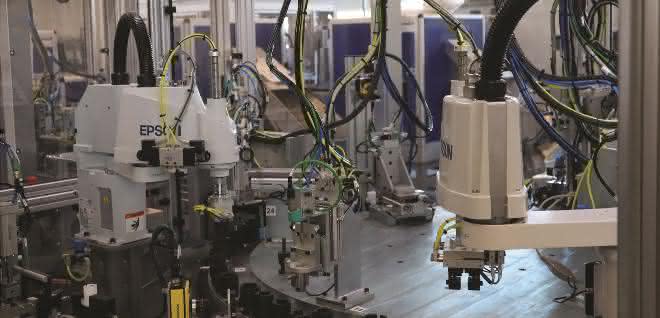
Since the invention of Scara robots, they have been synonymous with high speed and very good (relative) repeat accuracy in the automation industry. Thanks to their four axes, they also have a simple, robust design and a good price-performance ratio. All this explains the success of these machines. However, the strong diversification and reduction in the batch sizes of components to be produced, particularly since the beginning of the 2000s, also led to customers placing higher demands on the flexibility and adaptability of their production systems. Between 2011 and 2016, the Scaras market grew by an average of 12% per year [1] and now accounts for an important part of the overall robot market - and the trend is still rising.
A system from Camas in Rovato (Lombardy, Italy) demonstrates what Scaras can do and how companies can use these machines to ensure a high degree of flexibility in their systems. Founded in 1981, the company specializes in the design and construction of assembly and testing systems. A total of eight Epson Scara robots are used in a highly modular, flexible assembly and testing line developed by the company for safety valves used in car tanks.
In addition to the short cycle time (≤3.6 s per valve to be produced), the 15 possible valve variants, which can only be produced alternately with a short lead time in various large batch sizes, were a particular challenge for the customer. The use of the four-axis machines gives the system its high adaptability to rapidly changing tasks. They play a key role within the entire production line for "pick & place" applications. The robots make it possible to produce different variants of the component without the need for additional hardware components or compromising on execution speed.
The production line
The system comprises a total of five stations, consisting of four rotary tables and a free-running pallet conveyor, where the various sub-assemblies of the valves are constructed and finally assembled. The last station is a test station, which tests the finished valves for certain parameters. The design requires a number of constructive measures to make switching between different variants easier and more efficient. It is therefore possible that one station is busy constructing variant 1 while variant 2 is running at another station.
"A line of this complexity contains a number of stumbling blocks in the design," explains a Camas representative. "Fast and efficient handling systems like Scara robots help us a lot to be competitive in this demanding market. That's why we decided to have Scaras handle all the pick & place processes at this plant. Firstly, unlike other solutions, they allow us to process two components in parallel and secondly, they simplify the entire programming and coordination process. In addition, thanks to their simple design, the maintenance effort for the system is reduced without compromising performance and speed. After all, we must never forget that the system has to produce a finished part in a maximum of 3.6 seconds."
The first stage of the system deals with the component that controls the opening and closing phase of the valve. Here, various very small workpieces have to be picked up quickly and precisely in the correct orientation and reoriented. The choice of Scara robots for this segment makes it possible to process two components in each cycle instead of one. In the next part of this section, the pre-assembled part is quickly and accurately placed in the desired orientation. With the Scaras, the machine becomes smaller, as no mechanical aligner is required for the respective valve variant. The Scaras are also reliably fast and precise.
In the two subsequent stations, other sub-assemblies of the valve are assembled, which ultimately make up the entire component. Here, two Scara robots remove and assemble the relevant components from a supply.
"A central PLC monitors the entire line," explains Camas. "All of the machine's production data, including the batch of each individual component, is automatically tracked, stored and archived. If required, we can also provide our customers with IT support and help them manage their production data."
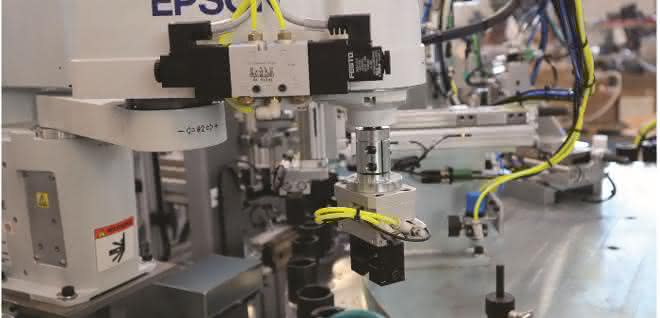
The final phase of the production line has a special feature in connection with Scara robots. At the special request of the user, there should be a backup station where the rejected parts are collected at the end of the day, evaluated, possibly sorted and then returned to the machine without having to throw away the entire valve with a faulty component. Care must be taken to ensure precise alignment of the valve on the return conveyor. This is possible thanks to the flexibility of the system. This is because if a valve has a "bad test", it is automatically removed from the assembly process without having to build an additional gripping and moving element for each variant. The other trajectory for 'bad' parts is also quick and easy to implement.
Camas continues: "Our system does not work strictly sequentially, but makes its own decisions depending on the available capacity. The PLC identifies free stations and optimizes the work process accordingly. This also makes the test cycle more complex, because a type 1 valve may be tested after a type 2 valve and then a type 1 valve is due again. This is where the simplicity with which Scaras align parts of almost any complexity is particularly helpful."
Variety of options without oversizing
The ability to select the optimum solution from a wide range of robot options was a decisive factor in the success of this line. Camas installed Epson-Scaras from three different series. The entry-level robots in the Epson T series are devices that have an internal controller and were mainly designed for simple tasks. The manufacturer describes them as "just enough" products because they are inexpensive and simple in design and meet completely simple requirements.
The slightly more sophisticated Epson LS series is characterized by a higher speed and has a built-in control system to control the movements. The Epson QMEMS technology, a piezo-based sensor, detects any vibrations of the robot arm and counteracts them accordingly. The result is a particularly smooth, precise movement without any loss of speed. QMEMS is also particularly suitable for avoiding overshooting when approaching a target point quickly.
Finally, the Epson G series represents the top models of the Epson Scara series. These robots are by far the most powerful machines in terms of precision and speed. They are also available in a variety of different assembly configurations. There is also a cleanroom version and various IP classes (IP54, IP65 and so on).
According to documents from Epson / ag
Literature:
[1] Technario Market Research.


You might also be interested in
ebm-papst is growing again thanks to AI and data centers
ebm-papst returned to a growth trajectory in fiscal year 2025/26. Air Technology, data center applications, and artificial intelligence are driving revenue and investment.
 read more...
SPE on the Verge of a Market Breakthrough
Single Pair Ethernet (SPE) has moved beyond the conceptual phase and is increasingly being implemented in industrial settings. The focus here is not only on higher data rates and simplified cabling, but above all on the issue of system integration...
read more...More than 900 exhibitors already registered
Around six months before the start of the trade fair, more than 900 companies have registered for SPS 2026 in Nuremberg. The trade fair focuses on industrial AI, cyber security and digital transformation.
read more...Virtual PLCs in practice: How vPLCs make production systems more flexible and scalable
The increasing networking of IT and OT is fundamentally changing industrial automation. The IT/OT Integration Summit shows how modern technologies can make production environments more efficient, flexible and future-proof. The event will focus on...
read more...Sales growth in a turbulent market environment
Thanks to innovations and a focus on strategic industrial markets, Sick was able to moderately increase its sales in the 2025 financial year. In a turbulent market environment, the company was able to maintain its position and gain market share with...
read more...Siemens presents new AI agent
Siemens is launching 'Eigen Engineering Agent', an AI for automation technology. The solution is integrated into the TIA Portal, has been tested with over 100 companies and is designed to significantly accelerate engineering processes.
read more...Schaeffler keeps sales almost stable
Schaeffler generated revenue of EUR 23.5 billion in 2025 and increased EBIT before special items to EUR 936 million. At 266 million euros, free cash flow was significantly above the prior year and forecast. Net income remained negative due to high...
read more...Advancing artificial intelligence together
Helukabel is stepping up its activities in the field of artificial intelligence and is now a member of the IPAI. The innovation and collaboration platform for companies, research facilities, institutions and administration has set itself the goal of...
read more...New impetus for ifm sales
Two new positions were filled at ifm at the start of 2026: Markus Wolf becomes Managing Director Sales Germany, Sven Quant takes over the position of Central Managing Director in the Process Sensors division within the ifm Group.
read more...