

Automatic disassembly
Robot recycles batteries
Used batteries from electric cars contain valuable raw materials that can still be used. In order to be able to recycle them, a research team from the Center for Digitized Battery Cell Production (ZDB) at Fraunhofer IPA is developing a robot cell with a wide variety of tools. It should be able to carry out all the necessary dismantling steps and be suitable for all battery types.
This trend, due to climate change, is creating a recycling problem: more and more batteries are being produced that need to be recycled. As a battery lasts around ten years on average, the problem is becoming more pressing every year. A team of scientists and technicians from various institutes is therefore looking for a way to deal with this impending flood. The "Industrial dismantling of batteries" (DeMoBat) research project, coordinated by the Fraunhofer Institute for Manufacturing Engineering and Automation IPA, aims to provide a universal solution that is suitable for all work steps and battery types.
Giving batteries a second life
The components of a battery cell are to be dismantled according to type and then checked to see whether they are still good enough for direct reuse. The aim is to one day create second-life batteries from used components. If the used components are no longer suitable, at least their chemical components are to be processed. This is because used batteries contain many raw materials that can still be used, such as nickel, cobalt, manganese and lithium. To get to them, the component must first be dismantled: Wires, cables, plugs, seals, screws, battery cells, electronic components, brackets - all of this has to be dismantled.
Lorenz Halt from the Robot and Assistance Systems department at Fraunhofer IPA is responsible for this part of the research project. The challenge here is that it is not a worker but an industrial robot that has to do the work. This is all the more difficult as car batteries are not standardized. Different makes of car, even different models, have different power storage units. The dismantling system must therefore be very flexible. Halt compares it to a Swiss army knife.
Robot unscrews or mills open the housing
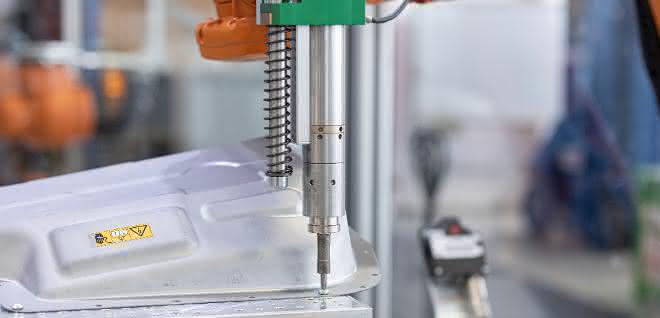
A two by three meter table with a flexible clamping system that can firmly grip any battery serves as a work surface. The robot first opens the cover by unscrewing the screws. Intelligent image processing shows it the way. But this doesn't always work, because after ten years in wind and weather, some screws are corroded and can no longer be loosened. Thanks to machine learning, the robot recognizes early on whether it can reach its destination with the screwdriver or whether it needs to reach for the milling cutter.
"Of course, it could also mill immediately," says researcher Halt. "But that's not the optimal strategy, because it produces metal chips that could lead to a short circuit and ultimately to a fire." But the system is also equipped for such cases: If a fire breaks out, a pusher quickly clears all the parts lying on the work table into an extinguishing bath.
First demonstrator as early as this fall
As with the screws, the devil is in the detail elsewhere too. Halt and his team had to solve numerous problems and develop new tools. For example, a type of can opener is used to loosen seals. And to lift out the individual battery cells, which are glued together, the experts involved have developed a kind of mini jack. Ingenuity is also required when handling cables and plugs that are difficult to grip.
The DeMoBat research project, which will run for a total of three years, has just reached the halfway point. The interim results are promising: the first demonstrator should be on display this fall. "In the future, we also want to develop solutions that make it possible to process the recovered and still intact components of a battery for a further life cycle and reassemble them into a new system," announces project manager Max Weeber.


You might also be interested in
Helu makes its first trade fair appearance under a new brand name
Helu Kabel will be presenting itself as Helu for the first time at Hannover Messe 2026, showcasing system solutions, Heluchain cables and new industrial luminaires.
 read more...
Strategic realignment with brand relaunch
In future, Helukabel will trade as Helu
The Helukabel Group is parting with part of its name: in future, the company will only operate under the Helu brand. With this step, the specialist for electrical connection technology is underlining its strategic development from a classic cable...
read more...Modular plant construction for corrugated board
Insight into the production of corrugators at BHS Corrugated: Automated, modular and equipped with Helukabel components.
read more...Best quality for the steel
Conditions in the steel industry are harsh and inhospitable. The machines used must be able to withstand the demanding environmental conditions in order to deliver the best quality at all times.
read more...If the standard cable is not sufficient
Lapp offers cables for countless applications - but not for all of them. From time to time, the developers have to modify a standard cable or develop a special cable.
read more...Slight decline in sales, strong investments
The Lapp Group has not been spared from the weakening global economy. However, the company only recorded a slight loss in the past 2024 financial year.
read more...Electrical connection technology
Cables and wires for industrial automation
Heukabel offers system solutions for cable routing from a single source. The subsidiary EKD Systems specializes in tailor-made cable drag chains made of steel, stainless steel and plastic, which are used in moving machines and systems as well as in...
read more...Lapp relies on Ultramid from BASF
Mobile charging of electric vehicles
The automotive industry is currently undergoing the biggest transformation in its history. The boom in battery electric vehicles in particular is presenting the industry with major challenges. Lapp, as a supplier of cables and connection...
read more...Cable handling application
At this year's Motek, ArtiMinds Robotics is showcasing a robot-based automation solution for the sensor-assisted assembly of flexible cables in connector housings.
read more...