
ROS - Robot Operating System
Making robotics open
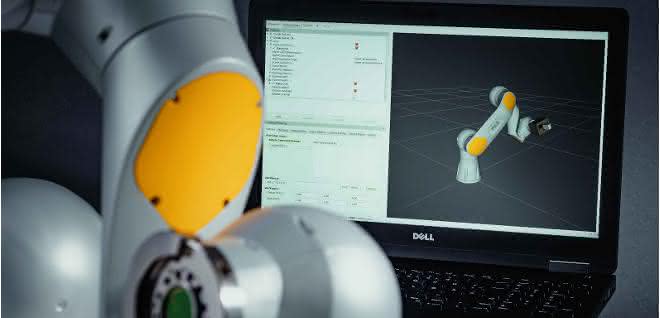
Robot Operating System, or ROS for short, is an open source framework for writing software for robotics applications. This programming framework consists of a collection of functions, drivers and a communication layer. Programmers create their own ROS packages, which contain certain functions and drivers and are made available to users via a community. This can be, for example, path planning, which is then adapted by the user to their individual application, such as a pick-and-place application. The individual packages are modular and compatible with hardware from different manufacturers.
ROS was developed in 2007 in a university and research environment. One advantage of the open source framework is the collaboration in the ROS community with specialists from various fields - from research institutions to robot manufacturers. Together, they are able to program even complex robotics applications. This online community works together on the ROS packages, carries out reviews and tests and supports each other. This includes, for example, the documentation of the packages, the processing of pull requests, i.e. suggestions for improving the code, and the creation of tutorials.
The advantages of ROS include the open availability of the source code and the use of programming languages such as Python or C++. This makes ROS ideal for industrial applications in which different sensors and actuators from any manufacturer take on different tasks and control complex algorithms. This requires a standardized communication layer.
The service robotics modules
With the service robotics modules, Pilz is presenting a modular kit from which users can put together their own individual robot application. This only works thanks to openness and the appropriate physical and virtual interfaces. Pilz therefore uses ROS for the service robotics modules. Many robot manufacturers have their ROS packages developed externally. In Pilz's case, however, the packages come directly from the manufacturer and take over the control and not just the sending of commands to the manufacturer-specific robot controller. The drive electronics are integrated in the manipulator and react directly to the set values of the ROS packages. This offers the user freedom in terms of path and motion planning. The company supports the ROS community not only by programming packages, but also with pull requests and the documentation of central code in the ROS wiki. Pilz also offers its users product support for its own ROS packages.
Open, but with quality standards
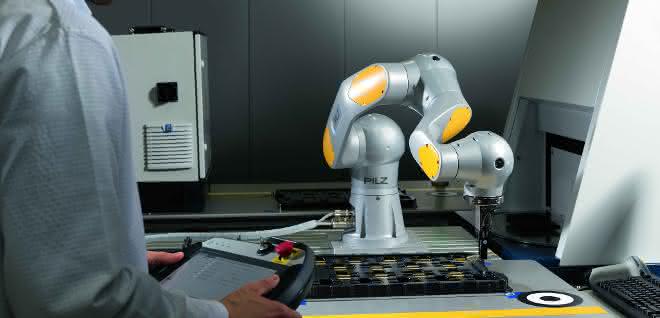
But how does the user benefit from this openness? Thanks to tutorials, users can quickly familiarize themselves with the packages. This means that even a mechanical integrator without expert knowledge of programming with ROS can set up their robot application individually. This can be interesting for small and medium-sized companies, for example, who want to use robots to increase the level of automation in their production. ROS also makes it possible to implement robot applications such as palletizing, conveyor tracking or camera-based object recognition.
For users who are not familiar with the special programming languages used in industry in accordance with EN 61131, it is also advantageous that ROS packages can be implemented using the Python programming language, among others. A Python programming interface also makes it possible to use the MoveIt! interface - a tool for path and motion planning. MoveIt! uses an environment model and the target position to plan the path of the manipulator. Pilz provides the robot kinematics there so that the specific application of the manipulator can be modelled in the 3D visualization tool RViz or in a simulation environment such as Gazebo. This saves the user time and money when commissioning the real robot virtually.
Open source also poses challenges: ROS packages generally come from different authors within the community. The quality of the packages therefore ranges from undocumented modules to professional, high-quality projects. A high quality standard for its ROS modules is very important to Pilz, which is why the software is developed and tested in accordance with the industrial quality criteria and requirements of the ROS Industrial Consortium. High-quality ROS packages make system integration easier for the user, as the packages are well documented and supporting tutorials are provided.
The ROS Industrial Consortium is an association of industrial companies that want to use and promote ROS for industrial applications. The initiative has around 65 members worldwide, ranging from start-ups to corporations and from research institutions to industrial end users. In Europe, the activities are coordinated by Fraunhofer IPA. The activities include, for example, the Easy Cohmo (Ergonomics Assistance Systems for Contactless Human-Machine Operation) research project, in which Fraunhofer IPA is developing gesture-controlled programming together with Pilz and other partners.
Dr. Manuel Schön, Product Management Controller at Pilz / ag
Hanover Fair, Hall 9, Stand D17


You might also be interested in
Conrad continues to grow
Conrad Electronic now generates 80% of its sales with business customers and has successfully developed from a traditional technology retailer into a B2B procurement platform. The company aims to become Europe's leading procurement platform for...
 read more...
AI finds its way into automotive customer service
In addition to computer solutions for vehicle diagnostics, Getac now also offers AI-based digital tools that support customer contact in service operations.
read more...SMC: "Preferred Supplier" from Bosch
The technology and service company Bosch has recognized SMC for the performance of its automation technology in factory and process automation and awarded it the status of "Preferred Supplier" in the material group "Standardized Pneumatic Devices".
read more...Combined ERP forces
The medium-sized ERP providers Step Ahead Software, Godesys and Informing merge to form the Step Ahead Group.
read more...Cybersecurity for asset-intensive companies
Forge Cybersecurity Platform, the new software platform from Honeywell, has been developed for the cybersecurity of asset-intensive companies and critical infrastructures. The platform is available in three versions.
read more...Automated machine tool as a success factor
Industry 4.0 is the hot topic of the moment. For small and medium-sized companies and contract manufacturers, it holds great potential for increasing production efficiency step by step. The focus here is on efficient and user-specific automation...
read more...Nemo hand vacuum lifts all materials
A new addition to the Eurotech portfolio is the battery-operated Nemo vacuum cleaner, which is suitable for handling almost all surfaces.
read more...Future-oriented cobot projects
Three pillars of successful cobot initiatives
What is important if cobot projects are to be future-oriented? Automation and robotics expert Omron has identified three aspects for human-machine collaboration.
read more...Short-stroke linear actuator instead of pneumatic cylinders
The new short-stroke linear actuator from Ketterer Antriebe and halstrup-walcher is characterized by high dynamics and a large stroke in a compact size. Thanks to the integrated electronics, the drive is easy to control compared to pneumatic...
read more...