
Precise positioning
Readjustment with the piezo effect
If a dimension between two components changes within precision machines, they must be readjusted. This may be necessary, for example, during initial setting after installation on site. This often affects optical or metrological equipment, astronomical devices, wafer processing machines or positioning systems for the heavy precision industry. Piezo-based washers are a practical solution for adjustment processes. These allow the distance between two components to be adjusted with nanometer precision. By Mathias Bach and Ellen-Christine Reiff
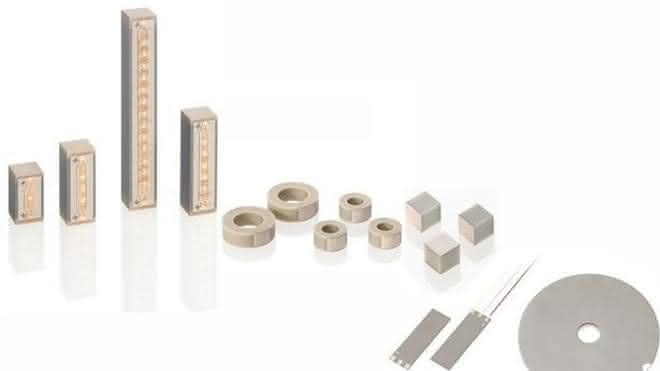
If components in precision machines need to be subsequently adjusted, washers ground to exact distances are often the method of choice. However, they have the disadvantage that they have to be installed mechanically. With the piezo-based PI Rest washers, Physik Instrumente offers an alternative. Due to the resolution of the actuators of a few nanometers, the washers are not only suitable for applications in classic mechanical engineering, but also for the adjustment of optical components in astronomy, materials research in synchrotrons or in vacuum environments.
The piezo-based washers can already be provided for by developers when designing a machine. They are available in almost any shape and size, such as plates, rings, cylinders or even in application-specific shapes. Like the PICMA actuators, they are manufactured using PI's own multilayer technology. The actual piezo ceramic - a monolithic block whose active layers consist of thin ceramic foils - is surrounded by a completely ceramic insulating layer. This protects against moisture in the air and against failures caused by increased leakage current. The monolithic piezoceramic block of a PICMA actuator achieves a high level of reliability even under extreme environmental conditions, such as in space travel, and can extend the service life.
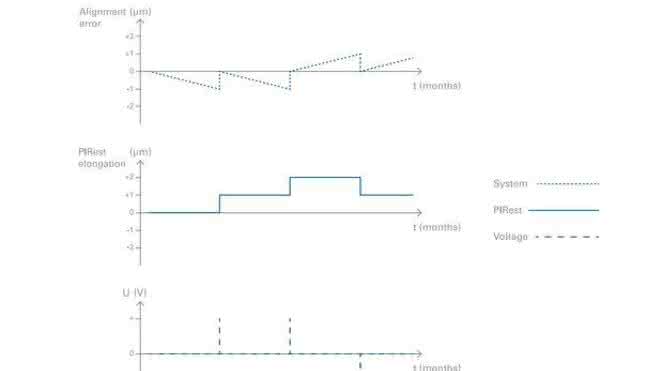
However, there is one point in which PI residual actuators differ from piezo actuators, which are not suitable for readjustment: With classic piezo actuators, the electrical voltage (offset voltage) must generally be maintained on the actuator as long as the deflection is required. This has disadvantages for adjustment applications: When equipping the machine, an additional power supply would have to be provided for this, and the service life of the actuators would also suffer. Although PI-Rest technology is based on piezo actuators, they maintain their deflection after adjustment in a stable and nanometer-precise manner even without an offset voltage thanks to a special control system.
Long-term stability in the nanometer range
The static distance can be adjusted by briefly applying a supply voltage to the actuator. A voltage connection is provided for this in the so-called "Active Shim", which only needs to be connected to a voltage source during the adjustment process. PI offers an easy-to-use power supply with the appropriate control for this purpose. The necessary cables can already be taken into account when designing the machine.
After adjustment, the actuator maintains the desired position without tension over the long term. The stability of the deflection depends only on the change in ambient temperature. Long-term tests in an environment with a temperature stability of 1 K have shown drifts of less than ±100 nm for an actuator with a nominal stroke of 10 µm, irrespective of the deflection. For standard products, the maximum deflection is between 5 and 35 µm, depending on the actuator size. The Active Shims simplify adjustment in inaccessible places, especially as the piezo-based shims can hold loads weighing several tons. If required, they can also be combined with classic piezo actuators, for example for dynamic vibration compensation.
Dr. Mathias Bach, Head of the Piezo Systems Product Division at Physik Instrumente. Ellen-Christine Reiff, M.A., editor at Redaktionsbüro Stutensee / am


You might also be interested in
Helu makes its first trade fair appearance under a new brand name
Helu Kabel will be presenting itself as Helu for the first time at Hannover Messe 2026, showcasing system solutions, Heluchain cables and new industrial luminaires.
 read more...
Strategic realignment with brand relaunch
In future, Helukabel will trade as Helu
The Helukabel Group is parting with part of its name: in future, the company will only operate under the Helu brand. With this step, the specialist for electrical connection technology is underlining its strategic development from a classic cable...
read more...Modular plant construction for corrugated board
Insight into the production of corrugators at BHS Corrugated: Automated, modular and equipped with Helukabel components.
read more...Best quality for the steel
Conditions in the steel industry are harsh and inhospitable. The machines used must be able to withstand the demanding environmental conditions in order to deliver the best quality at all times.
read more...If the standard cable is not sufficient
Lapp offers cables for countless applications - but not for all of them. From time to time, the developers have to modify a standard cable or develop a special cable.
read more...Slight decline in sales, strong investments
The Lapp Group has not been spared from the weakening global economy. However, the company only recorded a slight loss in the past 2024 financial year.
read more...Electrical connection technology
Cables and wires for industrial automation
Heukabel offers system solutions for cable routing from a single source. The subsidiary EKD Systems specializes in tailor-made cable drag chains made of steel, stainless steel and plastic, which are used in moving machines and systems as well as in...
read more...Lapp relies on Ultramid from BASF
Mobile charging of electric vehicles
The automotive industry is currently undergoing the biggest transformation in its history. The boom in battery electric vehicles in particular is presenting the industry with major challenges. Lapp, as a supplier of cables and connection...
read more...Cable handling application
At this year's Motek, ArtiMinds Robotics is showcasing a robot-based automation solution for the sensor-assisted assembly of flexible cables in connector housings.
read more...