
Robot integration
Process optimization during robot operation
To optimize robot applications, teach points are readjusted manually. Robot operation must be interrupted for this. ArtiMinds now offers a solution for fully automatic optimization.
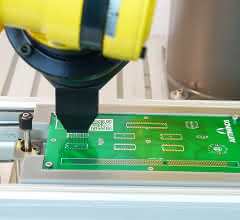
With the Learning & Analytics for Robots (LAR) software tool, the provider has developed a solution to specifically optimize relevant aspects of a robot program in terms of runtime and robustness and to continuously monitor processes.
Data analysis of the process data generated during operation of the robot is used for this purpose. This data can be automatically collected and annotated using the ArtiMinds RPS programming software without any additional programming effort. This means, for example, that the optimum starting point for a sensor-based search for a joining process can be determined very efficiently and transparently in LAR. The results can then be transferred offline to the RPS program to be optimized.
Fully automatic optimization
ArtiMinds now offers the option of using a PLC to enable fully automatic optimization without manual user input during ongoing robot operation, i.e. without stopping production. This acts as a gatekeeper between the LAR database backend and the robot controller, as the two have different requirements in terms of their communication protocols.
Furthermore, the PLC assumes the role of an additional safety instance that ensures that automatic optimizations can only take place to a safe extent and that guarantees uninterrupted robot operation even if the database is not available. Last but not least, an HMI on the PLC allows manual intervention in the optimization parameters or (de)activation of the optimization after successful user authentication.
Using the described approach of robot, PLC and data-driven optimization, not only individual, general optimizations can be carried out. The system is able to learn optimizations for each specific component or workpiece carrier and use them at runtime to suit the current situation. A reliable, self-optimizing system consisting of established industrial components can therefore be implemented from a single source.


You might also be interested in
ebm-papst is growing again thanks to AI and data centers
ebm-papst returned to a growth trajectory in fiscal year 2025/26. Air Technology, data center applications, and artificial intelligence are driving revenue and investment.
 read more...
SPE on the Verge of a Market Breakthrough
Single Pair Ethernet (SPE) has moved beyond the conceptual phase and is increasingly being implemented in industrial settings. The focus here is not only on higher data rates and simplified cabling, but above all on the issue of system integration...
read more...More than 900 exhibitors already registered
Around six months before the start of the trade fair, more than 900 companies have registered for SPS 2026 in Nuremberg. The trade fair focuses on industrial AI, cyber security and digital transformation.
read more...Virtual PLCs in practice: How vPLCs make production systems more flexible and scalable
The increasing networking of IT and OT is fundamentally changing industrial automation. The IT/OT Integration Summit shows how modern technologies can make production environments more efficient, flexible and future-proof. The event will focus on...
read more...Sales growth in a turbulent market environment
Thanks to innovations and a focus on strategic industrial markets, Sick was able to moderately increase its sales in the 2025 financial year. In a turbulent market environment, the company was able to maintain its position and gain market share with...
read more...Siemens presents new AI agent
Siemens is launching 'Eigen Engineering Agent', an AI for automation technology. The solution is integrated into the TIA Portal, has been tested with over 100 companies and is designed to significantly accelerate engineering processes.
read more...Schaeffler keeps sales almost stable
Schaeffler generated revenue of EUR 23.5 billion in 2025 and increased EBIT before special items to EUR 936 million. At 266 million euros, free cash flow was significantly above the prior year and forecast. Net income remained negative due to high...
read more...Advancing artificial intelligence together
Helukabel is stepping up its activities in the field of artificial intelligence and is now a member of the IPAI. The innovation and collaboration platform for companies, research facilities, institutions and administration has set itself the goal of...
read more...New impetus for ifm sales
Two new positions were filled at ifm at the start of 2026: Markus Wolf becomes Managing Director Sales Germany, Sven Quant takes over the position of Central Managing Director in the Process Sensors division within the ifm Group.
read more...