
Robotics and image processing
Pick and place: Precise to the point
A 3D image processing solution with 2D cameras, AI and robotics optimizes the production landscape.
The manufacturing industry is currently facing a number of challenges. Technological change, pressing environmental issues and globalization require a number of adjustments such as investing in new technologies, conserving resources and optimizing and securing supply chains.
Globally active companies have to assert themselves in a changing environment and at the same time overcome problems in supply chains. Shifting production back to the domestic market is increasingly an option. This requires not only a certain degree of resilience, but also compliance with strict environmental regulations and cost-efficient strategies to make domestic production competitive. If you want to ensure the competitiveness of domestic production, you also need to overcome staff shortages.
Automation through robotics has long since become the driving force here, and artificial intelligence is increasingly playing a key role. This technology is developing just as rapidly as the pressure to automate is increasing. In order to map production processes in your own company with AI, the simplest possible integration and the shortening of training phases are already decisive factors. This is where the British start-up Cambrian Robotics comes in with a fully AI-based solution for various robotics applications in production. It handles fast bin picking or pick and place, the precise feeding of parts for machines and various work steps in material handling.
Analyze and recognize
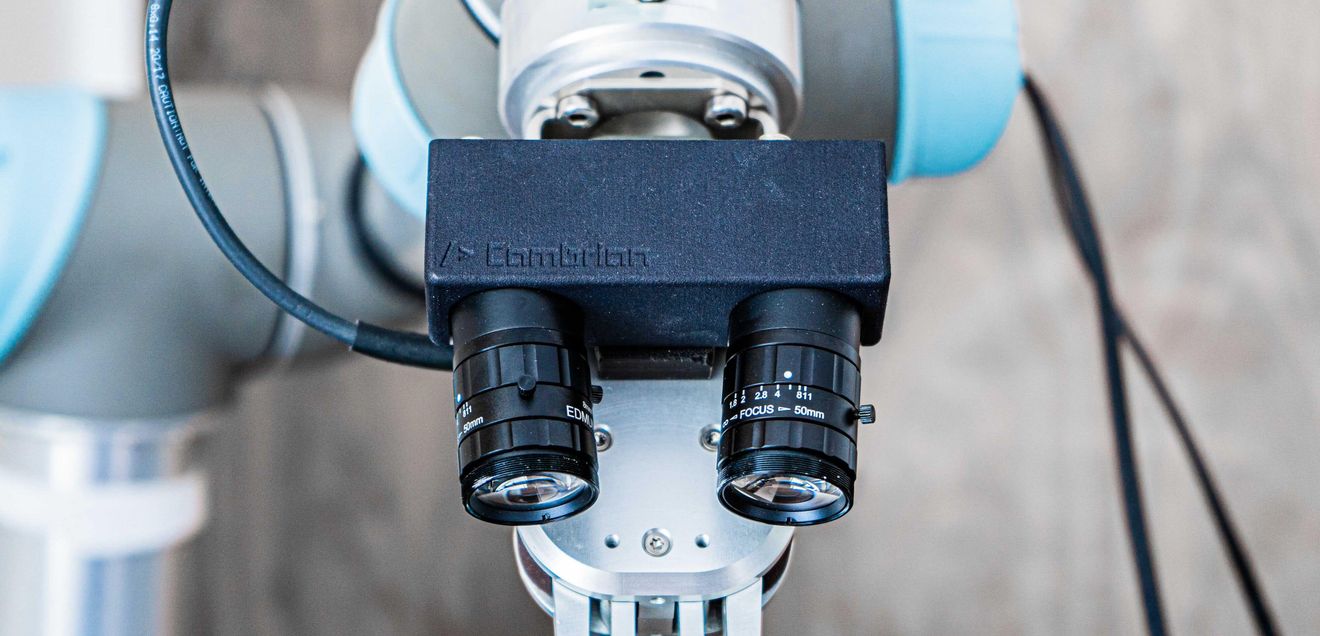
The easily integrated system consists of a module for robot arms, a computer unit with pre-installed, intelligent software and a camera module, each equipped with two uEye+ XCP cameras from IDS. "The task of the cameras is to capture an image of the area with the objects to be handled. Based on the images, the software can analyze the scene and identify exactly where the objects are located," explains Miika Satori, founder and CEO of Cambrian Robotics. The images are processed using the heart of Cambrian Vision, a self-learning software for predicting the position of parts and their pick points. This ensures image matching on an AI basis so that no classic 3D point cloud is required. Based on simulated data, the AI learns independently and localizes the pick points and parts extremely precisely. The AI models for part recognition and communication with the robot are controlled by a powerful GPU. "With the Cambrian software package, pick points for new parts can be defined and the application configured in just two to five minutes," emphasizes Satori.
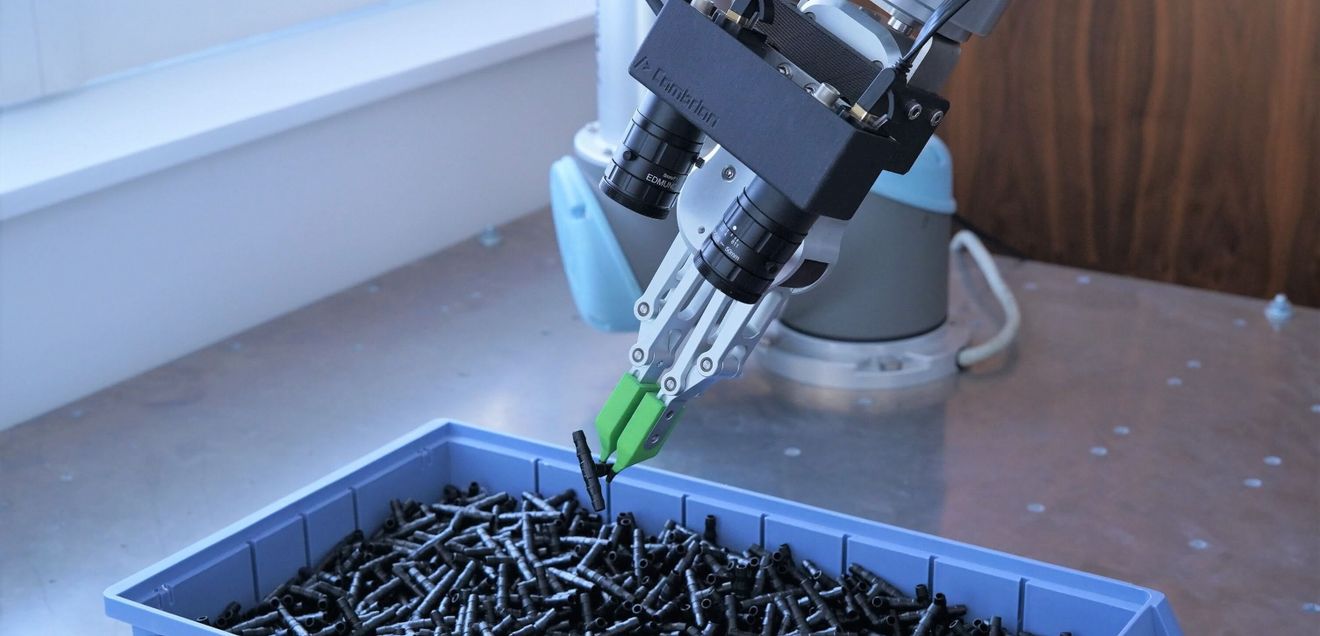
The associated camera module is equipped with two space-saving XCP industrial cameras. "The two IDS cameras use the stereovision principle to provide images of the object scene from different viewing angles. The challenge is to determine the position of the part to be gripped as accurately as possible from these images. This, in turn, is the task of the AI," says Satori. The combination of image acquisition, AI models and special image processing makes it possible to determine pick-up points and positions with particular precision. "Standard CAD applications for 3D bin picking often use structured light or sensors that project something onto the environment, generate a point cloud and then try to find the part within it. Cambrian uses just two standard industrial cameras instead of a 3D camera.
High accuracy and speed
With an accuracy of less than 1 mm, Cambrian-Vision is also more precise than other systems. "The system reliably detects a wide range of parts, including shiny, reflective or transparent components, where conventional vision systems often reach their limits. At the same time, it remains robust against external light conditions," says Satori, describing the special requirements placed on the cameras, which are a fundamental part of the solution. "The system is also super-fast, as the inference speed is less than 170 ms, whereas comparable solutions often take more than 1,000 ms." The fast calculation time enables cycle times of 2-3 s in a bin-picking setting. "This ensures efficient, precise and accurate execution in a single pass," emphasizes Miika Satori. The One-Shot system is therefore currently one of the fastest AI image recognition systems on the market.
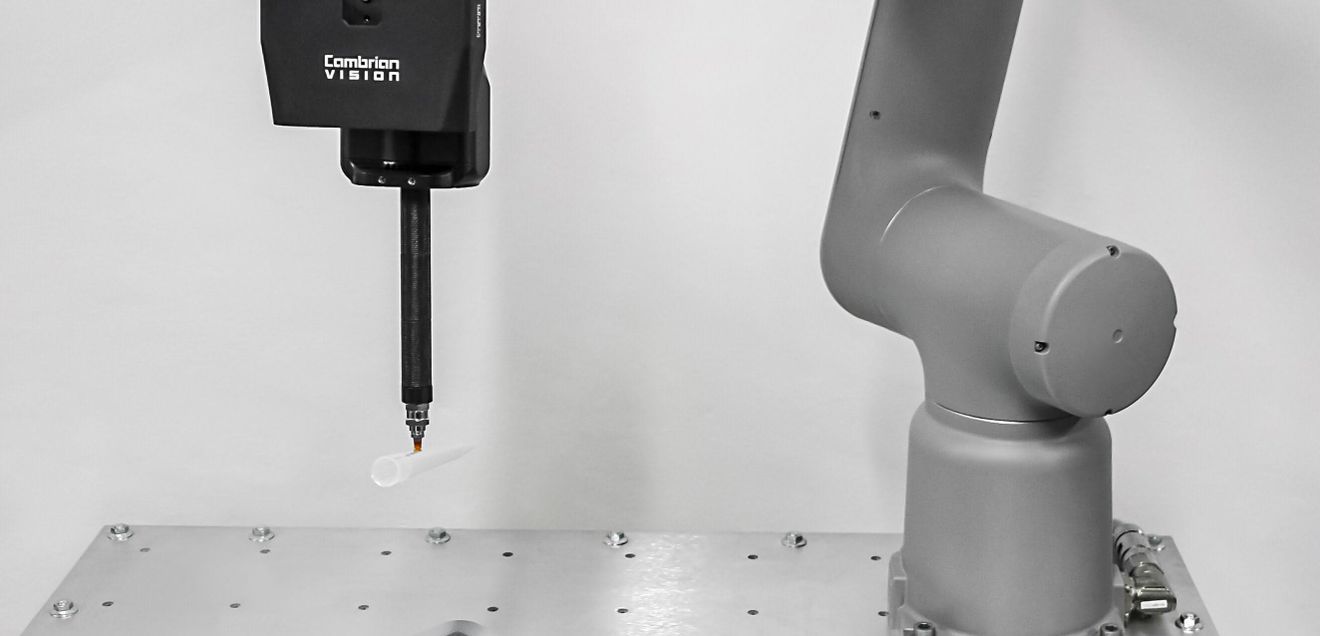
This is made possible not least by the SuperSpeed USB 5 Gbps cameras, which reliably deliver high-resolution data for detailed image analysis in any environment, especially in applications with low ambient light or changing lighting conditions. Thanks to BSI (Back Side Illumination) pixel technology, the integrated sensor (1/2.5", 5.04 MPixel rolling shutter CMOS sensor Onsemi AR0521) offers stable low-light performance and high sensitivity in the NIR range, enabling the uEye XCPs to deliver high-quality images with low pixel noise in almost any lighting situation. With its compact, lightweight full housing and screwable USB Micro-B connector, the USB3 XCP is particularly suitable for use in combination with robots and cobots in the field of automation.
Thanks to USB3 and vision standard compatibility, the XCP cameras can be easily integrated into any image processing system and used with any suitable software. The simple integration via the standard interface is particularly advantageous for Miika Satori: "We use different IDS cameras in our system depending on customer requirements. The standardized interface makes it possible to quickly use a wide variety of uEye models." Thanks to their compatibility with common lenses, a large number of cameras from the IDS portfolio are suitable for customer-specific Cambrian vision solutions and thus contribute to high production output.
Ready for use without robot training
Another key to efficiency lies in the uncomplicated integration of Cambrian Vision. The intelligent 3D vision system is immediately ready for use without any real robot training. Companies can therefore quickly benefit from the advantages of automation. They conserve resources and save costs by working more efficiently and competitively, while at the same time improving the quality of their products and the safety of their employees.
"The use of AI in robotics is only just beginning and is still in its infancy," states Miika Satori. Due to the growing demand, development in the field of image processing with AI will continue, cameras with higher data rates and faster and larger sensors will come onto the market, as will more price-optimized models with reliable basic functions. "Industrial cameras are becoming smaller and more affordable. This will enable even more applications. Our desire is to give robots capabilities on the same level as humans." By using AI-powered robots for mundane and repetitive tasks, human resources can be redirected to more creative, productive and valuable tasks.


You might also be interested in
Fraunhofer IOSB Opens Humanoid Robots Lab
The Fraunhofer IOSB is opening a Humanoid Robots Experience Lab in Karlsruhe, Lemgo, and Ilmenau. Companies and organizations can use these facilities to test potential applications for humanoid robots and develop pilot projects.
 read more...
Artificial Intelligence in Manufacturing
Trumpf and IPAI Are Expanding a European AI Network for Industry
The high-tech company Trumpf is an official partner of the IPAI AI network in Heilbronn. Together, the partners aim to exchange experiences, develop new AI applications for industrial use, and advance the development of artificial intelligence in...
read more...Case Study: Networked Manufacturing Platform for Toolmaking
Using a networked manufacturing platform, Escha GmbH & Co. KG, a manufacturer of industrial fastening technology, has comprehensively modernized its toolmaking operations.
read more...Barcelona Declaration on Robotics and...
Robotics Associations Adopt Global Automation Strategy
The global robotics industry is stepping up its collaboration. The associations AER Automation, A3, IFR, and VDMA Robotics + Automation have formed a long-term alliance by signing the “Barcelona Declaration on Robotics and Automation 2026.” The...
read more...Jane Heffner is the new president of the International Federation of Robotics
Jane Heffner is the new president of the International Federation of Robotics. Adrien Brouillard has been appointed vice president of the global federation.
read more...Greater Transparency in the Robotics Market
RoboFinder Launches as an Independent Comparison Platform
Launch at Gitex Europe: 'RoboFinder' aims to bring more transparency to the professional service robotics market. In this interview, founder and CEO Brian Engels discusses market potential, challenges, and the goals of the new platform.
read more...Artificial Intelligence for the Physical Space
Alibaba Expands Qwen Model Family with a Robotics Suite for Physical AI
Alibaba is expanding its Qwen model family with a robotics suite for Physical AI. The three models—for manipulation, navigation, and simulation—are designed to assist autonomous robots with complex tasks in real-world environments.
read more...International Federation of Robotics
U.S. Robotics Industry Sees Double-Digit Growth
In the U.S., sales of industrial robots rose by 11% compared to the previous year: 38,000 units were newly installed in 2025. This significant recovery is driven by robust growth in the food industry and other non-manufacturing sectors. However, the...
read more...Development Collaboration for Humanoid Robotic Hands Launched
Schunk is entering into a new development partnership with Robert Bosch Robotics. Their shared goal is to develop an industrial-grade robotic hand that can be integrated into various humanoid robot systems.
read more...