

Motek 2019
Electric lift transverse unit for transfer systems
Schnaithmann Maschinenbau has developed a purely electrically powered lift transverse unit (eHQE). For the Remshalden-based automation specialist, the eHQE is the first step on the way to an all-electric transfer system. The new unit will be presented at this year's Motek under the company's trade fair motto "Best of Automation".
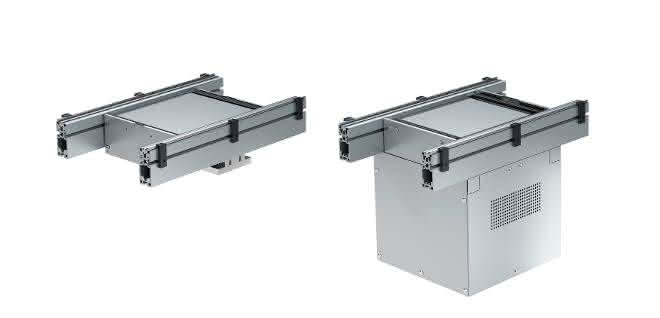
"For many of our customers, energy efficiency and overall cost-effectiveness are becoming an increasingly important issue and they want to avoid compressed air as an energy source wherever possible," says Thilo Hottmann, Managing Director at Schnaithmann. "The development of electrical components is the logical consequence of this." It also simplifies applications in clean room environments.
A lift transverse unit is effectively the switch in a transfer system. It can be used to transfer workpiece carriers to a parallel conveyor or to divert the material flow by 90 degrees. To do this, the transported goods must first be lifted slightly and then transported crosswise, whereby the lifting movement was previously realized with one or two pneumatic cylinders.
In the new electric version, two EC geared motors are used for the chain drive and stroke. The electronically commutated, brushless and therefore wear-free 24 V DC motors are extremely efficient and allow infinitely variable speed control. On the one hand, this allows ramp-shaped movement profiles to be generated, which is very beneficial for the conveyed goods. On the other hand, the conveying speed can be easily varied between 5 and 15 m/min. An integrated Hall sensor enables precise positioning tasks, which means that the lift/transverse unit can be used both as a two-position and three-position unit. Additional position sensors are not necessary; an electronic holding brake ensures the corresponding positional safety. The motors are controlled via a control module integrated into the linear-transverse unit and communication takes place via Profinet. This allows comprehensive drive diagnostics to be carried out if required.
By eliminating the standard geared motor previously responsible for the chain drive, the new unit requires considerably less installation space at the bottom. This is particularly advantageous in industrial applications where the transfer system requires a return track installed below the conveyor belt, for example for empty workpiece carriers. Otherwise, care was taken to ensure that the new assembly fits seamlessly into the existing modular system. A one-to-one replacement is therefore possible at any time.
Schnaithmann offers the lifting transverse unit for its BS11 and BS100 accumulation roller systems as well as for the BS20 and BS21 belt conveyor systems. The new unit is designed for all standard workpiece carrier sizes from 240 x 240 mm to 560 x 560 mm and up to a maximum total workpiece carrier weight of 50 kg. The new lift transverse unit is also ESD-capable. The assembly is currently undergoing intensive endurance testing and should be available on the market from the fourth quarter of 2019.
Motek: Hall 3, Stand 3420


You might also be interested in
ESD protection in electronics production
Work voltage-free
Electrostatic discharge (ESD) is an everyday phenomenon and usually harmless to humans. However, sensitive electronic components can be damaged or even destroyed as a result.
 read more...
Protection against electrostatic discharge
StoFloor ESD KU 614 from StoCretec: dissipative flooring with the latest technology meets all ESD standards, is economical, extremely durable, mechanically and chemically resistant. The surface can be adjusted to be slip-resistant. The system is...
read more...A new benchmark for collaborative robots
At this year's Automatica, Denso Robotics will be showcasing its innovations in the field of robotics. The collaborative Cobotta Pro product family will be the focus of the presentations. Visitors to the trade fair can see all variants in various...
read more...Four decades of robotics
Epson, manufacturer of Scara robots, will present the new Scara GX-B series at Automatica, the latest generation of high-performance Scara robots based on the existing GX series.
read more...Controlling machines more intelligently
At embedded world, Bopla Gehäuse Systeme will be presenting new HMI systems for customized machine control in the field of printed electronics. The focus is on complex interfaces via USB or RFID as well as an ultra-flat design and cost-effective...
read more...Process control with traceability through soldering tips with microchips
RS has added a new 300 W manual soldering platform to its range with the WXsmart from Weller. The station combines all soldering applications in a single device and comes with a new range of intelligent soldering tips. In this way, the WXsmart...
read more...Florian Becker is the new Managing Director at Krieg
Generation change at Krieg in Heimsheim: Andreas Krieg handed over the management of the company to Florian Becker on October 1, 2022. The company, which specializes in workplace systems and office furnishings, intends to focus even more strongly on...
read more...The fuel cell under control
The fuel cell is a serious solution for emission-free mobility. Having disappeared from the scene for a long time, it is now establishing itself as a viable option for zero-emission strategies.
read more...The modular system for pure production
Designing pure process environments quickly, modularly and safely - Item showed how this can be done at Cleanzone in Frankfurt. The company has added numerous components to its modular system.
read more...