
Collaborating robots in production
Cobots automate production line
Cobots are seen as the helpers of the future, especially in assembly. However, they can also be used as classic automation components in production, for example for feeding milling and turning centers. By Helmut Schmid
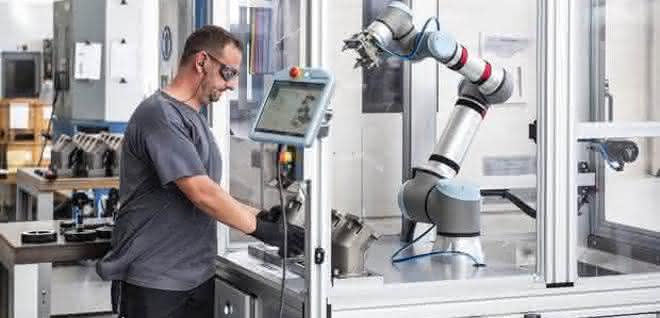
In order to relieve its employees and optimize production, the French supplier BW Industrie relies on robotics: four collaborative lightweight robots from Universal Robots support the company by feeding the milling and turning centers, deburring workpieces and checking their quality. Since then, the company has been more productive and the employees have more time for more demanding tasks. The UR16e in particular makes their work easier by handling heavy workpieces.
As a contract manufacturer for mechanical construction components, BW Industrie specializes in the contract machining of small series. The medium-sized company uses a machine park with several turning and milling centers for the CNC machining of parts. Lock covers, thrust plates and pump goggles are among the highly specific components that the small company manufactures for the automotive industry. Low tolerance limits often apply and the material is usually difficult to machine. Nevertheless, the company faces the challenge of meeting tight delivery deadlines despite complex production processes.
CNC feeding with Cobot
By automating the production line, the company wants to produce more efficiently and at the same time relieve its employees - especially from feeding the CNC machines. It was important for the production managers to find a flexible solution that could be used for different production steps. Manager Laurent Wagner recalls: "We initially tried a robot, but it wasn't flexible enough for our needs - that was very disappointing. It was also difficult for the employees to operate." Wagner and his team continued their search and finally found what they were looking for at Universal Robots. The collaborative lightweight robots are characterized above all by their ease of use and flexibility. Thanks to integrated safety functions, they can be used directly next to humans after a prior risk assessment - without safety fences. In 2011, BW Industrie brought a UR robot arm type UR5 onto the factory floor. The model can handle objects weighing up to 5 kg and is therefore ideal for handling small metal workpieces.
The new colleague impressed with its ease of use: "After half a day's training, all users were able to operate the control software and program the robot for new jobs," reports Raphael Schwartz, development and process engineer at BW Industrie. The robot quickly took over the loading of a CNC machine, immediately reducing the workload: whereas an employee previously had to constantly monitor the machine, he now only has to load and unload it every three hours at the end of a cycle. This leaves time for more demanding tasks, such as servicing and maintaining the machines. In addition, the risk of injury from ergonomically unfavorable activities or handling sharp or pointed components is reduced.
Thanks to its rapid commissioning, the purchase of the robot arm paid for itself after just one year, which was particularly important for a small company like BW Industrie. Following the successful pilot project, the company invested in additional UR5 and UR10 robot arms, which took on quality inspection tasks in addition to feeding other CNC machines. In 2019, the need to automate the highly complex surface processing of the components also became apparent. Here, the employees were still dealing with heavy components that exceeded the load capacity of the previously implemented robots. BW Industrie therefore opted for a UR16e, which can carry objects weighing up to 16 kg. An integrated force-torque sensor in its wrist gives the robot arm the necessary sensitivity to carry out precision work such as polishing or deburring without errors. The robot was up and running after two weeks. "Previously, our employees had handled hundreds of kilos of machine parts manually," explains Schwartz. "The UR16e now takes over: it can easily lift and deburr all our parts weighing between 4 and 14 kg. This flexibility makes it the ideal solution for this task."
The ability to adapt to workpieces of different shapes and sizes also makes the Cobot a valuable support in contract manufacturing. With an average footprint of 190 mm and its compact design, it also fits into tight production environments to save space.
Since the introduction of collaborative robot arms, production at BW Industrie has become much more productive. Unwanted production downtime is now a thing of the past and employees now have more time for more demanding tasks. In this way, automation is helping the small supplier to stay at the forefront of the automotive market of the future.
Helmut Schmid, General Manager Western Europe and Managing Director Universal Robots Germany / ag


You might also be interested in
Atlas Copco takes over long-standing sales partner
Atlas Copco has taken over Heide-Pumpen. The specialist for mobile pumps has been working closely with Atlas Copco in sales and service for a long time, especially for surface pumps for construction site dewatering and wastewater detour or in the...
 read more...
Lutz Pumpen at the Achema 2024
New mobile drum pump with battery drive
The new B3 Battery from Lutz Pumpen promises mobile and safe working with aggressive liquids without having to compromise on pumping performance compared to wired versions. The battery-powered drum pump will be on display at Achema, the world's...
read more...Maintenance and Pumps&Valves in February
Final preparations are underway in Dortmund: On February 21, 2024, maintenance will start as the leading trade fair for industrial maintenance and with it Pumps&Valves as the trade fair for industrial pumps, fittings and valves.
read more...Liquid separator keeps pumps dry
Vacuum clamping minimizes distortion and enables five sides to be machined in one clamping operation. The use of cooling lubricants poses a challenge: If they get into the vacuum generator, they can cause serious damage.
read more...Spring clutches for construction machinery
Spring clutches from Torsion Control Products (TCP) are ideal for use in construction machinery where modern diesel engines are used.
read more...Protection against cooling lubricant
Liquid separator from Schmalz keeps pumps dry
Anyone clamping with a vacuum during CNC machining must protect the pump from cooling lubricant. The NLS liquid separator from Schmalz separates the cooling lubricant and returns it to the running process - without interrupting the vacuum.
read more...Which clutch for what?
Mechanical engineering and its applications are multifaceted. Every application is special and requires a perfect machine design. Individual components in the system must also be optimally designed.
read more...Energy efficiency needs electrical engineering and IT
The energy crisis makes one thing clear: it is not enough to simply screw a photovoltaic system onto your roof or purchase green electricity. Industry is faced with the challenge of reducing consumption in order to counter the rise in energy prices,...
read more...Solutions for a networked and climate-neutral industry
At the world's leading trade fair for industry, around 4,000 companies from the mechanical engineering, electrical and digital industries as well as the energy sector will be showcasing solutions for the production and energy supply of the future.
read more...