
Tool changer
A robot cell for aircraft conversion
Since the coronavirus pandemic, there has been a significant increase in the need to convert passenger aircraft into cargo planes. The Zimmer Groupis on board for this technically challenging undertaking.
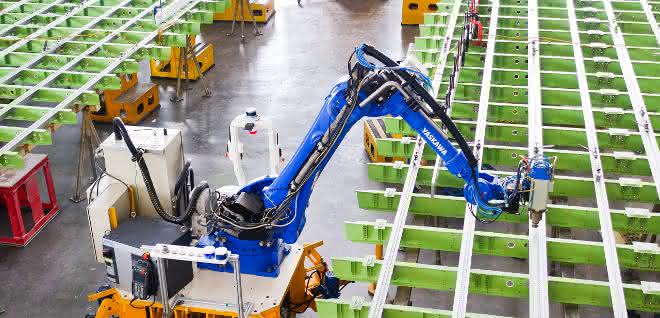
The aerospace division of Singapore-based ST Engineering Aerospace Ltd - a specialist in aircraft conversion - relies on the support of a robot cell. The company has been working with Helios Applied Systems, also based in Singapore, since 2019 to automate such complex processes.
The robot cell drills dozens of holes in the floor grilles of Boeing's 767-300ER aircraft at the Paya Lebah plant. To do this, the robot cell moves along the floor structure so that the robot can drill the corresponding holes according to a predefined plan. It is located in a hall that is conveniently directly adjacent to the converted aircraft. The robot cell consists of a hydraulically liftable, movable platform, a Yaskawa robot with a payload of 180 kilograms, an end-of-arm tool with a special image processing system developed by Helios and a motor spindle with 6 kW power as well as a hollow shank taper holder for automatic tool changes.
A spindle makes all the difference
The most important prerequisite for choosing the right spindle, in addition to parameters such as concentricity and high speeds, was the ability to easily adapt the spindle to the existing robot using robot changing units. Helios found what it was looking for with the automation specialist Zimmer Group from Rheinau in Germany. The company has 13 subsidiaries worldwide - three of which are also in Asia.
The Zimmer Group supplied Helios with an air-cooled spindle from the HF145-001 series, which has an output of 6 kW and a maximum speed of 24,000 rpm, complete with EtherCAT operating terminal, all necessary cables and a matching frequency inverter. This is particularly suitable for precise positioning tasks with integrated safety technology (STO) and for operations at low or high speeds.
In addition, the inverter offers optimum performance and power yield with perfect coordination of the spindle and frequency inverter. In order to be more flexible for future applications, the spindle was mounted directly on a robot changer unit (WWS100F-001/WWWS100L-001) - also from the Zimmer Group.
This robot exchange unit allows the motor spindle to be exchanged for another tool or handling unit, thereby enabling multiple use of a robot. The Zimmer Group also supplied a storage station for the tool holder. The HSK holders and tools themselves were provided on site by Helios. Helios uses the Zimmer spindle with a fieldbus connection (EtherCAT) and also received the complete parameterization from the Rheinau automation experts. They also provided Helios with comprehensive support for the products and software issues during and after installation.
Successful collaboration
"Due to the rigid construction and the very smooth running of the spindle, even at higher speeds, the drilling result is very good. You have to bear in mind that these parts are light and not completely flat, so the vision system recognizes the position and angle of each hole," says Sunil Raibagi, project manager and Vice President Business Development and Strategy at the Zimmer Group.
The customer Helios is also satisfied: "We value the Zimmer Group as a long-standing partner and are absolutely convinced of the qualities of the spindle. We were also particularly impressed with the service provided by the Zimmer Group, who were always on hand to help us throughout the installation," says Managing Director Shyi-Herng Kan.
Busy in the future
While the robot is currently focused on drilling floor grids, the ST Engineering team is working with Helios to program the machine so that it can also be used to set countersunk rivets. "We believe the robots can handle these types of processes well," said Hui Fung Lee, SVP and Head of Innovation and Continuous Improvement at ST Engineering Aerospace in an interview with cargo facts magazine.
In the coming months, the robot will also be programmed at ST Engineering for other functions and to work on other aircraft models, including the conversion of Airbus freighters. "We know that the P2F process is very complex and that many people are needed for the entire changeover process," explains Lee. "Therefore, we are constantly looking for ways to improve our productivity," Lee continues. Tasks that are suitable for automation are usually standardized and very repetitive, according to Lee. Starting next year, ST Engineering plans to automate the drilling of floor grilles for the A321-200P2F conversion programs it owns through EFW, a joint venture with Airbus.


You might also be interested in
Helu makes its first trade fair appearance under a new brand name
Helu Kabel will be presenting itself as Helu for the first time at Hannover Messe 2026, showcasing system solutions, Heluchain cables and new industrial luminaires.
 read more...
Strategic realignment with brand relaunch
In future, Helukabel will trade as Helu
The Helukabel Group is parting with part of its name: in future, the company will only operate under the Helu brand. With this step, the specialist for electrical connection technology is underlining its strategic development from a classic cable...
read more...Modular plant construction for corrugated board
Insight into the production of corrugators at BHS Corrugated: Automated, modular and equipped with Helukabel components.
read more...Best quality for the steel
Conditions in the steel industry are harsh and inhospitable. The machines used must be able to withstand the demanding environmental conditions in order to deliver the best quality at all times.
read more...If the standard cable is not sufficient
Lapp offers cables for countless applications - but not for all of them. From time to time, the developers have to modify a standard cable or develop a special cable.
read more...Slight decline in sales, strong investments
The Lapp Group has not been spared from the weakening global economy. However, the company only recorded a slight loss in the past 2024 financial year.
read more...Electrical connection technology
Cables and wires for industrial automation
Heukabel offers system solutions for cable routing from a single source. The subsidiary EKD Systems specializes in tailor-made cable drag chains made of steel, stainless steel and plastic, which are used in moving machines and systems as well as in...
read more...Lapp relies on Ultramid from BASF
Mobile charging of electric vehicles
The automotive industry is currently undergoing the biggest transformation in its history. The boom in battery electric vehicles in particular is presenting the industry with major challenges. Lapp, as a supplier of cables and connection...
read more...Cable handling application
At this year's Motek, ArtiMinds Robotics is showcasing a robot-based automation solution for the sensor-assisted assembly of flexible cables in connector housings.
read more...